Our classroom community
Students learn how a classroom works as a small community. They practice rules, take turns, and notice the jobs and choices that keep a group running smoothly.
This is the year students start noticing the world outside their own family. Students learn what rules are for, who helps run a community, and why people trade things they need. They begin reading simple maps and telling stories about long ago and today. By spring, they can name a leader in their community, point out their home on a map, and explain why a person might save a coin instead of spending it.
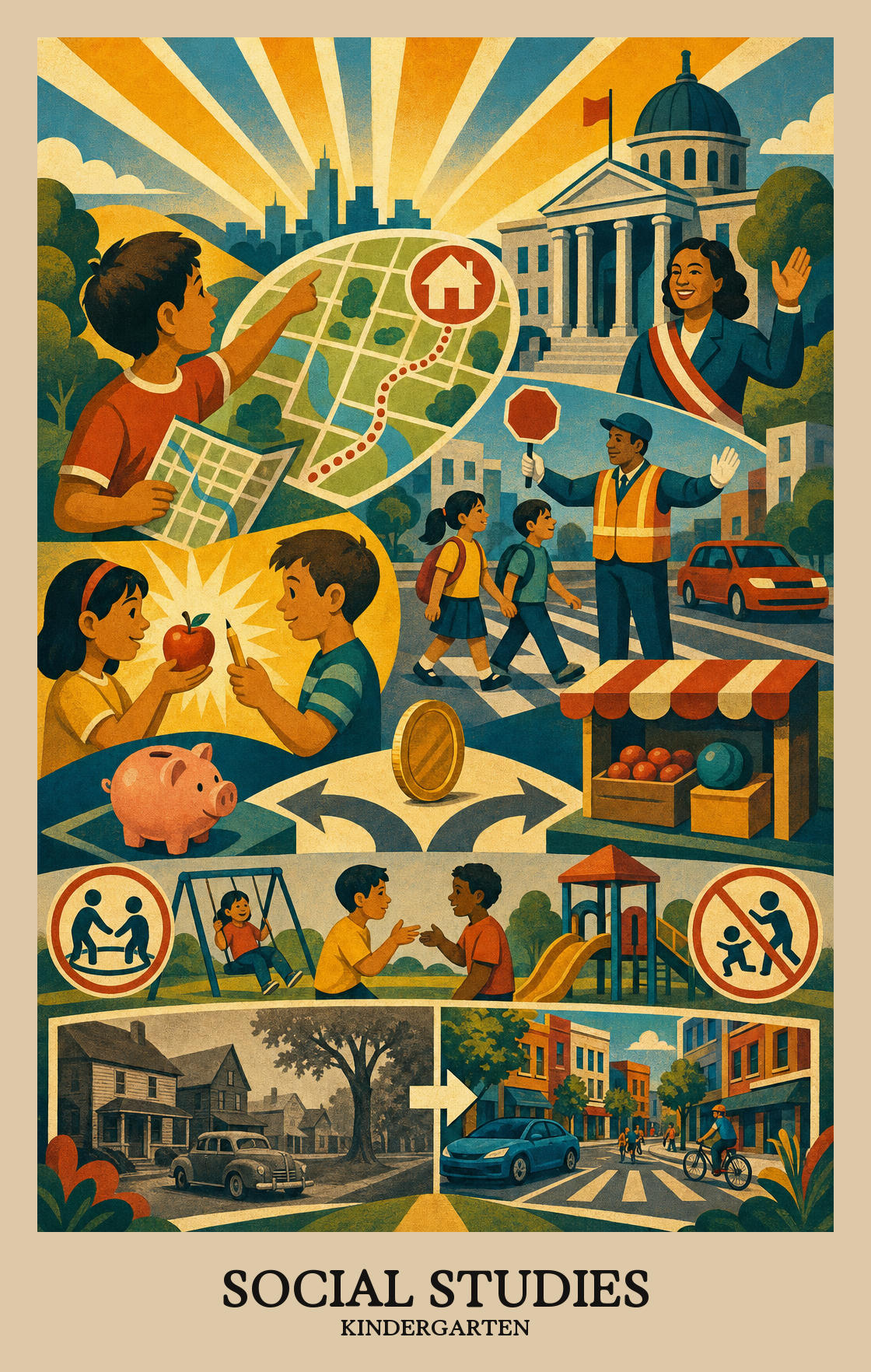
Students learn how a classroom works as a small community. They practice rules, take turns, and notice the jobs and choices that keep a group running smoothly.
Students start to picture their world on paper. They look at simple maps of the classroom, the school, and the neighborhood, and talk about what they see on the way home.
Students think about the difference between what they need and what they want. They notice that money and time run out, so people have to pick.
Students put events in order using words like before, after, yesterday, and long ago. They compare how families and tools have changed over time using pictures and family stories.
Schools, towns, and the country all have leaders and rules. Students learn who makes the rules, who carries them out, and how those jobs are split up so no single person is in charge of everything.
Students look at the big ideas behind American government, like fairness and freedom, and learn where those ideas show up in documents such as the Constitution.
Students learn what it means to be a good citizen: following rules, taking turns, and respecting others. They also explore basic rights, like going to school and being treated fairly.
Students practice taking turns, listening to others, and making simple decisions as a group. These are the habits that help people live and work together in a community.
| Standard | Definition | Code |
|---|---|---|
| Government | Schools, towns, and the country all have leaders and rules. Students learn who makes the rules, who carries them out, and how those jobs are split up so no single person is in charge of everything. | DE-SS.CIV.K.1 |
| Politics | Students look at the big ideas behind American government, like fairness and freedom, and learn where those ideas show up in documents such as the Constitution. | DE-SS.CIV.K.2 |
| Citizenship | Students learn what it means to be a good citizen: following rules, taking turns, and respecting others. They also explore basic rights, like going to school and being treated fairly. | DE-SS.CIV.K.3 |
| Participation | Students practice taking turns, listening to others, and making simple decisions as a group. These are the habits that help people live and work together in a community. | DE-SS.CIV.K.4 |
Scarcity means you can't have everything, so you have to choose. Students learn why people pick one thing over another and what they give up when they do.
Kindergartners look at how people, stores, and rules work together when buying and selling. They learn why things cost money, what makes people choose one thing over another, and how rules affect those choices.
Students look at how different communities decide who makes things, who sells them, and who gets to buy them. They also talk about why those rules might change as a community grows or its needs shift.
Students learn the difference between needs and wants, and start to see how families, stores, and workers depend on each other to get what they need.
| Standard | Definition | Code |
|---|---|---|
| Microeconomics | Scarcity means you can't have everything, so you have to choose. Students learn why people pick one thing over another and what they give up when they do. | DE-SS.ECON.K.1 |
| Macroeconomics | Kindergartners look at how people, stores, and rules work together when buying and selling. They learn why things cost money, what makes people choose one thing over another, and how rules affect those choices. | DE-SS.ECON.K.2 |
| Economic Systems | Students look at how different communities decide who makes things, who sells them, and who gets to buy them. They also talk about why those rules might change as a community grows or its needs shift. | DE-SS.ECON.K.3 |
| Personal Finance and Interdependence | Students learn the difference between needs and wants, and start to see how families, stores, and workers depend on each other to get what they need. | DE-SS.ECON.K.4 |
Students learn to find their way around familiar places like home, school, and their neighborhood. They use simple maps and pictures to understand where things are and how places relate to each other.
Students look at how people change the land around them, like building roads or clearing trees, and what happens to neighborhoods and nature because of those changes.
Students look at photos, stories, and maps to see how families around the world live differently, eat different foods, and celebrate different holidays. They also notice what makes their own neighborhood or town a distinct place.
Students learn that places can be grouped into regions based on what they share, like weather, land, or how people live. They start to see how those regions connect to each other.
| Standard | Definition | Code |
|---|---|---|
| Maps and Mental Maps | Students learn to find their way around familiar places like home, school, and their neighborhood. They use simple maps and pictures to understand where things are and how places relate to each other. | DE-SS.GEO.K.1 |
| Environment | Students look at how people change the land around them, like building roads or clearing trees, and what happens to neighborhoods and nature because of those changes. | DE-SS.GEO.K.2 |
| Places and Cultures | Students look at photos, stories, and maps to see how families around the world live differently, eat different foods, and celebrate different holidays. They also notice what makes their own neighborhood or town a distinct place. | DE-SS.GEO.K.3 |
| Regions | Students learn that places can be grouped into regions based on what they share, like weather, land, or how people live. They start to see how those regions connect to each other. | DE-SS.GEO.K.4 |
Students put events in order and talk about what happened before and after. They start to notice why things change over time and what stays the same.
Students look at photos, objects, and stories from the past to figure out what happened and why. This is how historians work, and kindergartners start practicing it early.
Students look at pictures, stories, and simple artifacts from the past and talk about what happened. They practice noticing that different people can remember or describe the same event in different ways.
Students learn about important events that happened in Delaware, the U.S., and around the world. Starting with stories and pictures, they begin to see how the past connects to life today.
| Standard | Definition | Code |
|---|---|---|
| Chronology | Students put events in order and talk about what happened before and after. They start to notice why things change over time and what stays the same. | DE-SS.HIST.K.1 |
| Analysis | Students look at photos, objects, and stories from the past to figure out what happened and why. This is how historians work, and kindergartners start practicing it early. | DE-SS.HIST.K.2 |
| Interpretation | Students look at pictures, stories, and simple artifacts from the past and talk about what happened. They practice noticing that different people can remember or describe the same event in different ways. | DE-SS.HIST.K.3 |
| Content | Students learn about important events that happened in Delaware, the U.S., and around the world. Starting with stories and pictures, they begin to see how the past connects to life today. | DE-SS.HIST.K.4 |
Federally administered sample-based assessment in reading, mathematics, science, and writing. NAEP results inform state-by-state comparisons rather than individual student or school accountability.
Students learn how their classroom, family, and neighborhood work. They talk about rules, jobs people do, simple maps of familiar places, and what happened yesterday compared to today. Most of it grows out of stories, pictures, and class routines.
Talk about the people and places students see every day. Point out the mail carrier, the grocery store, the stop sign, and the flag at school. Walks around the block and short conversations about why rules exist do more at this age than worksheets.
No. Start by drawing the bedroom or the kitchen on paper together and labeling the bed, the door, and the window. That is a map. From there, sketching the route from home to school is a natural next step.
Students learn that people cannot have everything they want, so they make choices. At home, let students pick between two small options at the store and talk through the trade. Naming coins and noticing prices on signs is plenty.
Start with self, family, and classroom in the fall, then widen to school and neighborhood by winter, and reach community, state, and country by spring. Civics ideas like rules and fairness can run all year through class routines rather than a separate unit.
Past, present, and future trip students up, especially words like yesterday, last week, and long ago. Same for needs versus wants. Revisit both through daily calendar talk and quick sorting tasks rather than one big lesson.
Use one photograph, object, or short song at a time and ask what students notice and wonder. A photo of the school from fifty years ago or a grandparent's old toy works well. The skill is looking closely and asking questions, not analysis.
By spring, students should follow class rules and explain why rules matter, name some community helpers and what they do, place events as past, present, or future, and point to home, school, and a familiar landmark on a simple map.