Counting and number names
Students learn to count out loud, point to objects one at a time, and write numbers up to 20. Expect a lot of counting toys, snacks, and steps at home.
This is the year numbers become something to count, compare, and add, not just say out loud. Students learn to count to 100, match numbers to groups of objects, and figure out which pile has more. They start putting small groups together and taking some away, and they name shapes like circles, squares, and triangles. By spring, students can count a group of up to 20 objects and tell you how many are left after taking some away.
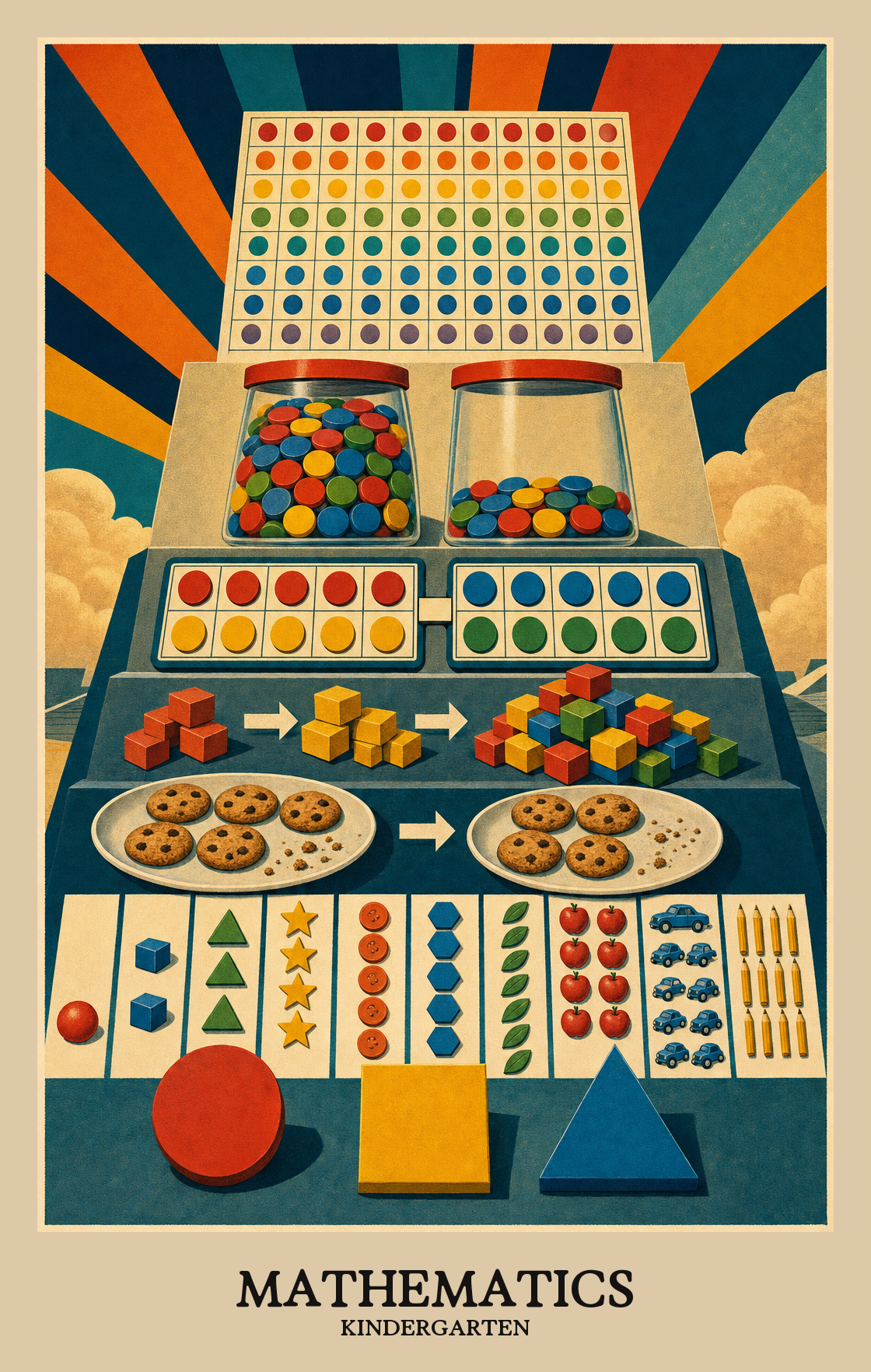
Students learn to count out loud, point to objects one at a time, and write numbers up to 20. Expect a lot of counting toys, snacks, and steps at home.
Students figure out which group has more, fewer, or the same amount. They start matching a number to a set of objects instead of just reciting numbers in order.
Students put small groups together and take some away, using fingers, blocks, or drawings. Most problems stay within 10 so students can see what is happening.
Students name shapes like circles, squares, triangles, and cubes, and notice them in real life. They also compare objects by length, weight, and size using words like longer, heavier, and shorter.
Students count past 20 and start to see numbers from 11 to 19 as a ten and some extra ones. This is the first step toward place value in first grade.
Kindergartners learn to figure out what a math problem is asking before they start solving it. When they get stuck, they try a different way instead of giving up.
Students take a real problem (like sharing 4 apples) and turn it into numbers on paper, then check that the numbers still make sense back in real life.
Students explain why their math answer makes sense, using objects or drawings as proof. They also listen to a classmate's reasoning and say whether they agree, and why.
Students use drawings, numbers, or objects to make sense of real everyday problems, like figuring out how many apples are left after sharing some.
Students learn to pick the right tool for the job: a ruler to measure, a drawing to work out a problem, or a calculator to check their thinking. The goal is knowing when each one helps.
Students use the right words for shapes, numbers, and measurements, and check that their answers make sense. Saying "circle" instead of "round thing" and counting carefully both count as precision.
Students notice patterns and shapes in numbers and objects, then use those patterns to make sense of new problems. For example, they see that a group of five fingers looks the same every time, and use that to count faster.
Students notice when the same steps keep showing up in math problems. They use that pattern as a shortcut instead of starting from scratch each time.
| Standard | Definition | Code |
|---|---|---|
| Make Sense of Problems | Kindergartners learn to figure out what a math problem is asking before they start solving it. When they get stuck, they try a different way instead of giving up. | DE-MATH.MP.K.1 |
| Reason Abstractly | Students take a real problem (like sharing 4 apples) and turn it into numbers on paper, then check that the numbers still make sense back in real life. | DE-MATH.MP.K.2 |
| Construct Arguments | Students explain why their math answer makes sense, using objects or drawings as proof. They also listen to a classmate's reasoning and say whether they agree, and why. | DE-MATH.MP.K.3 |
| Model with Mathematics | Students use drawings, numbers, or objects to make sense of real everyday problems, like figuring out how many apples are left after sharing some. | DE-MATH.MP.K.4 |
| Use Tools Strategically | Students learn to pick the right tool for the job: a ruler to measure, a drawing to work out a problem, or a calculator to check their thinking. The goal is knowing when each one helps. | DE-MATH.MP.K.5 |
| Attend to Precision | Students use the right words for shapes, numbers, and measurements, and check that their answers make sense. Saying "circle" instead of "round thing" and counting carefully both count as precision. | DE-MATH.MP.K.6 |
| Use Structure | Students notice patterns and shapes in numbers and objects, then use those patterns to make sense of new problems. For example, they see that a group of five fingers looks the same every time, and use that to count faster. | DE-MATH.MP.K.7 |
| Express Regularity | Students notice when the same steps keep showing up in math problems. They use that pattern as a shortcut instead of starting from scratch each time. | DE-MATH.MP.K.8 |
Counting whole numbers is the foundation of kindergarten math. Students count objects, say numbers in order, and begin to understand what each number actually means.
Students add and subtract small numbers to solve simple problems, like figuring out how many apples are left after some are taken away. This is their first look at how numbers change when things are combined or removed.
Students sort objects into groups and count how many are in each group. Then they show those counts in a simple picture graph or table so patterns are easy to see.
Students sort and describe flat shapes like circles and squares, and solid shapes like spheres and cubes. They notice how shapes are alike or different by looking at sides, corners, and size.
Students use simple comparisons to solve everyday problems, like figuring out if there are enough cups for every student at the table. This is the early start of ratio thinking, connecting quantities that go together.
| Standard | Definition | Code |
|---|---|---|
| Counting and Number | Counting whole numbers is the foundation of kindergarten math. Students count objects, say numbers in order, and begin to understand what each number actually means. | DE-MATH.K8.K.1 |
| Operations and Algebraic Thinking | Students add and subtract small numbers to solve simple problems, like figuring out how many apples are left after some are taken away. This is their first look at how numbers change when things are combined or removed. | DE-MATH.K8.K.2 |
| Measurement and Data | Students sort objects into groups and count how many are in each group. Then they show those counts in a simple picture graph or table so patterns are easy to see. | DE-MATH.K8.K.3 |
| Geometry | Students sort and describe flat shapes like circles and squares, and solid shapes like spheres and cubes. They notice how shapes are alike or different by looking at sides, corners, and size. | DE-MATH.K8.K.4 |
| Ratios and Proportional Relationships | Students use simple comparisons to solve everyday problems, like figuring out if there are enough cups for every student at the table. This is the early start of ratio thinking, connecting quantities that go together. | DE-MATH.K8.K.5 |
Delaware's spring summative math test for grades 3 through 8, aligned to the Delaware Math Standards.
Students should count to 100 by ones and tens, count groups of objects up to 20, and write numbers from 0 to 20. They should also add and subtract small numbers within 10, compare which group has more, and name basic shapes like circles, squares, and triangles.
Count real things together. Steps on the stairs, grapes on a plate, coins in a jar. Ask questions like which pile has more or how many are left after eating two. Five minutes a day adds up fast.
Not yet. Students are still building the idea that adding means putting groups together and subtracting means taking some away. Using fingers, beans, or buttons to solve problems within 10 is exactly what they should be doing.
Start with counting and matching numbers to groups of objects up to 10, then push to 20 by midyear. Save adding and subtracting within 10 for later in the fall once counting is solid. Reach 100 by ones and tens in the spring.
Writing numbers backwards is common and fades with practice. The harder sticking points are counting on from a number other than one, and seeing that the last number said tells how many. Both need repeated hands-on practice, not worksheets.
Students look at two groups and decide which has more, which has fewer, or whether they are the same. A child might line up six crackers next to four crackers and say six is more. That is the level of comparing expected.
Point out shapes on signs, food, and toys. Ask which spoon is longer, which cup holds more, or which book is heavier. Sorting laundry or groceries by size is real measurement practice.
A ready student counts to 100, counts a group of 20 objects accurately, writes numbers to 20, and solves simple add and take-away problems within 10 using objects or fingers. They can also name common shapes and compare two numbers under 10.