Becoming a scientist
Students learn how scientists work. They ask questions about things they notice, look closely, and share what they find with classmates using words, drawings, and simple charts.
This is the year students start acting like scientists by asking questions about the world they can actually see. Students push and pull objects to learn about motion, watch how weather changes day to day, and notice what plants and animals need to live. They sort, draw, and talk about what they observe. By spring, students can ask a question about something they noticed outside and share what they found out using pictures or simple words.
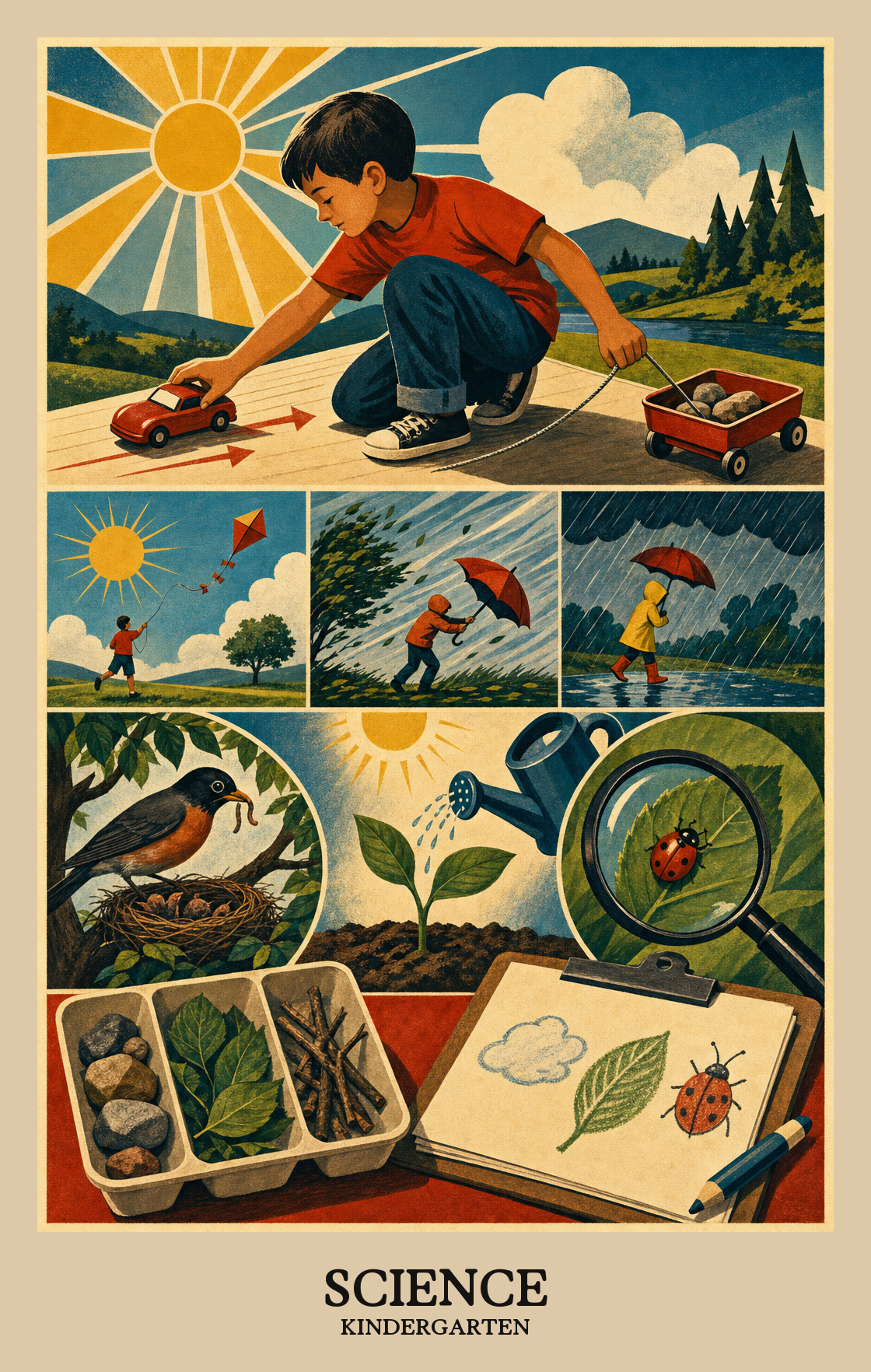
Students learn how scientists work. They ask questions about things they notice, look closely, and share what they find with classmates using words, drawings, and simple charts.
Students watch the weather across days and weeks. They track sunshine, rain, wind, and temperature, and start to spot patterns like warmer afternoons or rainier weeks.
Students look at what plants and animals need to live and where they live. They compare a squirrel to a fish, a tree to a flower, and notice how living things fit their surroundings.
Students play with motion and energy. They push and pull objects to see what happens, and feel how sunlight warms a sidewalk, a rock, or a cup of water.
Students act like engineers. They spot a small problem, like a tower that keeps falling or a puddle on the playground, sketch a fix, build it, and try again when it does not work.
Students ask simple questions about the world around them, like why leaves fall or how a ramp works, then figure out whether testing or building something could actually answer it.
Students draw pictures or use objects to show how something in the world works. A model might be a diagram of the sky, a drawing of an animal, or a simple structure built to solve a problem.
Students gather information by trying things out, like watching what happens when they mix materials or drop different objects. They plan a simple test and pay attention to what they observe.
Students look at information gathered from science activities and find what it shows. They notice when something happens more than once or when a result looks the same across tests.
Students use counting, sorting, and simple patterns to back up what they observe in science. A number or a picture of how many helps explain why something happened.
Students look at what they observed or tested, then explain why they think something happened. The explanation connects to what they actually saw, not just a guess.
Students look at two ideas and decide which one has better proof behind it. They explain why one answer makes more sense using what they saw or tested.
Students share what they observe and learn about the world around them. They look at pictures, listen to explanations, and tell or draw what they found out.
| Standard | Definition | Code |
|---|---|---|
| Asking Questions and Defining Problems | Students ask simple questions about the world around them, like why leaves fall or how a ramp works, then figure out whether testing or building something could actually answer it. | DE-SCI.SEP.K.1 |
| Developing and Using Models | Students draw pictures or use objects to show how something in the world works. A model might be a diagram of the sky, a drawing of an animal, or a simple structure built to solve a problem. | DE-SCI.SEP.K.2 |
| Planning and Carrying Out Investigations | Students gather information by trying things out, like watching what happens when they mix materials or drop different objects. They plan a simple test and pay attention to what they observe. | DE-SCI.SEP.K.3 |
| Analyzing and Interpreting Data | Students look at information gathered from science activities and find what it shows. They notice when something happens more than once or when a result looks the same across tests. | DE-SCI.SEP.K.4 |
| Mathematics and Computational Thinking | Students use counting, sorting, and simple patterns to back up what they observe in science. A number or a picture of how many helps explain why something happened. | DE-SCI.SEP.K.5 |
| Constructing Explanations | Students look at what they observed or tested, then explain why they think something happened. The explanation connects to what they actually saw, not just a guess. | DE-SCI.SEP.K.6 |
| Engaging in Argument from Evidence | Students look at two ideas and decide which one has better proof behind it. They explain why one answer makes more sense using what they saw or tested. | DE-SCI.SEP.K.7 |
| Communicating Information | Students share what they observe and learn about the world around them. They look at pictures, listen to explanations, and tell or draw what they found out. | DE-SCI.SEP.K.8 |
Students sort and describe everyday objects by what they look, feel, or sound like. This builds the first ideas about why materials behave the way they do.
Students push, pull, and roll objects to see how things start moving, stop, or stay still. They learn that a harder push moves something farther and that things don't move on their own.
Students explore how light, sound, and heat move from one place to another. They notice that energy changes form but doesn't disappear.
Students explore how waves move, like sound traveling from a drum to your ear or light from a lamp across a room. They learn that waves carry energy and can even carry information from one place to another.
| Standard | Definition | Code |
|---|---|---|
| Matter and Interactions | Students sort and describe everyday objects by what they look, feel, or sound like. This builds the first ideas about why materials behave the way they do. | DE-SCI.PS.K.1 |
| Motion and Stability | Students push, pull, and roll objects to see how things start moving, stop, or stay still. They learn that a harder push moves something farther and that things don't move on their own. | DE-SCI.PS.K.2 |
| Energy | Students explore how light, sound, and heat move from one place to another. They notice that energy changes form but doesn't disappear. | DE-SCI.PS.K.3 |
| Waves and Information | Students explore how waves move, like sound traveling from a drum to your ear or light from a lamp across a room. They learn that waves carry energy and can even carry information from one place to another. | DE-SCI.PS.K.4 |
Students look at plants and animals up close to notice the parts that help them eat, move, and grow. Even simple creatures have pieces that work together to keep them alive.
Students learn that plants need sunlight and water to grow, and that animals eat plants or other animals to get energy. Living things depend on each other and on their surroundings to survive.
Students look at plants or animals and notice which features get passed from parents to offspring, like leaf shape or eye color, and which ones vary. Not every parent and child look exactly the same.
Students look at different plants and animals to see how living things can be alike in some ways and very different in others. This is the start of understanding why so many kinds of life exist.
| Standard | Definition | Code |
|---|---|---|
| Structures and Processes | Students look at plants and animals up close to notice the parts that help them eat, move, and grow. Even simple creatures have pieces that work together to keep them alive. | DE-SCI.LS.K.1 |
| Ecosystems | Students learn that plants need sunlight and water to grow, and that animals eat plants or other animals to get energy. Living things depend on each other and on their surroundings to survive. | DE-SCI.LS.K.2 |
| Heredity | Students look at plants or animals and notice which features get passed from parents to offspring, like leaf shape or eye color, and which ones vary. Not every parent and child look exactly the same. | DE-SCI.LS.K.3 |
| Biological Evolution | Students look at different plants and animals to see how living things can be alike in some ways and very different in others. This is the start of understanding why so many kinds of life exist. | DE-SCI.LS.K.4 |
Students learn where Earth sits in space and how the Sun, Moon, and stars follow regular patterns across the sky each day and season.
Students look at how land, water, air, and living things work together on Earth. They notice what happens when these parts of the world meet and affect each other.
Students look at ways people change the land, water, and air around them, and at how events like floods or storms affect where and how people live.
| Standard | Definition | Code |
|---|---|---|
| Earth's Place in the Universe | Students learn where Earth sits in space and how the Sun, Moon, and stars follow regular patterns across the sky each day and season. | DE-SCI.ESS.K.1 |
| Earth's Systems | Students look at how land, water, air, and living things work together on Earth. They notice what happens when these parts of the world meet and affect each other. | DE-SCI.ESS.K.2 |
| Earth and Human Activity | Students look at ways people change the land, water, and air around them, and at how events like floods or storms affect where and how people live. | DE-SCI.ESS.K.3 |
Students look at something that isn't working, think up ways to fix it, and try out their best idea. Then they see what works and make it better.
Students look at everyday tools and structures, like bridges or water faucets, to see how people's needs shape inventions and how those inventions change the way people live.
| Standard | Definition | Code |
|---|---|---|
| Engineering Design | Students look at something that isn't working, think up ways to fix it, and try out their best idea. Then they see what works and make it better. | DE-SCI.ETS.K.1 |
| Links Among Engineering, Technology, and Society | Students look at everyday tools and structures, like bridges or water faucets, to see how people's needs shape inventions and how those inventions change the way people live. | DE-SCI.ETS.K.2 |
Federally administered sample-based assessment in reading, mathematics, science, and writing. NAEP results inform state-by-state comparisons rather than individual student or school accountability.
Most of the year is hands-on. Students notice things outside, ask questions, push and pull objects to see what moves, watch the weather, and look at how plants and animals grow. They are learning to act like scientists more than memorize facts.
Go outside and talk about what you see. Watch ants on the sidewalk, drop leaves in a puddle, or notice where shadows fall in the morning and afternoon. Asking questions like why do you think that happened matters more than knowing the right answer.
Not really. Plain words are fine. Push, pull, sink, float, sunny, windy, hot, cold, alive, growing. The point is noticing patterns and explaining what students see, not using textbook terms.
A common pattern is weather and seasons in the fall, force and motion in the winter, then plants, animals, and habitats in the spring. The science practices like asking questions and gathering evidence are woven through every unit, not taught on their own.
Two things tend to stick. First, the difference between a question and a guess. Second, using what they actually saw as evidence instead of what they already believed. Both improve with repeated short investigations across the year.
It means defining a small problem and trying to solve it. Building a ramp so a ball rolls farther, making a shelter that keeps a paper figure dry, or designing a cup that holds more rocks. Students test, change one thing, and try again.
They can ask a question, suggest a way to test it, and point to what they saw as the reason for their answer. They can describe weather patterns, sort living from nonliving things, and explain how a push or pull changed an object's motion.
Probably not. At this age, science often shows up inside other activities like a read aloud about animals, sorting rocks at the sensory table, or talking about the weather at morning meeting. Students rarely call that science, but it counts.