Letters, sounds, and books
Students learn the names and sounds of each letter and how a book works, like which way to turn the pages and where a sentence starts. They begin to hear the separate sounds inside short spoken words.
This is the year letters and sounds click into reading. Students learn how books work, match each letter to its sound, and start sounding out short words like cat and run. They listen to stories, talk about what happened, and share their own ideas in full sentences. By spring, they can read simple books and write a short sentence about a picture using letters they know.
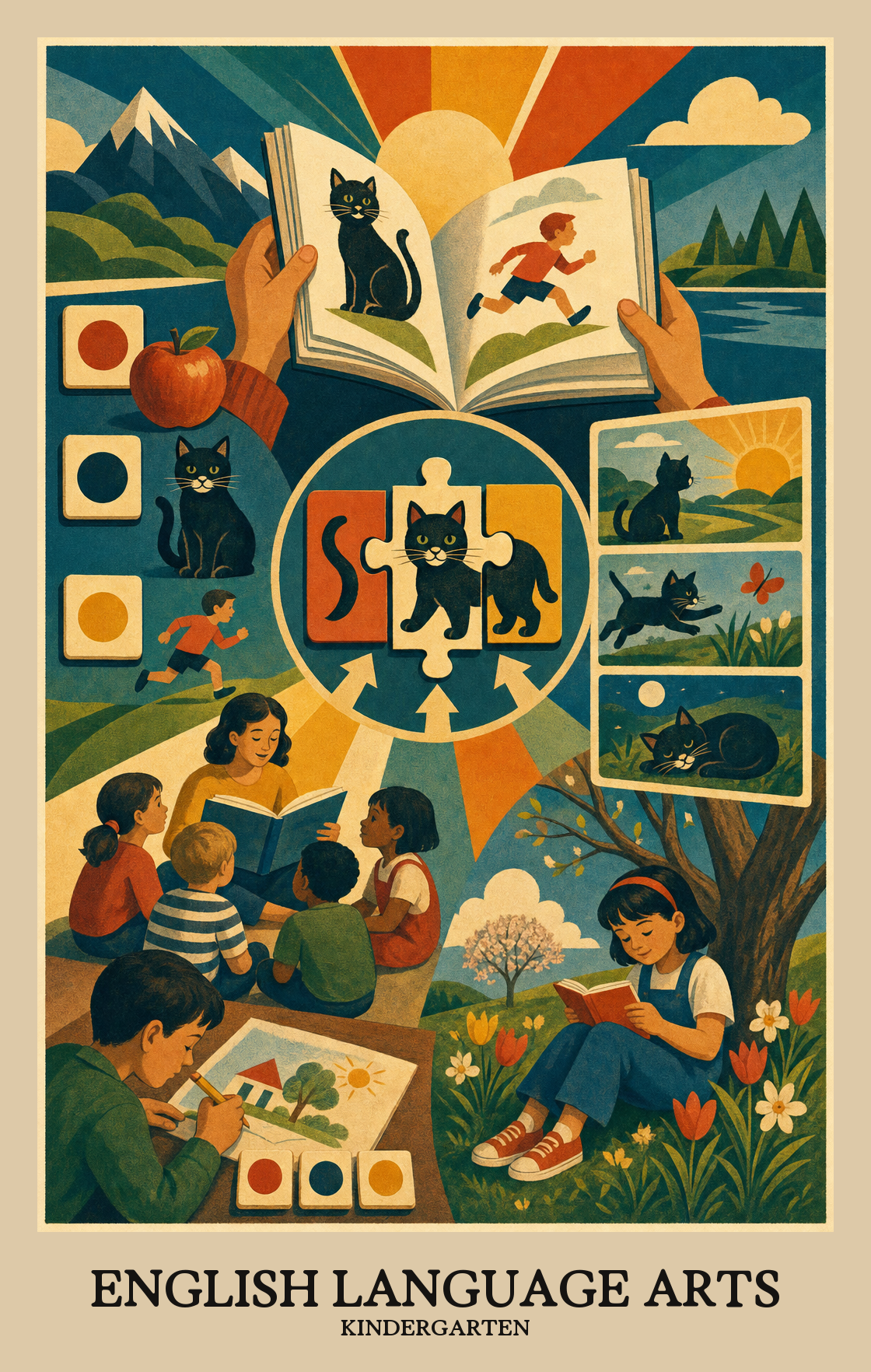
Students learn the names and sounds of each letter and how a book works, like which way to turn the pages and where a sentence starts. They begin to hear the separate sounds inside short spoken words.
Students blend letter sounds to read short words like cat and sun, and start to spot common words such as the and is on sight. Many will bring home their first little books to read aloud.
Students listen to picture books and fact books read aloud, then talk about who is in the story, what happens, and what they learned. They start asking and answering questions about the pictures and the words.
Students use drawings, letters, and short sentences to tell what they think, what happened, or what they know about a topic. Spelling will look invented at first as they listen for sounds and write them down.
Students read simple books more smoothly and join group conversations by taking turns, listening, and speaking in full sentences. They use new words from books and lessons when they share ideas at school and at home.
Students answer questions about a story using details straight from the book. They point to what the words actually say before drawing any conclusions.
Students retell what a story is mostly about and name the details that support it. This is the foundation for summarizing any book or passage they will read in later grades.
Students tell who is in a story and explain what that character does or what happens. They start to notice how one event leads to the next.
Students listen to a story and talk about what the words mean in context. They notice how the author's word choices make a scene feel silly, scary, or sad.
Students learn that a story has parts that fit together. They notice how the beginning sets up what happens next, and how each part connects to make the whole story work.
Stories are told by someone, and that narrator's perspective shapes what gets included and how it sounds. Students notice whether a story is told by a character inside it or a voice outside it.
Students look at pictures, listen to stories, and talk about what they notice across both. They practice making sense of a book using the words and the illustrations together.
Kindergartners aren't expected to evaluate arguments yet. This standard is typically introduced in later grades. If this code appears here, it likely reflects a placeholder or a data error in the source framework.
Two stories can cover the same idea in different ways. Students look at two books on the same topic and talk about what is alike, what is different, and what each author chose to show.
Students sit with a book and work through it on their own, making sense of the words and story without help. The goal is to read a range of books, not just easy ones.
| Standard | Definition | Code |
|---|---|---|
| Cite Textual Evidence | Students answer questions about a story using details straight from the book. They point to what the words actually say before drawing any conclusions. | DE-ELA.RL.K.1 |
| Central Ideas | Students retell what a story is mostly about and name the details that support it. This is the foundation for summarizing any book or passage they will read in later grades. | DE-ELA.RL.K.2 |
| Analyze Development | Students tell who is in a story and explain what that character does or what happens. They start to notice how one event leads to the next. | DE-ELA.RL.K.3 |
| Word Meanings | Students listen to a story and talk about what the words mean in context. They notice how the author's word choices make a scene feel silly, scary, or sad. | DE-ELA.RL.K.4 |
| Text Structure | Students learn that a story has parts that fit together. They notice how the beginning sets up what happens next, and how each part connects to make the whole story work. | DE-ELA.RL.K.5 |
| Point of View | Stories are told by someone, and that narrator's perspective shapes what gets included and how it sounds. Students notice whether a story is told by a character inside it or a voice outside it. | DE-ELA.RL.K.6 |
| Integrate Diverse Media | Students look at pictures, listen to stories, and talk about what they notice across both. They practice making sense of a book using the words and the illustrations together. | DE-ELA.RL.K.7 |
| Evaluate Arguments | Kindergartners aren't expected to evaluate arguments yet. This standard is typically introduced in later grades. If this code appears here, it likely reflects a placeholder or a data error in the source framework. | DE-ELA.RL.K.8 |
| Compare Texts | Two stories can cover the same idea in different ways. Students look at two books on the same topic and talk about what is alike, what is different, and what each author chose to show. | DE-ELA.RL.K.9 |
| Range of Reading | Students sit with a book and work through it on their own, making sense of the words and story without help. The goal is to read a range of books, not just easy ones. | DE-ELA.RL.K.10 |
Students answer questions about a book by pointing to or talking about what the words on the page actually say.
Students pick the big idea a book or article is mostly about, then point to details in the text that back it up.
Students notice how people, places, or ideas in a nonfiction book connect to each other. They ask why something happened and what came next.
Students learn what unfamiliar words mean by looking at the words and pictures around them in a nonfiction book. They practice noticing how a single word can change the feeling or meaning of a sentence.
Students learn that a book about a real topic has a front, a middle, and an end, and that each page connects to the bigger idea the whole book is about.
Students notice who wrote a book or article and think about why that person wrote it. Understanding the author's purpose helps students see why certain words and pictures were chosen.
Students look at a photo, chart, or drawing in a nonfiction book and explain what it adds to the words on the page.
Students listen to a nonfiction book and decide whether the author's reasons make sense. Does the proof given actually back up the point being made?
Two books can cover the same topic in different ways. Students listen to or read two texts on the same subject and talk about what each one teaches them or how the authors handle it differently.
Kindergartners listen to and talk about books on real topics, like animals or weather. By the end of the year, students follow along with these books on their own and show they understand what they heard or read.
| Standard | Definition | Code |
|---|---|---|
| Cite Textual Evidence | Students answer questions about a book by pointing to or talking about what the words on the page actually say. | DE-ELA.RI.K.1 |
| Central Ideas | Students pick the big idea a book or article is mostly about, then point to details in the text that back it up. | DE-ELA.RI.K.2 |
| Analyze Development | Students notice how people, places, or ideas in a nonfiction book connect to each other. They ask why something happened and what came next. | DE-ELA.RI.K.3 |
| Word Meanings | Students learn what unfamiliar words mean by looking at the words and pictures around them in a nonfiction book. They practice noticing how a single word can change the feeling or meaning of a sentence. | DE-ELA.RI.K.4 |
| Text Structure | Students learn that a book about a real topic has a front, a middle, and an end, and that each page connects to the bigger idea the whole book is about. | DE-ELA.RI.K.5 |
| Point of View | Students notice who wrote a book or article and think about why that person wrote it. Understanding the author's purpose helps students see why certain words and pictures were chosen. | DE-ELA.RI.K.6 |
| Integrate Diverse Media | Students look at a photo, chart, or drawing in a nonfiction book and explain what it adds to the words on the page. | DE-ELA.RI.K.7 |
| Evaluate Arguments | Students listen to a nonfiction book and decide whether the author's reasons make sense. Does the proof given actually back up the point being made? | DE-ELA.RI.K.8 |
| Compare Texts | Two books can cover the same topic in different ways. Students listen to or read two texts on the same subject and talk about what each one teaches them or how the authors handle it differently. | DE-ELA.RI.K.9 |
| Range of Reading | Kindergartners listen to and talk about books on real topics, like animals or weather. By the end of the year, students follow along with these books on their own and show they understand what they heard or read. | DE-ELA.RI.K.10 |
Students learn that words are made of letters, that spaces separate words, and that print moves left to right across the page.
Students listen to spoken words and practice breaking them into syllables and individual sounds. This is the groundwork for learning to read and spell.
Students use letter-sound patterns they know to figure out unfamiliar words. This is the foundation of reading: seeing letters on a page and sounding out the word they make.
Students read simple words and short sentences aloud smoothly enough to understand what they just read. Sounding out words is only the first step; reading with some flow is what helps meaning click.
| Standard | Definition | Code |
|---|---|---|
| Print Concepts | Students learn that words are made of letters, that spaces separate words, and that print moves left to right across the page. | DE-ELA.RF.K.1 |
| Phonological Awareness | Students listen to spoken words and practice breaking them into syllables and individual sounds. This is the groundwork for learning to read and spell. | DE-ELA.RF.K.2 |
| Phonics and Word Recognition | Students use letter-sound patterns they know to figure out unfamiliar words. This is the foundation of reading: seeing letters on a page and sounding out the word they make. | DE-ELA.RF.K.3 |
| Fluency | Students read simple words and short sentences aloud smoothly enough to understand what they just read. Sounding out words is only the first step; reading with some flow is what helps meaning click. | DE-ELA.RF.K.4 |
Kindergartners state an opinion about a topic or book and give a reason why they think so. This is the beginner version of making an argument in writing.
Students pick a topic they know and write sentences that share real facts about it. The writing sticks to the topic and gives readers clear, true information.
Students tell a story about something real or make-believe by drawing or writing. They put events in order and add details so a reader can follow what happened.
Writing fits the reason for writing. Kindergartners learn to put their ideas in an order that makes sense and to write in a way that fits who will read it.
Students learn that writing is a process. They plan before they write, then go back to fix, change, or restart until the writing says what they mean.
Students use a computer or tablet to write and share their work. This might mean typing a sentence, publishing a short piece online, or working with a classmate on a shared document.
Students pick a simple question and find out the answer by looking at books or pictures. They show what they learned by drawing or writing about it.
Students find facts from books and websites, check that the source can be trusted, and put the information into their own words.
Students point to pictures or words in a book to show why they think something about a story or topic. This is the beginning of backing up ideas with real proof from a text.
Students write often, on short tasks and longer ones, for different reasons and different readers. Practice across many kinds of writing builds the habit of putting ideas on paper.
| Standard | Definition | Code |
|---|---|---|
| Arguments | Kindergartners state an opinion about a topic or book and give a reason why they think so. This is the beginner version of making an argument in writing. | DE-ELA.W.K.1 |
| Informative Texts | Students pick a topic they know and write sentences that share real facts about it. The writing sticks to the topic and gives readers clear, true information. | DE-ELA.W.K.2 |
| Narratives | Students tell a story about something real or make-believe by drawing or writing. They put events in order and add details so a reader can follow what happened. | DE-ELA.W.K.3 |
| Coherent Writing | Writing fits the reason for writing. Kindergartners learn to put their ideas in an order that makes sense and to write in a way that fits who will read it. | DE-ELA.W.K.4 |
| Revision Process | Students learn that writing is a process. They plan before they write, then go back to fix, change, or restart until the writing says what they mean. | DE-ELA.W.K.5 |
| Use Technology | Students use a computer or tablet to write and share their work. This might mean typing a sentence, publishing a short piece online, or working with a classmate on a shared document. | DE-ELA.W.K.6 |
| Research Projects | Students pick a simple question and find out the answer by looking at books or pictures. They show what they learned by drawing or writing about it. | DE-ELA.W.K.7 |
| Gather Information | Students find facts from books and websites, check that the source can be trusted, and put the information into their own words. | DE-ELA.W.K.8 |
| Cite Evidence | Students point to pictures or words in a book to show why they think something about a story or topic. This is the beginning of backing up ideas with real proof from a text. | DE-ELA.W.K.9 |
| Range of Writing | Students write often, on short tasks and longer ones, for different reasons and different readers. Practice across many kinds of writing builds the habit of putting ideas on paper. | DE-ELA.W.K.10 |
Kindergartners listen to what a classmate says, then add their own idea to keep the conversation going. They practice talking and listening with different partners, not just their friends.
Students listen to a read-aloud, watch a short video, or look at a picture and then talk about what they learned. They practice pulling information from different sources, not just words on a page.
Students listen to someone speak and start to notice whether what the speaker says makes sense and whether they back it up. In kindergarten, this means asking "how do they know that?" and deciding if the reason sounds right.
Students share an idea out loud and back it up with a reason, organizing what they say to match who is listening and why.
Students add pictures, drawings, or simple visuals to help an audience understand what they are sharing. A photo or diagram can say what words alone can't.
Students learn when to use everyday talk and when to switch to careful, formal English. Talking to a friend sounds different from answering a teacher or sharing with the class.
| Standard | Definition | Code |
|---|---|---|
| Collaborative Discussions | Kindergartners listen to what a classmate says, then add their own idea to keep the conversation going. They practice talking and listening with different partners, not just their friends. | DE-ELA.SL.K.1 |
| Integrate Information | Students listen to a read-aloud, watch a short video, or look at a picture and then talk about what they learned. They practice pulling information from different sources, not just words on a page. | DE-ELA.SL.K.2 |
| Evaluate Speaker | Students listen to someone speak and start to notice whether what the speaker says makes sense and whether they back it up. In kindergarten, this means asking "how do they know that?" and deciding if the reason sounds right. | DE-ELA.SL.K.3 |
| Present Ideas | Students share an idea out loud and back it up with a reason, organizing what they say to match who is listening and why. | DE-ELA.SL.K.4 |
| Use Visual Displays | Students add pictures, drawings, or simple visuals to help an audience understand what they are sharing. A photo or diagram can say what words alone can't. | DE-ELA.SL.K.5 |
| Adapt Speech | Students learn when to use everyday talk and when to switch to careful, formal English. Talking to a friend sounds different from answering a teacher or sharing with the class. | DE-ELA.SL.K.6 |
Students learn the basic rules of speaking and writing in English: how to name things, describe them, and put words together so sentences make sense.
Students learn when to use a capital letter, how to end a sentence with a period or question mark, and how to spell simple words. These basics show up in every writing task from the first day of school.
Students practice choosing words that fit the moment, learning that the words used in a story sound different from the words used in a conversation. That awareness helps them understand what they read and hear.
When students meet a word they don't know, they use clues from the sentence around it to figure out what it means. They may also look at parts of the word or check a dictionary for help.
Students learn that words can do more than state facts. They explore how some words feel bigger or smaller than others, and how two words can mean almost the same thing but in different ways.
Students learn and correctly use everyday words that show up across subjects, like words for describing, comparing, and explaining. A strong working vocabulary helps them read, write, and talk about what they're learning.
| Standard | Definition | Code |
|---|---|---|
| Standard Grammar | Students learn the basic rules of speaking and writing in English: how to name things, describe them, and put words together so sentences make sense. | DE-ELA.L.K.1 |
| Spelling and Punctuation | Students learn when to use a capital letter, how to end a sentence with a period or question mark, and how to spell simple words. These basics show up in every writing task from the first day of school. | DE-ELA.L.K.2 |
| Style | Students practice choosing words that fit the moment, learning that the words used in a story sound different from the words used in a conversation. That awareness helps them understand what they read and hear. | DE-ELA.L.K.3 |
| Word Strategies | When students meet a word they don't know, they use clues from the sentence around it to figure out what it means. They may also look at parts of the word or check a dictionary for help. | DE-ELA.L.K.4 |
| Figurative Language | Students learn that words can do more than state facts. They explore how some words feel bigger or smaller than others, and how two words can mean almost the same thing but in different ways. | DE-ELA.L.K.5 |
| Academic Vocabulary | Students learn and correctly use everyday words that show up across subjects, like words for describing, comparing, and explaining. A strong working vocabulary helps them read, write, and talk about what they're learning. | DE-ELA.L.K.6 |
Delaware's spring summative test in reading and writing for grades 3 through 8, aligned to the Delaware ELA Standards.
By spring, students should know all the letters and the sounds they make, sound out simple words like cat and sun, and read short books with a lot of pictures. Most can retell a story they just heard and point to the title and author on the cover.
Read a picture book together every night and run a finger under the words as you go. Stop now and then to ask what just happened or what might happen next. Short, daily reading matters more than long sessions once a week.
Ask students to look at the first letter and try the sound, then look at the picture for a clue. If they are still stuck after a few seconds, say the word and keep going so the story does not fall apart. Come back to tricky words after the book is done.
Start with letter names and single sounds, then move to blending two and three sounds into short words like at, mat, and sit. By winter, most students are ready for simple sight words and short sentences. Save longer words and word families for spring.
Not yet. Students start with drawings, then add a label or a letter that matches the first sound. By the end of the year, many can write a short sentence using sounds they hear, even if the spelling is off. Invented spelling is a good sign, not a problem.
Blending sounds into a word and pulling a word apart into sounds are the two skills that trip students up most often. Many also need extra practice with lowercase letters and with the difference between a letter, a word, and a sentence. Build short daily drills for these.
Students should try three kinds of writing: telling a story from their own life, sharing facts about a topic like frogs or trucks, and giving an opinion about a book or food. Pictures count as part of the writing all year. Aim for a short piece every week.
A ready first grader knows letter sounds, can sound out simple words, and can write their name and a short sentence about a picture. They should also be able to sit and listen to a story, then answer a question about it. If most of these are in place, they are ready.
A lot. Kindergarten students learn words by using them, so plan time every day for partner talk, sharing about a picture, or asking a question about a story. Speaking and listening are not extras at this age. They feed reading and writing.