Our classroom community
Students start the year learning how to be part of a group. They practice asking questions, sharing materials, taking turns, and following classroom rules that keep everyone safe and heard.
This is the year social studies begins with the world students already know: their family, their classroom, and their neighborhood. Students learn what rules are and why they matter, who works in their community, and how to read a simple map of familiar places. They ask questions about people and places and share what they notice through pictures, words, and class talk. By spring, they can name a few classroom rules, point out their home and school on a map, and tell a short story about someone important in their community.
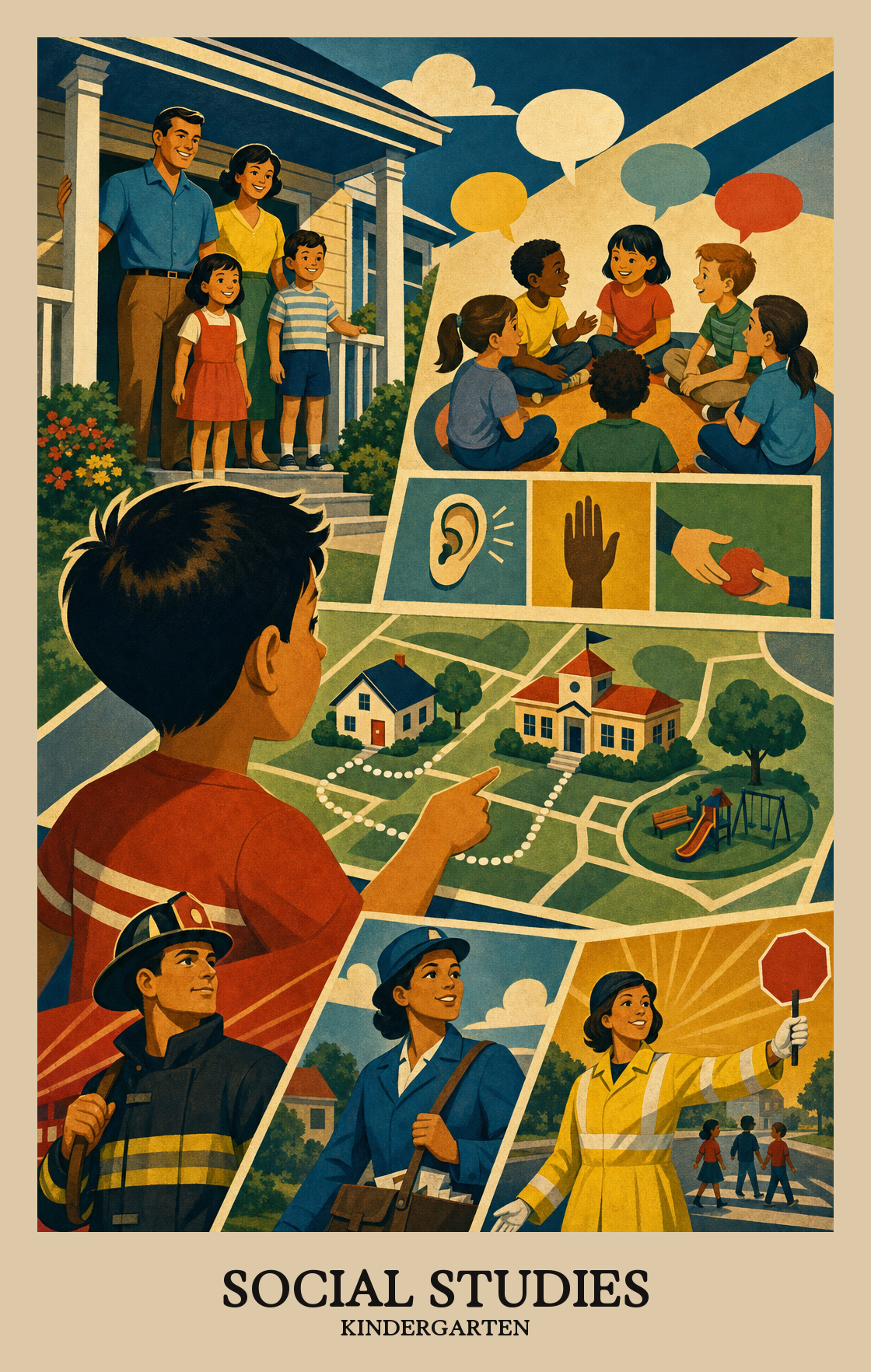
Students start the year learning how to be part of a group. They practice asking questions, sharing materials, taking turns, and following classroom rules that keep everyone safe and heard.
Students look at why rules matter at home, at school, and in the city. They talk about fairness, how leaders are chosen, and what it means to be a good citizen in their neighborhood.
Students explore maps, photos, and globes to find where they live. They notice landmarks around the school, point out streets and parks, and see how people use the land around them.
Students sort out the difference between things they need and things they want. They learn what it means to save, spend, and make a choice when there is not enough to go around.
Students hear stories about people and events that shaped Washington, DC and the country. They start to notice what has changed over time and what has stayed the same in their own lives.
Students ask questions about the world around them: why things happen, how places differ, and how people live. This is the first step in learning to think like a historian, a citizen, or a scientist.
Students use maps, money, rules, and stories about the past to answer questions about how people live together. This standard covers all four areas of social studies at once.
Students look at photos, books, and other sources to decide if the information seems trustworthy, then use what they find to back up what they say.
Students share what they've learned by drawing, talking, or writing about it, then do something with that knowledge, like helping in the classroom or the community.
| Standard | Definition | Code |
|---|---|---|
| Develop Questions | Students ask questions about the world around them: why things happen, how places differ, and how people live. This is the first step in learning to think like a historian, a citizen, or a scientist. | DC-SS.INQ.K.1 |
| Apply Disciplinary Tools | Students use maps, money, rules, and stories about the past to answer questions about how people live together. This standard covers all four areas of social studies at once. | DC-SS.INQ.K.2 |
| Evaluate Sources and Use Evidence | Students look at photos, books, and other sources to decide if the information seems trustworthy, then use what they find to back up what they say. | DC-SS.INQ.K.3 |
| Communicate and Take Action | Students share what they've learned by drawing, talking, or writing about it, then do something with that knowledge, like helping in the classroom or the community. | DC-SS.INQ.K.4 |
Students learn what governments do and why they exist. They look at the rules and leaders that run their neighborhood, city, and country.
Kindergartners look at rules, fairness, and rights in stories and real life. They connect basic ideas about how the U.S. government works to examples they can see and discuss.
Students learn what they're allowed to do and what they're expected to do as a member of a group, like a classroom or community. They practice listening, taking turns, and helping make decisions together.
| Standard | Definition | Code |
|---|---|---|
| Government Institutions | Students learn what governments do and why they exist. They look at the rules and leaders that run their neighborhood, city, and country. | DC-SS.CIV.K.1 |
| Foundational Principles | Kindergartners look at rules, fairness, and rights in stories and real life. They connect basic ideas about how the U.S. government works to examples they can see and discuss. | DC-SS.CIV.K.2 |
| Citizenship and Participation | Students learn what they're allowed to do and what they're expected to do as a member of a group, like a classroom or community. They practice listening, taking turns, and helping make decisions together. | DC-SS.CIV.K.3 |
Scarcity means there isn't enough of something for everyone. Students learn why people make choices about what to buy, save, or share when they can't have everything they want.
Stores and markets sell things people want, and prices help decide who buys what. Students learn why some things cost more than others and how buyers and sellers make choices.
Saving means setting money aside for later. Students learn basic money choices: when to spend, when to save, and what it means to borrow or grow money over time.
| Standard | Definition | Code |
|---|---|---|
| Economic Decision Making | Scarcity means there isn't enough of something for everyone. Students learn why people make choices about what to buy, save, or share when they can't have everything they want. | DC-SS.ECON.K.1 |
| Markets and Exchange | Stores and markets sell things people want, and prices help decide who buys what. Students learn why some things cost more than others and how buyers and sellers make choices. | DC-SS.ECON.K.2 |
| Personal Finance | Saving means setting money aside for later. Students learn basic money choices: when to spend, when to save, and what it means to borrow or grow money over time. | DC-SS.ECON.K.3 |
Students look at maps and photos to learn about places near and far. They notice what the land looks like and how people live in it.
Students look at how weather, land, and water affect where people build homes and how they get food. They also notice how people change the land around them, like clearing trees or building roads.
Students look at simple maps or pictures to see where people moved, where they settled, and what they brought with them. This builds the habit of asking why people go places and what changes when they arrive.
| Standard | Definition | Code |
|---|---|---|
| Geographic Representations | Students look at maps and photos to learn about places near and far. They notice what the land looks like and how people live in it. | DC-SS.GEO.K.1 |
| Human-Environment Interaction | Students look at how weather, land, and water affect where people build homes and how they get food. They also notice how people change the land around them, like clearing trees or building roads. | DC-SS.GEO.K.2 |
| Movement and Connections | Students look at simple maps or pictures to see where people moved, where they settled, and what they brought with them. This builds the habit of asking why people go places and what changes when they arrive. | DC-SS.GEO.K.3 |
Students learn who and what shaped Washington, D.C. They hear stories about key people and moments in the city's past and how those events connect to the rest of the country.
Students look at how life in America has changed over time, from the days of the first settlers to today, and notice what has stayed the same along the way.
Students look at two places or groups from long ago and spot what made them different. They also think about how those old events still show up in the world today.
Students look at old photos, objects, or stories to figure out what happened in the past. They practice explaining what the evidence shows and why someone else might see it differently.
| Standard | Definition | Code |
|---|---|---|
| District of Columbia History | Students learn who and what shaped Washington, D.C. They hear stories about key people and moments in the city's past and how those events connect to the rest of the country. | DC-SS.HIST.K.1 |
| United States History | Students look at how life in America has changed over time, from the days of the first settlers to today, and notice what has stayed the same along the way. | DC-SS.HIST.K.2 |
| World History | Students look at two places or groups from long ago and spot what made them different. They also think about how those old events still show up in the world today. | DC-SS.HIST.K.3 |
| Historical Reasoning | Students look at old photos, objects, or stories to figure out what happened in the past. They practice explaining what the evidence shows and why someone else might see it differently. | DC-SS.HIST.K.4 |
Federally administered sample-based assessment in reading, mathematics, science, and writing. NAEP results inform state-by-state comparisons rather than individual student or school accountability.
Students learn about the people and places around them. They talk about rules at school and at home, jobs people do in the neighborhood, and how families are alike and different. A lot of the learning happens through stories, pictures, and short walks around the school.
Talk about your day on the way home. Point out helpers like bus drivers, mail carriers, and store clerks, and ask what they do. Look at a map of the neighborhood together and find your home, the school, and a favorite park.
Not at this age. Students start with their own family, school, and city, then meet a few important people through picture books and short stories. Recognizing names like George Washington or Martin Luther King Jr. is plenty.
Treat the question as a win. Say what you do know, then look it up together in a picture book or a short video. Curiosity matters more than a perfect answer at this age.
Start close in and move out. Begin with self, family, and classroom rules, then move to the school, the neighborhood, and the city. Save bigger ideas about the country and the wider world for the spring once students have the local vocabulary.
Map skills and the difference between needs and wants tend to need several rounds. Students also need repeated practice taking turns in a discussion and giving a reason for an opinion. Short, frequent practice works better than long lessons.
Anchor it in places students can picture: the Capitol, the Washington Monument, the Mall, and their own neighborhood. Use photographs and a few short read-alouds about people who lived and worked here. Field trips and virtual tours stick better than timelines.
Students can name some rules and why they matter, point to home and school on a simple map, and describe a few jobs people do in the community. They can also share an opinion and give one reason for it.