Counting and naming numbers
Students count objects out loud, match each number word to one item, and write the numbers they say. Parents may notice counting toys, steps, or snacks at home.
Kindergarten is the year numbers start to mean something real. Students learn to count past twenty, match each number to one object, and tell which group has more. They begin adding and taking away with small numbers using fingers, blocks, or drawings. By spring, students can count a small pile of objects, name basic shapes like circles and squares, and solve simple stories about putting things together.
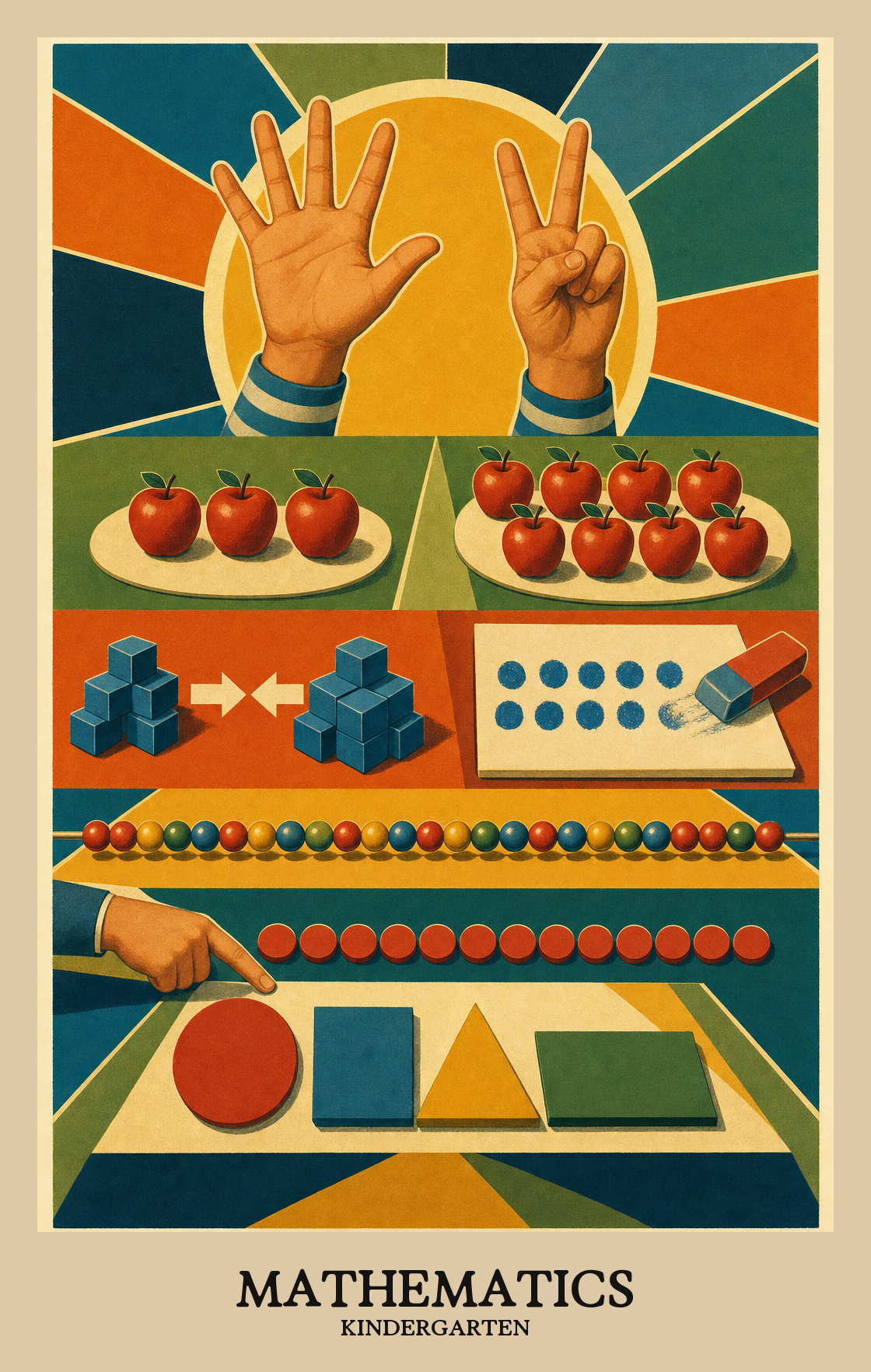
Students count objects out loud, match each number word to one item, and write the numbers they say. Parents may notice counting toys, steps, or snacks at home.
Students name circles, squares, triangles, and rectangles, and sort objects by color, size, or shape. They start noticing shapes in signs, blocks, and food.
Students put small groups together and take some away, using fingers, blocks, or drawings. They begin to answer simple story problems about how many in all or how many are left.
Students compare which group has more or fewer and decide which object is longer, shorter, or heavier. They also read simple picture graphs about things like favorite snacks or pets.
Students count past 20 and on toward 100, often by ones and tens. They spot patterns in numbers and shapes and use what they know to solve small everyday problems.
Students learn to understand what a problem is asking before jumping to an answer, and to keep trying when the work gets hard.
Students move back and forth between a real object (three apples) and its number (3). They use the number to solve a problem, then connect the answer back to what it means in the real world.
Students explain why their answer makes sense and listen to how a classmate solved the same problem. They practice saying "I think this because..." and pointing out when a different approach doesn't quite work.
Students use simple math to make sense of real situations, like counting chairs at a table or figuring out if there are enough snacks for everyone.
Students learn when to grab a pencil, use a calculator, or make a quick estimate to solve a problem. Picking the right tool is part of doing the math.
Students use the right math words and pay close attention when counting or measuring. Getting the details right, like saying "four squares" instead of just "four," is part of the work.
Students notice patterns and shapes that repeat or fit together in a predictable way, then use that structure to solve problems. Seeing that numbers and shapes follow rules helps students work faster and make smarter guesses.
Students notice when the same steps keep showing up in a problem and start using that pattern as a shortcut. They ask themselves why it works, not just whether it works.
| Standard | Definition | Code |
|---|---|---|
| Make Sense of Problems | Students learn to understand what a problem is asking before jumping to an answer, and to keep trying when the work gets hard. | DC-MATH.MP.K.1 |
| Reason Abstractly | Students move back and forth between a real object (three apples) and its number (3). They use the number to solve a problem, then connect the answer back to what it means in the real world. | DC-MATH.MP.K.2 |
| Construct Arguments | Students explain why their answer makes sense and listen to how a classmate solved the same problem. They practice saying "I think this because..." and pointing out when a different approach doesn't quite work. | DC-MATH.MP.K.3 |
| Model with Mathematics | Students use simple math to make sense of real situations, like counting chairs at a table or figuring out if there are enough snacks for everyone. | DC-MATH.MP.K.4 |
| Use Tools Strategically | Students learn when to grab a pencil, use a calculator, or make a quick estimate to solve a problem. Picking the right tool is part of doing the math. | DC-MATH.MP.K.5 |
| Attend to Precision | Students use the right math words and pay close attention when counting or measuring. Getting the details right, like saying "four squares" instead of just "four," is part of the work. | DC-MATH.MP.K.6 |
| Use Structure | Students notice patterns and shapes that repeat or fit together in a predictable way, then use that structure to solve problems. Seeing that numbers and shapes follow rules helps students work faster and make smarter guesses. | DC-MATH.MP.K.7 |
| Express Regularity | Students notice when the same steps keep showing up in a problem and start using that pattern as a shortcut. They ask themselves why it works, not just whether it works. | DC-MATH.MP.K.8 |
Counting and number reasoning starts here. Students count objects, learn the order of numbers, and begin to understand what numbers mean. This is the foundation for every math skill that follows.
Students practice adding and subtracting small groups of objects or numbers. They figure out how many are left, how many in all, or how many more one group has than another.
Students sort objects into groups and count each group, then show the results in a simple chart or picture graph. Reading the chart tells students which group has more, fewer, or the same.
Students sort and describe everyday shapes, like circles, squares, and cubes, by talking about their sides, corners, and size. They compare flat shapes with solid ones and start building the vocabulary to describe what they see.
Ratio reasoning at this age means noticing "more," "fewer," and "same amount" in everyday situations. Students compare groups of objects and describe how quantities relate to each other.
| Standard | Definition | Code |
|---|---|---|
| Counting and Number | Counting and number reasoning starts here. Students count objects, learn the order of numbers, and begin to understand what numbers mean. This is the foundation for every math skill that follows. | DC-MATH.K8.K.1 |
| Operations and Algebraic Thinking | Students practice adding and subtracting small groups of objects or numbers. They figure out how many are left, how many in all, or how many more one group has than another. | DC-MATH.K8.K.2 |
| Measurement and Data | Students sort objects into groups and count each group, then show the results in a simple chart or picture graph. Reading the chart tells students which group has more, fewer, or the same. | DC-MATH.K8.K.3 |
| Geometry | Students sort and describe everyday shapes, like circles, squares, and cubes, by talking about their sides, corners, and size. They compare flat shapes with solid ones and start building the vocabulary to describe what they see. | DC-MATH.K8.K.4 |
| Ratios and Proportional Relationships | Ratio reasoning at this age means noticing "more," "fewer," and "same amount" in everyday situations. Students compare groups of objects and describe how quantities relate to each other. | DC-MATH.K8.K.5 |
DC's spring summative math test for grades 3 through 8, aligned to DC's Common Core-based math standards.
Alternate assessment for students with the most significant cognitive disabilities, given in grades 3-8 and high school in ELA, math, and science.
Students should count to 100, write numbers up to 20, and add and subtract small amounts within 10. They should also name basic shapes like circles, squares, and triangles, and compare which group has more or fewer.
Count real things together: stairs, raisins on a plate, cars in the parking lot. Ask questions like how many are left after eating two, or which pile has more. Five minutes a day adds up fast.
Start with counting and number recognition through 10, then build to 20 by late fall. Move into adding and taking away small amounts in the winter, then shapes and measurement in the spring. Counting practice should stay in the warm-up all year.
Reversing numbers like 3 and 7 is common at this age and usually fades by first grade. Keep practicing with a finger trace in sand or on paper. If reversals are still frequent by the end of the year, mention it to the teacher.
Counting past 13 trips up a lot of students because the teen names do not follow the pattern. Writing numbers backward is also common. Plan extra time on teen numbers and on the meaning of the plus and minus signs.
A student ready for first grade can count a group of 20 objects without losing track, solve simple story problems with fingers or counters, and tell which of two numbers is bigger. They can also sort shapes and compare two objects by length or weight.
Not yet. Students should be able to add and subtract within 5 quickly by the end of the year, but they can still use fingers or counters for sums up to 10. Speed drills are not the goal at this age.
Word problems matter, but keep them short and tied to real situations: three apples plus two more, or five crackers with two eaten. Acting them out with objects builds more understanding than worksheets at this stage.