Letters, sounds, and book basics
Students learn the names and sounds of letters and how a book works. They practice holding a book the right way, following words left to right, and noticing that spaces separate words.
This is the year letters and sounds click into reading. Students learn how a book works, match each letter to the sound it makes, and start sounding out simple words like cat and sun. They also retell favorite stories, ask questions about what was read aloud, and write short pieces using a mix of drawing, letters, and early spelling. By spring, students can read simple sentences and write a few about a story or a topic they know.
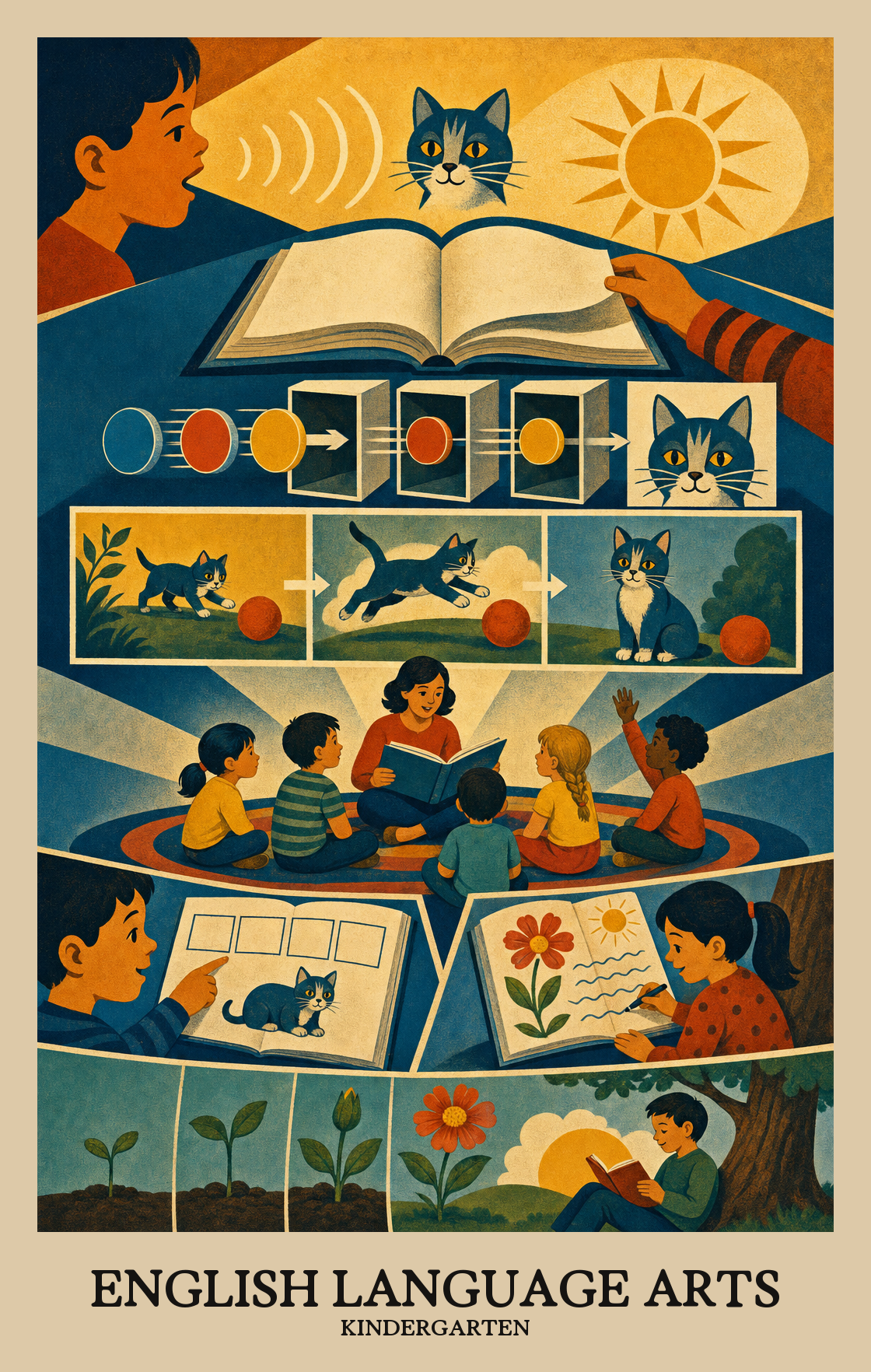
Students learn the names and sounds of letters and how a book works. They practice holding a book the right way, following words left to right, and noticing that spaces separate words.
Students play with the sounds inside spoken words. They clap syllables, find words that rhyme, and start to pull apart the first, middle, and last sounds in short words like cat or sun.
Students begin sounding out short words and recognizing common words like the, is, and and on sight. Simple books start to feel readable, and they can talk about who is in a story and what happens.
Students draw and write to share an opinion, tell about something they know, or describe what happened. Spelling is invented and letters may be backward, but the meaning comes through.
Students take turns in conversations, listen to stories read aloud, and ask questions when something is unclear. They start using new words they hear in books and at school.
Students answer questions about a story by pointing to or quoting the part of the book that shows the answer. They stick to what the story actually says.
Students listen to a story and figure out what it is mostly about, then point to the key moments that show that big idea.
Students name a character or event from a story and explain what happened and why. Simple stories are the starting point, so "the bear was hungry, so he looked for food" counts as analysis here.
Students listen to a story and talk about what specific words mean in that moment. They notice how a word like "cold" can mean chilly weather or an unfriendly feeling, depending on how the author uses it.
Students notice how a story is put together: how one sentence leads to the next and how the beginning, middle, and end connect to make the whole story make sense.
Students notice who is telling the story and how that choice changes what gets shared. A story told by a child sounds different from one told by a parent.
Students look at pictures, illustrations, or other visuals in a story and explain what they add to the words on the page.
Kindergartners are not expected to evaluate arguments in the way older students do. This standard appears in the wrong place: RL.K.8 is typically marked "not applicable" in kindergarten ELA frameworks, since argument analysis begins in later grades. If this standard is listed for kindergarten, students are likely just learning to notice why a character does something or what a book is trying to tell them. They listen to a story and talk about whether the author's idea makes sense.
Two stories can cover the same idea in different ways. Students look at how two books handle the same topic and talk about what's similar, what's different, and what they learned from reading both.
Students listen to and follow along with stories and simple books, building the habit of reading on their own. The goal is comfort with books at the right level for kindergarten.
| Standard | Definition | Code |
|---|---|---|
| Cite Textual Evidence | Students answer questions about a story by pointing to or quoting the part of the book that shows the answer. They stick to what the story actually says. | DC-ELA.RL.K.1 |
| Central Ideas | Students listen to a story and figure out what it is mostly about, then point to the key moments that show that big idea. | DC-ELA.RL.K.2 |
| Analyze Development | Students name a character or event from a story and explain what happened and why. Simple stories are the starting point, so "the bear was hungry, so he looked for food" counts as analysis here. | DC-ELA.RL.K.3 |
| Word Meanings | Students listen to a story and talk about what specific words mean in that moment. They notice how a word like "cold" can mean chilly weather or an unfriendly feeling, depending on how the author uses it. | DC-ELA.RL.K.4 |
| Text Structure | Students notice how a story is put together: how one sentence leads to the next and how the beginning, middle, and end connect to make the whole story make sense. | DC-ELA.RL.K.5 |
| Point of View | Students notice who is telling the story and how that choice changes what gets shared. A story told by a child sounds different from one told by a parent. | DC-ELA.RL.K.6 |
| Integrate Diverse Media | Students look at pictures, illustrations, or other visuals in a story and explain what they add to the words on the page. | DC-ELA.RL.K.7 |
| Evaluate Arguments | Kindergartners are not expected to evaluate arguments in the way older students do. This standard appears in the wrong place: RL.K.8 is typically marked "not applicable" in kindergarten ELA frameworks, since argument analysis begins in later grades. If this standard is listed for kindergarten, students are likely just learning to notice why a character does something or what a book is trying to tell them. They listen to a story and talk about whether the author's idea makes sense. | DC-ELA.RL.K.8 |
| Compare Texts | Two stories can cover the same idea in different ways. Students look at how two books handle the same topic and talk about what's similar, what's different, and what they learned from reading both. | DC-ELA.RL.K.9 |
| Range of Reading | Students listen to and follow along with stories and simple books, building the habit of reading on their own. The goal is comfort with books at the right level for kindergarten. | DC-ELA.RL.K.10 |
Students answer questions about a nonfiction book using words or pictures directly from the page. They point to or quote the part that backs up what they said.
Students pick out the main idea of a short nonfiction book or passage and name the details that back it up.
Students listen to a nonfiction book and talk about why something happened or how a person or animal caused a change. They connect one part of the story to another.
Students learn what unfamiliar words mean by looking at how they are used in a nonfiction book or article. They also notice how an author's word choices change the feeling or message of what they read.
Students learn that a book has a beginning, a middle, and an end, and that each part connects to the others. Even in kindergarten, students notice how sentences and pages work together to tell one complete idea.
Students notice who is telling the information and why. That shapes what details get included and how the words sound.
Students look at pictures, photos, or simple charts in a book and talk about what those visuals add to the words on the page.
Students listen to a nonfiction book and decide whether the author's reasons make sense. They practice asking: does that reason actually back up what the author is saying?
Two books can cover the same topic in different ways. Students look at two informational books on the same subject and notice what each one teaches and how the authors chose to explain it.
Students listen to and talk about short nonfiction books and passages, building the habit of making sense of what they hear and read on their own.
| Standard | Definition | Code |
|---|---|---|
| Cite Textual Evidence | Students answer questions about a nonfiction book using words or pictures directly from the page. They point to or quote the part that backs up what they said. | DC-ELA.RI.K.1 |
| Central Ideas | Students pick out the main idea of a short nonfiction book or passage and name the details that back it up. | DC-ELA.RI.K.2 |
| Analyze Development | Students listen to a nonfiction book and talk about why something happened or how a person or animal caused a change. They connect one part of the story to another. | DC-ELA.RI.K.3 |
| Word Meanings | Students learn what unfamiliar words mean by looking at how they are used in a nonfiction book or article. They also notice how an author's word choices change the feeling or message of what they read. | DC-ELA.RI.K.4 |
| Text Structure | Students learn that a book has a beginning, a middle, and an end, and that each part connects to the others. Even in kindergarten, students notice how sentences and pages work together to tell one complete idea. | DC-ELA.RI.K.5 |
| Point of View | Students notice who is telling the information and why. That shapes what details get included and how the words sound. | DC-ELA.RI.K.6 |
| Integrate Diverse Media | Students look at pictures, photos, or simple charts in a book and talk about what those visuals add to the words on the page. | DC-ELA.RI.K.7 |
| Evaluate Arguments | Students listen to a nonfiction book and decide whether the author's reasons make sense. They practice asking: does that reason actually back up what the author is saying? | DC-ELA.RI.K.8 |
| Compare Texts | Two books can cover the same topic in different ways. Students look at two informational books on the same subject and notice what each one teaches and how the authors chose to explain it. | DC-ELA.RI.K.9 |
| Range of Reading | Students listen to and talk about short nonfiction books and passages, building the habit of making sense of what they hear and read on their own. | DC-ELA.RI.K.10 |
Students learn that print works in a specific order: left to right, top to bottom, and one word at a time. They practice tracking text with a finger and recognizing where a sentence starts and stops.
Phonological awareness covers how words are built from smaller pieces. Students learn to clap out syllables, hear rhymes, and separate the individual sounds inside spoken words.
Students use letter-sound patterns they have learned to figure out new words. This is the core of early reading: seeing letters, knowing their sounds, and blending them into words.
Students read simple words and short sentences aloud smoothly enough to understand what they just read. At this stage, that means recognizing familiar words quickly and not losing the meaning while sounding out new ones.
| Standard | Definition | Code |
|---|---|---|
| Print Concepts | Students learn that print works in a specific order: left to right, top to bottom, and one word at a time. They practice tracking text with a finger and recognizing where a sentence starts and stops. | DC-ELA.RF.K.1 |
| Phonological Awareness | Phonological awareness covers how words are built from smaller pieces. Students learn to clap out syllables, hear rhymes, and separate the individual sounds inside spoken words. | DC-ELA.RF.K.2 |
| Phonics and Word Recognition | Students use letter-sound patterns they have learned to figure out new words. This is the core of early reading: seeing letters, knowing their sounds, and blending them into words. | DC-ELA.RF.K.3 |
| Fluency | Students read simple words and short sentences aloud smoothly enough to understand what they just read. At this stage, that means recognizing familiar words quickly and not losing the meaning while sounding out new ones. | DC-ELA.RF.K.4 |
Kindergarteners share an opinion about a topic or book and give a reason that supports it. This is the foundation of argument writing, practiced at the simplest level.
Students pick a topic they know and write sentences that explain it to a reader. The focus is on sharing real information clearly, not telling a story.
Students tell a story about something real or made up, putting the events in an order that makes sense and adding details that bring the story to life.
Students write sentences that fit the assignment: a story sounds like a story, directions sound like directions, and the words stay simple enough for the reader to follow.
Students learn that writing improves with a second look. They practice going back to add a detail, fix a word, or try a completely different way of saying something.
Students use a computer or tablet to type words, share their writing, and work with classmates on a piece together.
Students pick a simple question and find answers about it, then show what they learned. Think of it as a tiny research project, like figuring out why leaves change color or how frogs grow.
Students find facts from books and websites, check that the source seems trustworthy, and put the information into their own words.
Students point to a picture, word, or sentence from a book to back up what they say or write about it. This starts the habit of using the text itself as proof.
Students practice writing often, for different reasons: to tell a story, share an opinion, or explain something. Some pieces take a few days; others get done in a single sitting.
| Standard | Definition | Code |
|---|---|---|
| Arguments | Kindergarteners share an opinion about a topic or book and give a reason that supports it. This is the foundation of argument writing, practiced at the simplest level. | DC-ELA.W.K.1 |
| Informative Texts | Students pick a topic they know and write sentences that explain it to a reader. The focus is on sharing real information clearly, not telling a story. | DC-ELA.W.K.2 |
| Narratives | Students tell a story about something real or made up, putting the events in an order that makes sense and adding details that bring the story to life. | DC-ELA.W.K.3 |
| Coherent Writing | Students write sentences that fit the assignment: a story sounds like a story, directions sound like directions, and the words stay simple enough for the reader to follow. | DC-ELA.W.K.4 |
| Revision Process | Students learn that writing improves with a second look. They practice going back to add a detail, fix a word, or try a completely different way of saying something. | DC-ELA.W.K.5 |
| Use Technology | Students use a computer or tablet to type words, share their writing, and work with classmates on a piece together. | DC-ELA.W.K.6 |
| Research Projects | Students pick a simple question and find answers about it, then show what they learned. Think of it as a tiny research project, like figuring out why leaves change color or how frogs grow. | DC-ELA.W.K.7 |
| Gather Information | Students find facts from books and websites, check that the source seems trustworthy, and put the information into their own words. | DC-ELA.W.K.8 |
| Cite Evidence | Students point to a picture, word, or sentence from a book to back up what they say or write about it. This starts the habit of using the text itself as proof. | DC-ELA.W.K.9 |
| Range of Writing | Students practice writing often, for different reasons: to tell a story, share an opinion, or explain something. Some pieces take a few days; others get done in a single sitting. | DC-ELA.W.K.10 |
Kindergartners take turns talking with classmates, listen to what others say, and add their own thoughts to keep the conversation going.
A teacher reads a story aloud, shows a photo, or plays a short video. Students listen and look closely, then talk about what they learned from it.
Students listen to someone talk and decide whether that person's idea makes sense and whether they backed it up with good reasons.
Students practice saying ideas out loud in a clear order so listeners can follow along. The words and details they choose fit who they are talking to and why.
Students use pictures, drawings, or simple visuals to help explain an idea when they share something with the class.
Students practice using formal English when the moment calls for it, like answering a question in class instead of chatting with a friend. They learn that how they talk can change depending on who is listening.
| Standard | Definition | Code |
|---|---|---|
| Collaborative Discussions | Kindergartners take turns talking with classmates, listen to what others say, and add their own thoughts to keep the conversation going. | DC-ELA.SL.K.1 |
| Integrate Information | A teacher reads a story aloud, shows a photo, or plays a short video. Students listen and look closely, then talk about what they learned from it. | DC-ELA.SL.K.2 |
| Evaluate Speaker | Students listen to someone talk and decide whether that person's idea makes sense and whether they backed it up with good reasons. | DC-ELA.SL.K.3 |
| Present Ideas | Students practice saying ideas out loud in a clear order so listeners can follow along. The words and details they choose fit who they are talking to and why. | DC-ELA.SL.K.4 |
| Use Visual Displays | Students use pictures, drawings, or simple visuals to help explain an idea when they share something with the class. | DC-ELA.SL.K.5 |
| Adapt Speech | Students practice using formal English when the moment calls for it, like answering a question in class instead of chatting with a friend. They learn that how they talk can change depending on who is listening. | DC-ELA.SL.K.6 |
Students learn the basic rules of how sentences work: how words go in order, when to use words like "a" or "the," and how to put a thought into words on paper or out loud.
Kindergartners practice the basic rules of writing: starting sentences with a capital letter, ending with a period or question mark, and spelling simple words correctly.
Students learn that word choice changes how a sentence sounds and what it means. Picking the right words helps them say exactly what they mean when writing and understand more when listening to a story read aloud.
When students come across a word they don't know, they use clues from nearby words and sentences to figure out what it means. They can also look at parts of the word or check a dictionary.
Words don't always mean exactly what they say. Students explore how words connect, how some phrases paint a picture, and how two words can mean almost the same thing but feel different.
Students learn and use the everyday words and topic-specific words they need to read, write, and talk about what they're learning. In kindergarten, that means building a working vocabulary for school conversations and simple writing tasks.
| Standard | Definition | Code |
|---|---|---|
| Standard Grammar | Students learn the basic rules of how sentences work: how words go in order, when to use words like "a" or "the," and how to put a thought into words on paper or out loud. | DC-ELA.L.K.1 |
| Spelling and Punctuation | Kindergartners practice the basic rules of writing: starting sentences with a capital letter, ending with a period or question mark, and spelling simple words correctly. | DC-ELA.L.K.2 |
| Style | Students learn that word choice changes how a sentence sounds and what it means. Picking the right words helps them say exactly what they mean when writing and understand more when listening to a story read aloud. | DC-ELA.L.K.3 |
| Word Strategies | When students come across a word they don't know, they use clues from nearby words and sentences to figure out what it means. They can also look at parts of the word or check a dictionary. | DC-ELA.L.K.4 |
| Figurative Language | Words don't always mean exactly what they say. Students explore how words connect, how some phrases paint a picture, and how two words can mean almost the same thing but feel different. | DC-ELA.L.K.5 |
| Academic Vocabulary | Students learn and use the everyday words and topic-specific words they need to read, write, and talk about what they're learning. In kindergarten, that means building a working vocabulary for school conversations and simple writing tasks. | DC-ELA.L.K.6 |
DC's spring summative test in reading and writing for grades 3 through 8, aligned to DC's Common Core-based ELA standards.
Alternate assessment for students with the most significant cognitive disabilities, given in grades 3-8 and high school in ELA, math, and science.
By spring, most students can name every letter, match letters to their sounds, and sound out short words like cat, sun, and red. They can listen to a story, retell what happened, and answer questions about the characters. Some will start reading simple books on their own.
Read aloud every day, even for ten minutes. Point to the words as you go so students see that print moves left to right. After the story, ask who was in it and what happened first, next, and at the end.
Pause and let them try to sound it out before jumping in. Cover part of the word so they can tackle one sound at a time. If they are still stuck after a few seconds, say the word, have them repeat it, and keep reading so the story does not fall apart.
Start with letter names and single sounds, then move into blending two and three sounds into short words. Add simple sight words a few at a time so students can read easy sentences by midyear. Save trickier spelling patterns and longer words for spring once blending is solid.
Students draw a picture and add letters, words, or a short sentence to tell about it. They write about something that happened, share an opinion like a favorite food, or explain how something works. Invented spelling is expected and shows students are listening for sounds.
Hearing the separate sounds in a spoken word is the skill that holds students back most often. Blending sounds into a whole word and segmenting a word back into sounds need daily practice in short bursts. Letter sounds for vowels and similar pairs like b and d also need extra time.
Not in the way older students do. The goal is to hear the sounds in a word and write a letter for each sound, even if the spelling is not perfect. A handful of common words like the, is, and and are worth learning by sight because they show up everywhere.
By June, students should know letter sounds, blend short words, and write a sentence or two about a picture. They should be able to retell a story with a beginning, middle, and end. If sounding out short words still feels very hard in late spring, ask the teacher about extra practice.
A lot. Kindergartners build reading by talking about books, taking turns in conversation, and following multi-step directions. Plan short partner talks after read-alouds and structured share times so every student practices speaking in full sentences daily.