Asking questions like a researcher
Students start the year learning how to ask good questions about people, places, and events. They practice checking where information comes from and whether a source can be trusted.
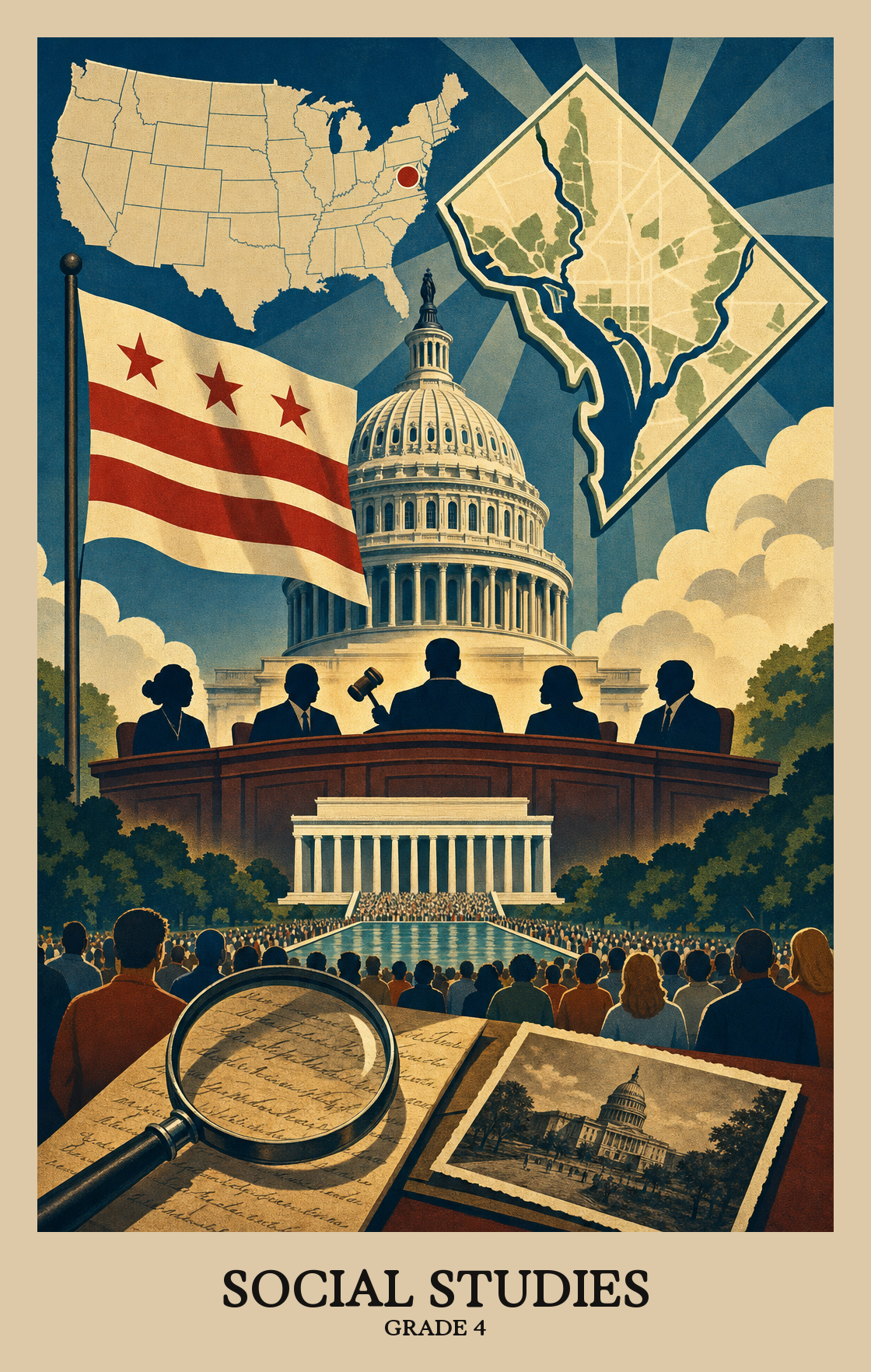
This is the year social studies zooms in on Washington, DC itself and how it fits into the larger country. Students learn how the city is governed, how it differs from a state, and the people and events that shaped it. They read maps, study old photos and documents, and start backing up what they say with evidence. By spring, they can explain who runs DC, point to it on a map, and tell a short story from its past using a real source.
Students start the year learning how to ask good questions about people, places, and events. They practice checking where information comes from and whether a source can be trusted.
Students look at how the city, the state, and the country make decisions and pass laws. They learn what rights citizens have and what it means to take part in a community.
Students see why people cannot have everything they want and how prices and competition shape what gets bought and sold. They also practice basic ideas about saving, spending, and using credit.
Students read maps and photos to study how land shapes the way people live and how people change the land around them. They follow how families and goods move between regions.
Students dig into the history of Washington, DC and its place in the country, from colonial times to today. They also compare turning points from around the world and connect them to life now.
Students pull together what they have learned and write or present an argument backed by real evidence. They weigh different points of view and share what they found with classmates or the wider community.
Students write their own questions about history, government, maps, and money. They practice asking both big "why does this matter" questions and smaller follow-up questions that help dig into the details.
Students pick a real question about communities, money, maps, or the past and use what they know from social studies to investigate it. They draw on more than one subject to build an answer.
Students decide whether a source is trustworthy, then use details from that source to back up what they say. They practice this with firsthand accounts like letters or diaries alongside textbooks and articles.
Students share what they learned from an investigation by writing, speaking, or presenting, then use those findings to do something real, like writing a letter or speaking up about an issue in their school or community.
| Standard | Definition | Code |
|---|---|---|
| Develop Questions | Students write their own questions about history, government, maps, and money. They practice asking both big "why does this matter" questions and smaller follow-up questions that help dig into the details. | DC-SS.INQ.4.1 |
| Apply Disciplinary Tools | Students pick a real question about communities, money, maps, or the past and use what they know from social studies to investigate it. They draw on more than one subject to build an answer. | DC-SS.INQ.4.2 |
| Evaluate Sources and Use Evidence | Students decide whether a source is trustworthy, then use details from that source to back up what they say. They practice this with firsthand accounts like letters or diaries alongside textbooks and articles. | DC-SS.INQ.4.3 |
| Communicate and Take Action | Students share what they learned from an investigation by writing, speaking, or presenting, then use those findings to do something real, like writing a letter or speaking up about an issue in their school or community. | DC-SS.INQ.4.4 |
Students learn how local, state, and federal government bodies are set up and what each one actually does. That includes DC's own government, which handles many of the same jobs a state government would.
Students look at a real law, a historical event, or a news story and explain how core American ideas like shared power, equal rights, and government by the people's consent shaped it.
Students learn what rights citizens have and what responsibilities come with them. They practice the skills that let people take part in how their community and government make decisions.
| Standard | Definition | Code |
|---|---|---|
| Government Institutions | Students learn how local, state, and federal government bodies are set up and what each one actually does. That includes DC's own government, which handles many of the same jobs a state government would. | DC-SS.CIV.4.1 |
| Foundational Principles | Students look at a real law, a historical event, or a news story and explain how core American ideas like shared power, equal rights, and government by the people's consent shaped it. | DC-SS.CIV.4.2 |
| Citizenship and Participation | Students learn what rights citizens have and what responsibilities come with them. They practice the skills that let people take part in how their community and government make decisions. | DC-SS.CIV.4.3 |
Scarcity means there isn't enough of something for everyone who wants it. Students learn how that shortage, along with rewards and consequences, pushes people to make choices about spending, saving, and rules that affect whole communities.
Markets are places where buyers and sellers agree on prices. When lots of sellers compete, prices tend to drop and resources shift toward what people actually want to buy.
Students learn the basics of handling money: why saving matters, how spending choices add up, what it means to borrow money and pay it back, and how investing can grow savings over time.
| Standard | Definition | Code |
|---|---|---|
| Economic Decision Making | Scarcity means there isn't enough of something for everyone who wants it. Students learn how that shortage, along with rewards and consequences, pushes people to make choices about spending, saving, and rules that affect whole communities. | DC-SS.ECON.4.1 |
| Markets and Exchange | Markets are places where buyers and sellers agree on prices. When lots of sellers compete, prices tend to drop and resources shift toward what people actually want to buy. | DC-SS.ECON.4.2 |
| Personal Finance | Students learn the basics of handling money: why saving matters, how spending choices add up, what it means to borrow money and pay it back, and how investing can grow savings over time. | DC-SS.ECON.4.3 |
Students read maps, photos, and data to figure out what a place looks like, how people live there, and how the land shapes daily life.
Students look at how the land, water, and climate around them affect where people build, farm, and travel, and how those same human choices change the environment in return. Both local and global examples count.
Students look at why people moved from one region to another, where they settled, and what goods, ideas, and customs traveled with them.
| Standard | Definition | Code |
|---|---|---|
| Geographic Representations | Students read maps, photos, and data to figure out what a place looks like, how people live there, and how the land shapes daily life. | DC-SS.GEO.4.1 |
| Human-Environment Interaction | Students look at how the land, water, and climate around them affect where people build, farm, and travel, and how those same human choices change the environment in return. Both local and global examples count. | DC-SS.GEO.4.2 |
| Movement and Connections | Students look at why people moved from one region to another, where they settled, and what goods, ideas, and customs traveled with them. | DC-SS.GEO.4.3 |
Students learn about the people, events, and movements that shaped Washington, D.C., and explain how the city's history connects to the rest of the country.
Students follow the through-line of American history, from early colonial settlements to today, noticing what changed over time and what stayed the same across major periods.
Students look at two or more ancient civilizations or major historical events, spot what they had in common or how they differed, and explain how those moments still shape the world today.
Students read firsthand accounts and written histories to build an argument about a past event. They look at the same event through more than one person's eyes before drawing a conclusion.
| Standard | Definition | Code |
|---|---|---|
| District of Columbia History | Students learn about the people, events, and movements that shaped Washington, D.C., and explain how the city's history connects to the rest of the country. | DC-SS.HIST.4.1 |
| United States History | Students follow the through-line of American history, from early colonial settlements to today, noticing what changed over time and what stayed the same across major periods. | DC-SS.HIST.4.2 |
| World History | Students look at two or more ancient civilizations or major historical events, spot what they had in common or how they differed, and explain how those moments still shape the world today. | DC-SS.HIST.4.3 |
| Historical Reasoning | Students read firsthand accounts and written histories to build an argument about a past event. They look at the same event through more than one person's eyes before drawing a conclusion. | DC-SS.HIST.4.4 |
Federally administered sample-based assessment in reading, mathematics, science, and writing. NAEP results inform state-by-state comparisons rather than individual student or school accountability.
Students study how their city government works, how the country was built, how maps and regions shape daily life, and how people earn, spend, and save money. They also look at world history and how past events still shape life today.
Talk about the news at dinner and ask what students think and why. Pull out a map when a place comes up in a book or movie. Walk through how money decisions get made when shopping, like comparing prices or choosing what to save for.
Students should look at a letter, photo, or speech and figure out who made it, when, and why. They should pull a piece of evidence from it to back up a claim, and notice when a source might be one-sided.
Some key people and events matter, but the bigger goal is understanding why things happened and how they connect. A student who can explain how a law gets made or why people moved to a region is in good shape, even if a few dates slip.
Many teachers anchor the year in local history and DC government, then widen out to the nation and the world. Geography and economics work well as lenses you return to inside each history unit, instead of standalone blocks.
Students will write short arguments and explanations that use evidence from a source. A typical piece might answer a question like why a community grew where it did, with two or three pieces of evidence from a map, a reading, or a chart.
Reading a primary source carefully and citing evidence are the stickiest. Students also tend to struggle with separation of powers and with telling the difference between a fact from a source and their own opinion. Plan to revisit these across units.
Point out local government when it shows up, like a city council sign, a voting day, or a news story about a new law. Let students help make small family decisions and talk about who got a say. Visiting a museum or monument in the city counts too.
A ready student can read a short article or source and pull out the main idea, locate a place on a map, and explain a basic economic choice like saving versus spending. They should also be able to ask a good follow-up question about something they read.