Thinking like a scientist
Students start the year learning how scientists work. They ask questions, plan small experiments, and use drawings and charts to show what they notice.
This is the year science shifts from watching the world to testing it. Students ask a question, plan a small experiment, collect data, and explain what the results mean. They study how energy moves, how plants and animals depend on each other, and how Earth's land, water, and weather change over time. By spring, students can run a simple investigation and use the evidence to back up their answer.
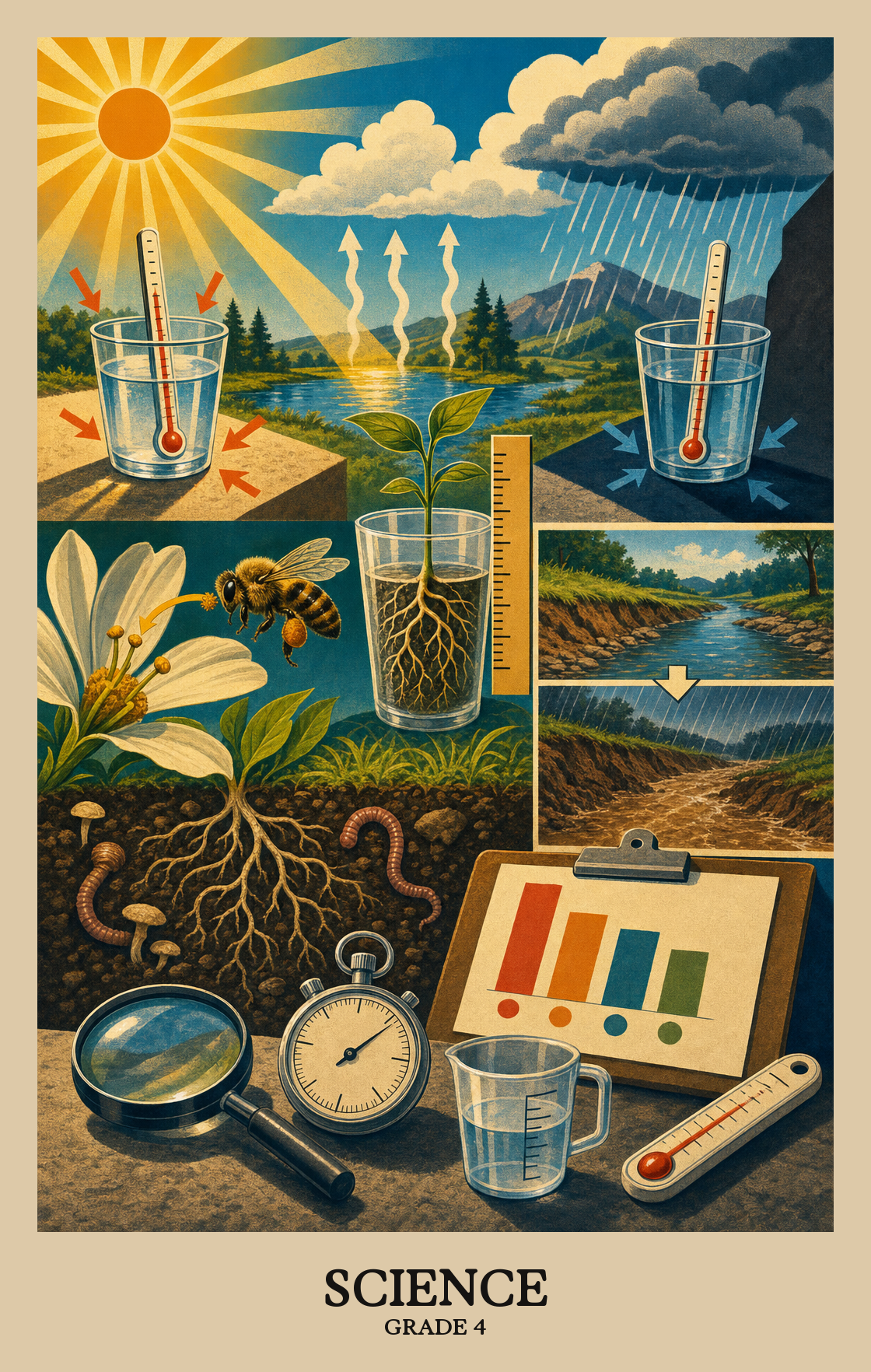
Students start the year learning how scientists work. They ask questions, plan small experiments, and use drawings and charts to show what they notice.
Students explore how things move, speed up, and slow down. They look at energy in everyday objects and how sound and light carry information from one place to another.
Students study how living things are built and how they survive. They follow food from the sun to plants to animals and notice how creatures depend on each other in a habitat.
Students look at rocks, water, air, and the patterns of the sun, moon, and stars. They track how weather changes and how people affect the land and water around them.
Students take on a real problem and try to solve it. They sketch ideas, build a simple model, test it, and improve the design based on what worked and what did not.
Students come up with questions that can be tested with an experiment, or spot a real problem that could be fixed with a design or invention.
Students build or draw a model (a diagram, a sketch, or a physical prototype) to show how something in nature works or how a design is meant to function. The model helps explain what they observed or predict what might happen next.
Students plan a test or experiment, collect real data, and use what they find to check whether their idea holds up.
Reading a chart, table, or graph to spot patterns and explain what the numbers or results actually mean.
Students use numbers, measurements, and simple calculations to support a scientific idea. Instead of just describing what they observe, they back it up with data.
Students use facts from observations or experiments to explain why something happens or to figure out how to solve a problem. The explanation has to be backed by evidence, not just a guess.
Students look at two different explanations or solutions, then use evidence to argue which one holds up better. Think of it as a structured debate where the data does the talking.
Students read science texts, diagrams, and data, then decide what information is accurate and useful. They share what they find through writing, talk, or labeled drawings.
| Standard | Definition | Code |
|---|---|---|
| Asking Questions and Defining Problems | Students come up with questions that can be tested with an experiment, or spot a real problem that could be fixed with a design or invention. | DC-SCI.SEP.4.1 |
| Developing and Using Models | Students build or draw a model (a diagram, a sketch, or a physical prototype) to show how something in nature works or how a design is meant to function. The model helps explain what they observed or predict what might happen next. | DC-SCI.SEP.4.2 |
| Planning and Carrying Out Investigations | Students plan a test or experiment, collect real data, and use what they find to check whether their idea holds up. | DC-SCI.SEP.4.3 |
| Analyzing and Interpreting Data | Reading a chart, table, or graph to spot patterns and explain what the numbers or results actually mean. | DC-SCI.SEP.4.4 |
| Mathematics and Computational Thinking | Students use numbers, measurements, and simple calculations to support a scientific idea. Instead of just describing what they observe, they back it up with data. | DC-SCI.SEP.4.5 |
| Constructing Explanations | Students use facts from observations or experiments to explain why something happens or to figure out how to solve a problem. The explanation has to be backed by evidence, not just a guess. | DC-SCI.SEP.4.6 |
| Engaging in Argument from Evidence | Students look at two different explanations or solutions, then use evidence to argue which one holds up better. Think of it as a structured debate where the data does the talking. | DC-SCI.SEP.4.7 |
| Communicating Information | Students read science texts, diagrams, and data, then decide what information is accurate and useful. They share what they find through writing, talk, or labeled drawings. | DC-SCI.SEP.4.8 |
Students take a close look at what everyday objects are made of and how tiny particles fit together to explain why things behave the way they do.
Students test how pushes and pulls change the speed and direction of objects. They learn why things stay still, slow down, or keep moving when forces act on them.
Students explore how energy moves and changes form, like heat traveling through a metal spoon or light turning into warmth. They learn that energy isn't created or destroyed, just shifted from one place to another.
Students explore how waves move energy from place to place, like sound traveling through air or light bouncing off a mirror. They also look at how waves carry information, the way a phone signal or radio wave does.
| Standard | Definition | Code |
|---|---|---|
| Matter and Interactions | Students take a close look at what everyday objects are made of and how tiny particles fit together to explain why things behave the way they do. | DC-SCI.PS.4.1 |
| Motion and Stability | Students test how pushes and pulls change the speed and direction of objects. They learn why things stay still, slow down, or keep moving when forces act on them. | DC-SCI.PS.4.2 |
| Energy | Students explore how energy moves and changes form, like heat traveling through a metal spoon or light turning into warmth. They learn that energy isn't created or destroyed, just shifted from one place to another. | DC-SCI.PS.4.3 |
| Waves and Information | Students explore how waves move energy from place to place, like sound traveling through air or light bouncing off a mirror. They also look at how waves carry information, the way a phone signal or radio wave does. | DC-SCI.PS.4.4 |
Students explore how living things are built and how they work, from the tiny cells inside them to the larger systems those cells form, like a heart pumping blood or roots pulling water from soil.
Students trace how energy from the sun moves through plants and animals in an ecosystem, and how the same matter gets used and reused. They also look at how living things in one place depend on and affect each other.
Students look at physical traits like eye color or leaf shape and figure out which ones get passed from parents to offspring. Not every offspring looks identical to its parents, and students explore why traits can vary across generations.
Students compare living things to spot patterns in how they are built and how they behave. That work builds toward understanding why species change over generations and why some survive when conditions shift.
| Standard | Definition | Code |
|---|---|---|
| Structures and Processes | Students explore how living things are built and how they work, from the tiny cells inside them to the larger systems those cells form, like a heart pumping blood or roots pulling water from soil. | DC-SCI.LS.4.1 |
| Ecosystems | Students trace how energy from the sun moves through plants and animals in an ecosystem, and how the same matter gets used and reused. They also look at how living things in one place depend on and affect each other. | DC-SCI.LS.4.2 |
| Heredity | Students look at physical traits like eye color or leaf shape and figure out which ones get passed from parents to offspring. Not every offspring looks identical to its parents, and students explore why traits can vary across generations. | DC-SCI.LS.4.3 |
| Biological Evolution | Students compare living things to spot patterns in how they are built and how they behave. That work builds toward understanding why species change over generations and why some survive when conditions shift. | DC-SCI.LS.4.4 |
Students study where Earth sits in the solar system and how the sun, moon, and planets move in patterns we can observe and predict. They also explore how Earth itself has changed over a very long time.
Students learn how Earth's land, water, air, and living things connect and affect each other. They look at how a rainstorm shapes soil, how plants change the air, and how those systems push and pull on one another.
Students explore how people change the land, water, and air around them, and how events like floods, earthquakes, and wildfires affect where and how people live.
| Standard | Definition | Code |
|---|---|---|
| Earth's Place in the Universe | Students study where Earth sits in the solar system and how the sun, moon, and planets move in patterns we can observe and predict. They also explore how Earth itself has changed over a very long time. | DC-SCI.ESS.4.1 |
| Earth's Systems | Students learn how Earth's land, water, air, and living things connect and affect each other. They look at how a rainstorm shapes soil, how plants change the air, and how those systems push and pull on one another. | DC-SCI.ESS.4.2 |
| Earth and Human Activity | Students explore how people change the land, water, and air around them, and how events like floods, earthquakes, and wildfires affect where and how people live. | DC-SCI.ESS.4.3 |
Students identify a real problem, sketch or build possible fixes, then test and improve their design until it works better.
Students explore how inventions shape daily life and how the needs of society push engineers to create new tools. A new technology, like a water filter or a phone, can change how people live, work, and solve problems.
| Standard | Definition | Code |
|---|---|---|
| Engineering Design | Students identify a real problem, sketch or build possible fixes, then test and improve their design until it works better. | DC-SCI.ETS.4.1 |
| Links Among Engineering, Technology, and Society | Students explore how inventions shape daily life and how the needs of society push engineers to create new tools. A new technology, like a water filter or a phone, can change how people live, work, and solve problems. | DC-SCI.ETS.4.2 |
Alternate assessment for students with the most significant cognitive disabilities, given in grades 3-8 and high school in ELA, math, and science.
Federally administered sample-based assessment in reading, mathematics, science, and writing. NAEP results inform state-by-state comparisons rather than individual student or school accountability.
Students study matter and motion, energy and waves, plants and animals, Earth and space, and a bit of engineering design. The big shift is doing science, not just reading about it. Students ask questions, run small tests, look at the results, and explain what they found.
Ask why questions during normal life. Why do ice cubes melt faster in water than on the counter? Why does the moon look different tonight? Then let students guess, try something, and talk about what happened. Cooking, gardening, and weather watching all count.
Some words matter, like energy, force, cell, and ecosystem. But knowing the word is not the goal. Students should be able to explain what is happening in their own words and back it up with something they saw or read.
Most teachers anchor each unit in a phenomenon students can observe, then bring in the content as students try to explain it. A common order is physical science first, then life science, then Earth and space, with engineering design woven through. Practices build all year.
Energy transfer, the difference between weather and climate, and how traits pass from parents to offspring tend to slip. Students also struggle to separate evidence from opinion when arguing for an explanation. Plan to revisit these through short writing tasks and quick discussions across units.
A science notebook is where students sketch what they see, record data, and write explanations. It gives students a place to think on paper and gives teachers evidence of reasoning over time. At home, a cheap composition book works fine for backyard observations.
Most weeks should include at least one investigation where students collect data, even if it is short and uses simple materials like cups, magnets, seeds, or flashlights. Reading and video have a place, but students learn the practices by doing them.
Students should be able to plan a simple test, record results in a table or chart, and explain a pattern using evidence. They should also be comfortable revising an idea when the data does not match. Confidence with the process matters more than any single topic.