Place value and big numbers
Students read, write, and compare numbers up to a million. They round to a chosen place and use that skill to estimate sums and differences before solving the full problem.
This is the year math stretches into bigger numbers and fractions students can actually reason about. Students work with numbers in the thousands, learn the long versions of multiplication and division, and start comparing fractions like 3/4 and 5/8 instead of just naming them. They also measure angles and read charts that show real information. By spring, they can multiply a two-digit number by a two-digit number on paper and explain why two fractions are equal.
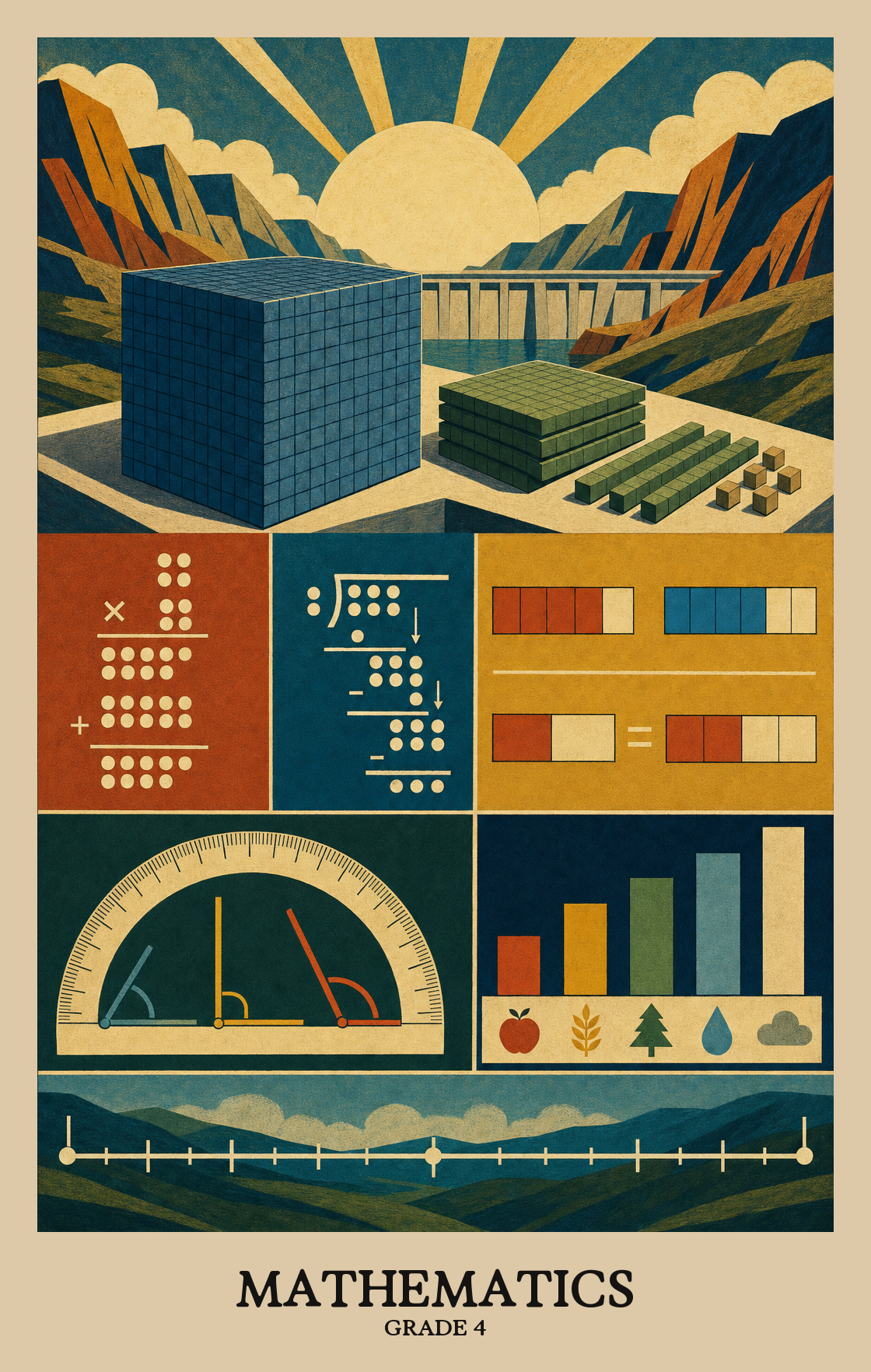
Students read, write, and compare numbers up to a million. They round to a chosen place and use that skill to estimate sums and differences before solving the full problem.
Students multiply larger numbers by one and two digits and divide with remainders. Word problems push them to decide which operation fits and to check whether the answer makes sense.
Students compare fractions, find equivalent ones, and add and subtract fractions with the same bottom number. They also start multiplying a fraction by a whole number using pictures and number lines.
Students connect fractions like tenths and hundredths to decimals such as 0.7 and 0.25. They convert between units like meters and centimeters and solve problems about length, weight, time, and money.
Students measure angles with a protractor, sort shapes by their sides and angles, and find lines of symmetry. They also read line plots that show measurements in fractions of an inch.
Students read a math problem carefully, figure out what it's actually asking, and keep trying even when the first approach doesn't work.
Students take a real situation (sharing pizza, counting coins) and turn it into numbers and symbols to solve it, then translate the answer back into plain language that fits the original problem.
Students explain why their math answer is correct and listen to how classmates solved the same problem. They spot mistakes in someone else's reasoning and explain what went wrong.
Students use math to make sense of real situations, like figuring out how much something costs or how long a trip will take. They draw pictures, write equations, or build charts to show their thinking.
Students choose the right tool for the math in front of them. That might mean reaching for a calculator, sketching it out on paper, or making a quick estimate to check whether an answer makes sense.
Students use exact words, labels, and careful calculations when explaining their math work. That means writing the unit (inches, dollars, minutes) and choosing the right math term instead of a vague one.
Students look for patterns and rules hiding inside a math problem, like noticing that all even numbers end the same way, then use that pattern to solve problems faster.
When something works the same way every time, students notice that pattern and use it as a shortcut. Spotting those shortcuts is the start of real mathematical thinking.
| Standard | Definition | Code |
|---|---|---|
| Make Sense of Problems | Students read a math problem carefully, figure out what it's actually asking, and keep trying even when the first approach doesn't work. | DC-MATH.MP.4.1 |
| Reason Abstractly | Students take a real situation (sharing pizza, counting coins) and turn it into numbers and symbols to solve it, then translate the answer back into plain language that fits the original problem. | DC-MATH.MP.4.2 |
| Construct Arguments | Students explain why their math answer is correct and listen to how classmates solved the same problem. They spot mistakes in someone else's reasoning and explain what went wrong. | DC-MATH.MP.4.3 |
| Model with Mathematics | Students use math to make sense of real situations, like figuring out how much something costs or how long a trip will take. They draw pictures, write equations, or build charts to show their thinking. | DC-MATH.MP.4.4 |
| Use Tools Strategically | Students choose the right tool for the math in front of them. That might mean reaching for a calculator, sketching it out on paper, or making a quick estimate to check whether an answer makes sense. | DC-MATH.MP.4.5 |
| Attend to Precision | Students use exact words, labels, and careful calculations when explaining their math work. That means writing the unit (inches, dollars, minutes) and choosing the right math term instead of a vague one. | DC-MATH.MP.4.6 |
| Use Structure | Students look for patterns and rules hiding inside a math problem, like noticing that all even numbers end the same way, then use that pattern to solve problems faster. | DC-MATH.MP.4.7 |
| Express Regularity | When something works the same way every time, students notice that pattern and use it as a shortcut. Spotting those shortcuts is the start of real mathematical thinking. | DC-MATH.MP.4.8 |
Grade 4 number work covers whole numbers, fractions, and basic rational numbers. Students read, compare, and reason about these numbers, building the foundation for multiplication, division, and fraction operations later in the year.
Students use addition, subtraction, multiplication, and division to solve word problems and write number sentences that show how the pieces of a problem fit together.
Reading a bar graph, a line plot, or a table and making sense of what the numbers say. Students also create their own graphs to show data they collect.
Students sort, describe, and measure flat shapes (like squares and triangles) and solid shapes (like cubes and cones). They use what they know about sides, angles, and faces to explain how shapes are alike or different.
Students use ratio reasoning to solve everyday problems, like figuring out how many supplies are needed for a group or how two quantities compare. This is an introduction to that kind of proportional thinking at the fourth-grade level.
| Standard | Definition | Code |
|---|---|---|
| Counting and Number | Grade 4 number work covers whole numbers, fractions, and basic rational numbers. Students read, compare, and reason about these numbers, building the foundation for multiplication, division, and fraction operations later in the year. | DC-MATH.K8.4.1 |
| Operations and Algebraic Thinking | Students use addition, subtraction, multiplication, and division to solve word problems and write number sentences that show how the pieces of a problem fit together. | DC-MATH.K8.4.2 |
| Measurement and Data | Reading a bar graph, a line plot, or a table and making sense of what the numbers say. Students also create their own graphs to show data they collect. | DC-MATH.K8.4.3 |
| Geometry | Students sort, describe, and measure flat shapes (like squares and triangles) and solid shapes (like cubes and cones). They use what they know about sides, angles, and faces to explain how shapes are alike or different. | DC-MATH.K8.4.4 |
| Ratios and Proportional Relationships | Students use ratio reasoning to solve everyday problems, like figuring out how many supplies are needed for a group or how two quantities compare. This is an introduction to that kind of proportional thinking at the fourth-grade level. | DC-MATH.K8.4.5 |
DC's spring summative math test for grades 3 through 8, aligned to DC's Common Core-based math standards.
Alternate assessment for students with the most significant cognitive disabilities, given in grades 3-8 and high school in ELA, math, and science.
Federally administered sample-based assessment in reading, mathematics, science, and writing. NAEP results inform state-by-state comparisons rather than individual student or school accountability.
Students work with larger whole numbers, multi-digit multiplication, and long division. They compare fractions, add and subtract fractions with the same bottom number, and start working with decimals to the hundredths. They also measure, read graphs, and study shapes and angles.
Quick practice with times tables makes the rest of the year much easier. Five minutes a few nights a week with flash cards or a quick quiz in the car goes a long way. Once the basic facts are quick, multiplying bigger numbers feels less heavy.
Ask students to read the problem twice and then say it back in their own words before picking numbers. Drawing a quick picture or bar helps a lot. The goal is to slow down and understand the question, not to race to an answer.
Most teachers start with place value and multi-digit operations, since fractions and measurement lean on that fluency. Fractions usually come mid-year, with decimals and measurement after. Geometry and angle work fit well near the end, when students can handle more precise tools.
Long division and fraction comparison are the two big ones. Students often guess at division steps without understanding place value, and they treat fractions like whole numbers when comparing them. Plan extra time and small-group work for both.
Yes. Fluency with facts up to 10 by 10 is the single biggest predictor of a smooth year. Without it, multi-digit multiplication and long division become slow and full of small errors.
By spring, students should multiply and divide multi-digit numbers, compare fractions with different bottom numbers, and solve multi-step word problems with the four operations. They should also measure with a ruler and protractor and explain their thinking in a sentence or two.
Cooking and pizza work well. Ask students to double a recipe, cut something into sixths, or figure out how many quarter cups make a full cup. Real objects make fractions feel concrete instead of abstract.