Mapping the world around us
Students start the year by reading maps and globes to describe where places are and what makes them different. They look at how mountains, rivers, and climate shape where people settle and how they live.
Sixth grade is the year social studies starts asking why, not just what. Students dig into how government actually works, why prices go up, how maps tell a story about people, and how one event in history sets off the next. They start backing up answers with evidence from real sources instead of just remembering facts. By spring, students can read a primary source and explain what it shows about the people who wrote it.
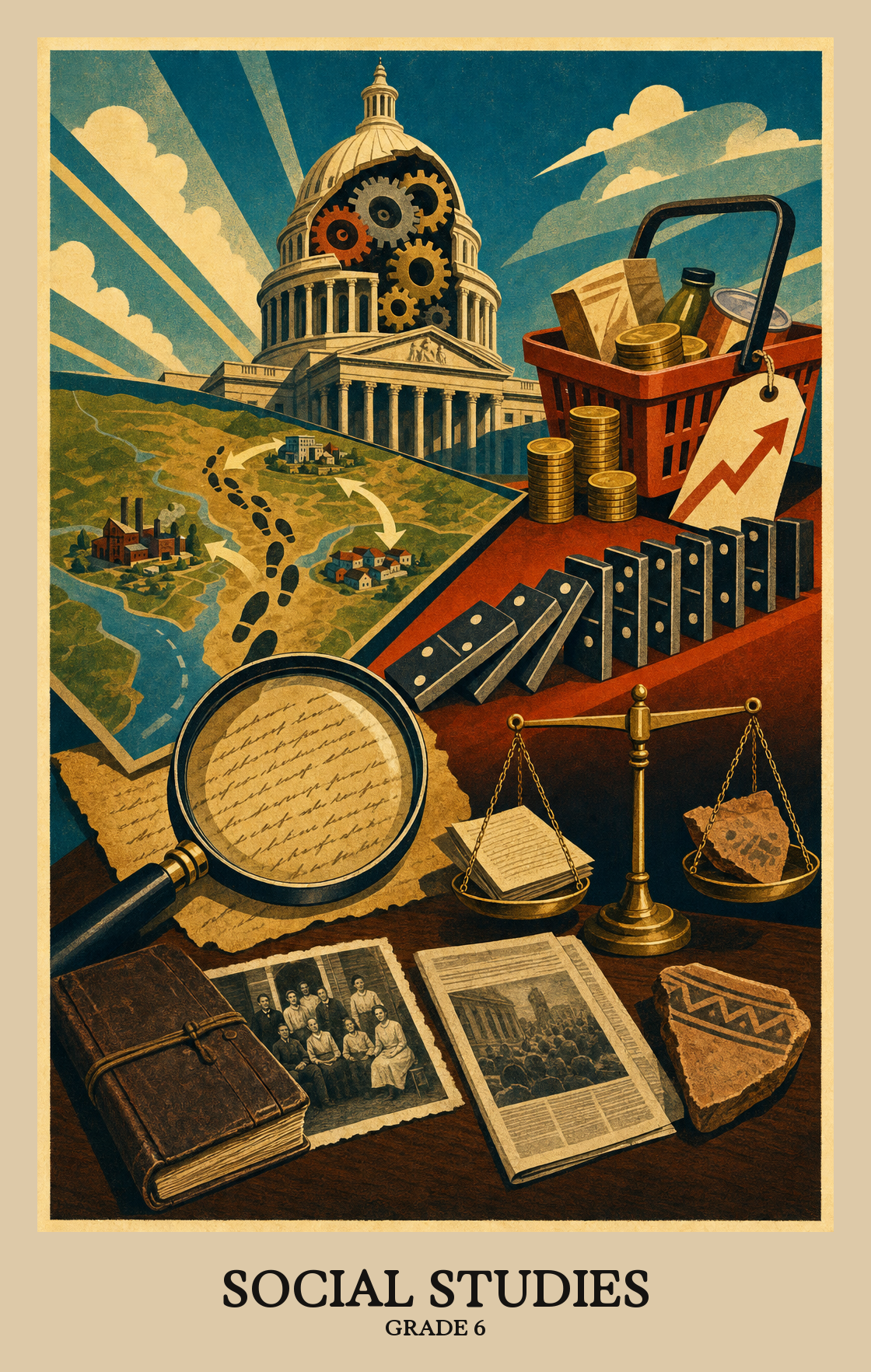
Students start the year by reading maps and globes to describe where places are and what makes them different. They look at how mountains, rivers, and climate shape where people settle and how they live.
Students study how people change the land around them by farming, building cities, and using natural resources. They also look at how the environment pushes back through floods, droughts, and other events that shape daily life.
Students learn how power is split between local, state, and national governments and across the three branches. They read parts of founding documents and talk about the rights and duties that come with being a citizen.
Students look at why people cannot have everything they want and how that shapes the choices families, businesses, and governments make. They compare different ways countries run their economies and start building basic money skills.
Students work with old letters, photos, and other primary sources to piece together what happened in the past. They practice spotting cause and effect and noticing how the same event can look different depending on who tells the story.
Students pull the year together by studying key events in Delaware, United States, and world history. They trace how choices made long ago still shape the places, governments, and economies students live with today.
Students learn how government is organized and why it exists, including how power is split between the President, Congress, and courts, and why some decisions happen at the national level while others are handled by states or towns.
Students read the Declaration of Independence, the Constitution, and other founding documents to find the core ideas behind American government, like liberty, equality, and self-rule, and explain where those ideas show up in the text.
Citizens in a democracy have rights the government must protect and responsibilities they are expected to meet. Students examine what those rights look like in practice and what citizens owe their community in return.
Students practice the skills that make participation in community life real: listening, speaking up, and working with others to address local issues.
| Standard | Definition | Code |
|---|---|---|
| Government | Students learn how government is organized and why it exists, including how power is split between the President, Congress, and courts, and why some decisions happen at the national level while others are handled by states or towns. | DE-SS.CIV.6.1 |
| Politics | Students read the Declaration of Independence, the Constitution, and other founding documents to find the core ideas behind American government, like liberty, equality, and self-rule, and explain where those ideas show up in the text. | DE-SS.CIV.6.2 |
| Citizenship | Citizens in a democracy have rights the government must protect and responsibilities they are expected to meet. Students examine what those rights look like in practice and what citizens owe their community in return. | DE-SS.CIV.6.3 |
| Participation | Students practice the skills that make participation in community life real: listening, speaking up, and working with others to address local issues. | DE-SS.CIV.6.4 |
When something is scarce, people can't have everything they want, so every choice has a trade-off. Students look at real buying and saving decisions to weigh what a choice costs against what it gains.
In a market economy, prices and incentives push people, businesses, and governments to make different choices. Students look at how those forces interact and how government policy can shift what gets bought, sold, or produced.
Students look at how different societies decide who makes goods, who owns them, and who sets prices. They also explain what causes those rules to shift over time.
Students learn how to manage money (budgeting, saving, spending) and explore how families, local businesses, and countries depend on each other to get the goods and services they need.
| Standard | Definition | Code |
|---|---|---|
| Microeconomics | When something is scarce, people can't have everything they want, so every choice has a trade-off. Students look at real buying and saving decisions to weigh what a choice costs against what it gains. | DE-SS.ECON.6.1 |
| Macroeconomics | In a market economy, prices and incentives push people, businesses, and governments to make different choices. Students look at how those forces interact and how government policy can shift what gets bought, sold, or produced. | DE-SS.ECON.6.2 |
| Economic Systems | Students look at how different societies decide who makes goods, who owns them, and who sets prices. They also explain what causes those rules to shift over time. | DE-SS.ECON.6.3 |
| Personal Finance and Interdependence | Students learn how to manage money (budgeting, saving, spending) and explore how families, local businesses, and countries depend on each other to get the goods and services they need. | DE-SS.ECON.6.4 |
Students build a mental map of the world and use physical maps, charts, and other tools to explore how places are connected and what makes a region distinct.
Students look at how people change the land, water, and air around them, and what happens to communities and wildlife as a result. They also examine how people adapt when nature pushes back.
Students compare how different communities around the world live, including their customs, languages, and beliefs, and look at what makes each place distinct.
Regions are areas that share something in common, like climate, language, or how land is used. Students learn how regions connect to each other and how those connections look different depending on whether you zoom in on a neighborhood or out to the whole world.
| Standard | Definition | Code |
|---|---|---|
| Maps and Mental Maps | Students build a mental map of the world and use physical maps, charts, and other tools to explore how places are connected and what makes a region distinct. | DE-SS.GEO.6.1 |
| Environment | Students look at how people change the land, water, and air around them, and what happens to communities and wildlife as a result. They also examine how people adapt when nature pushes back. | DE-SS.GEO.6.2 |
| Places and Cultures | Students compare how different communities around the world live, including their customs, languages, and beliefs, and look at what makes each place distinct. | DE-SS.GEO.6.3 |
| Regions | Regions are areas that share something in common, like climate, language, or how land is used. Students learn how regions connect to each other and how those connections look different depending on whether you zoom in on a neighborhood or out to the whole world. | DE-SS.GEO.6.4 |
Students look at events across time to figure out what caused them, what changed, and what stayed the same. It's the habit of asking "why did that happen?" and "what came next?"
Students find and compare original sources (like letters or photos) alongside textbooks or articles written later, then use both to figure out what actually happened in the past.
Students look at historical evidence and explain how the people involved, and who is telling the story, can change what we think happened and why.
Students build a working knowledge of major events in Delaware, U.S., and world history. This means knowing not just what happened, but when and why it mattered.
| Standard | Definition | Code |
|---|---|---|
| Chronology | Students look at events across time to figure out what caused them, what changed, and what stayed the same. It's the habit of asking "why did that happen?" and "what came next?" | DE-SS.HIST.6.1 |
| Analysis | Students find and compare original sources (like letters or photos) alongside textbooks or articles written later, then use both to figure out what actually happened in the past. | DE-SS.HIST.6.2 |
| Interpretation | Students look at historical evidence and explain how the people involved, and who is telling the story, can change what we think happened and why. | DE-SS.HIST.6.3 |
| Content | Students build a working knowledge of major events in Delaware, U.S., and world history. This means knowing not just what happened, but when and why it mattered. | DE-SS.HIST.6.4 |
Federally administered sample-based assessment in reading, mathematics, science, and writing. NAEP results inform state-by-state comparisons rather than individual student or school accountability.
Students study four big areas this year: how government works, how money and trade work, how places and people connect on maps, and how the past shapes today. Expect a mix of current events, map work, and reading about people from long ago and right now.
Talk about the news at dinner. Ask why a price went up, why a law was passed, or why a place looks the way it does on the map. Five minutes of real conversation does more than a worksheet, because students start to see social studies in everyday life.
Pick one topic they care about, like sports, food, or video games, and trace it back. Where is it made? Who decided the rules? What did it look like a hundred years ago? Curiosity grows when the subject feels personal.
Most teachers anchor the year in history and weave civics, economics, and geography into each unit. A unit on early civilizations, for example, can hit geography through maps, economics through trade, and civics through early laws. Teaching the strands together saves time and helps students see the connections.
Reading primary sources and spotting point of view. Sixth graders can summarize a document but often miss who wrote it and why. Build in short, repeated practice with one source at a time rather than long packets.
By spring, students should be able to read a short primary source, explain a basic cause and effect in history, locate major regions on a map, and describe how a government decision affects everyday life. They should also handle a simple budget question with trade-offs.
Ask a few questions: Can they name the three branches of government and what each does? Can they find continents and major countries on a map? Can they explain why people had to make a hard choice in a story from history? If yes, they are in good shape.
Some, but not as many as you might remember from school. The focus has shifted to understanding why events happened and how they connect. Help students explain a story in their own words rather than drilling flashcards.
Plan for short written responses tied to evidence, not long research papers every unit. A strong sixth grade response answers a question, points to one or two details from a source, and explains what those details show. Build that habit early and reuse it all year.