Thinking and working like scientists
Students start the year learning how scientists and engineers actually work. They ask testable questions, plan experiments, collect data, and back up their claims with evidence instead of guesses.
Middle school is when science shifts from observing the world to explaining how it works. Students dig into atoms, forces, cells, ecosystems, and the way Earth moves through space, building real explanations from evidence instead of memorizing facts. Students also start thinking like engineers, designing solutions and testing what fails. By spring, a student can look at something like a thunderstorm or a food web and explain what is happening using evidence.
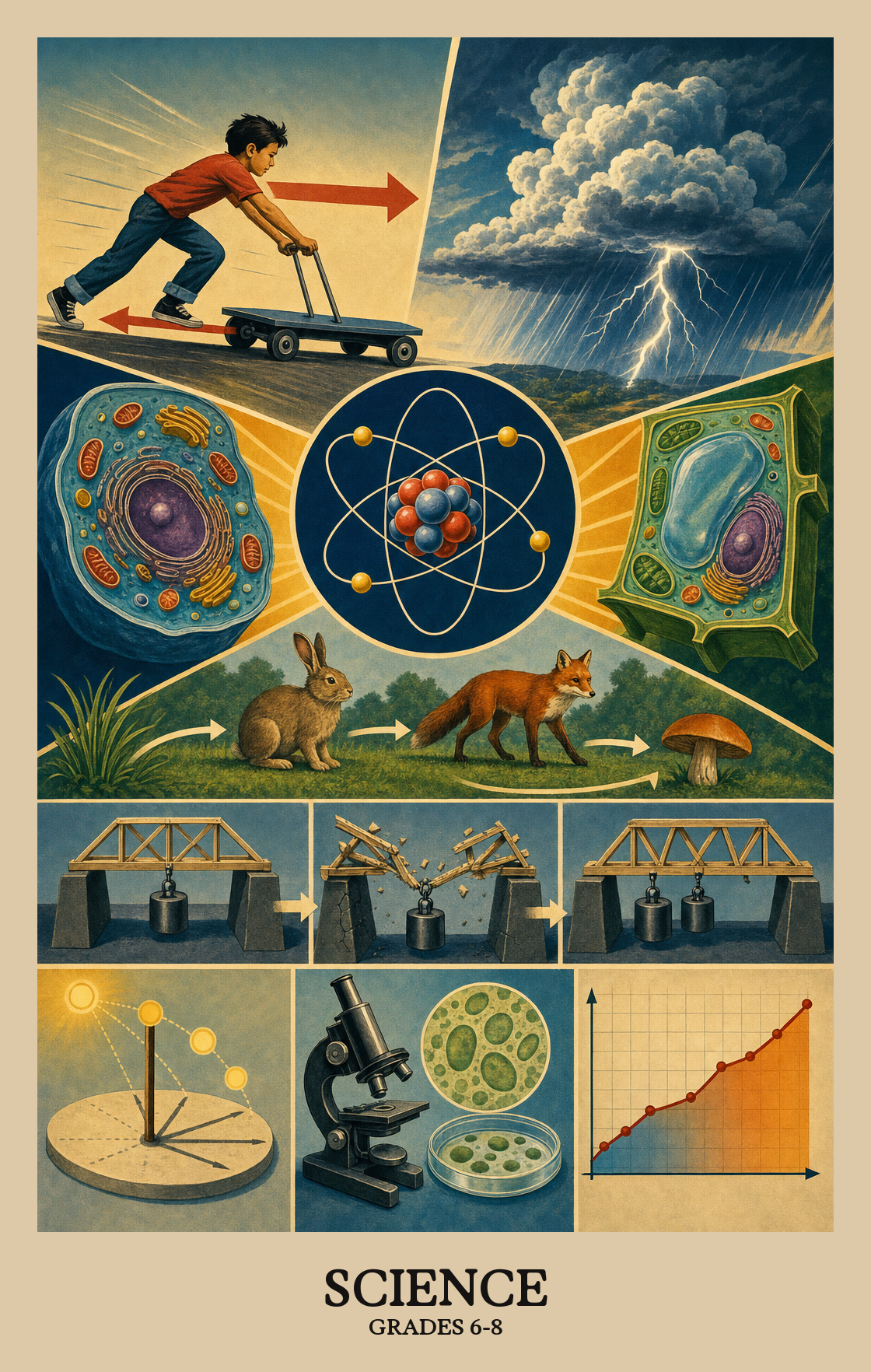
Students start the year learning how scientists and engineers actually work. They ask testable questions, plan experiments, collect data, and back up their claims with evidence instead of guesses.
Students dig into the physical world. They study what things are made of at the atomic level, how forces move objects, and how energy shifts from one form to another, including light, sound, and other waves.
Students explore living things from the inside out. They look at how cells and body systems keep an organism alive, how food and energy move through an ecosystem, and how traits pass from parents to offspring.
Students study why living things look so different from each other and yet share so much in common. They learn how species change over long stretches of time and how fossils and DNA tell that story.
Students zoom out to Earth and beyond. They look at the solar system, how Earth's land, water, and air interact, and how human choices and natural hazards shape the planet people live on.
Students close the year as engineers. They define a real problem, sketch possible solutions, build and test a prototype, and improve the design based on what the data shows.
Students learn to frame a question so it can actually be tested with data or an experiment, and to describe a problem clearly enough that an engineer could try to solve it.
Students build diagrams, physical models, or simulations to show how something in nature works or how an engineered system is put together. The model helps explain a pattern or predict what will happen next.
Students design a test, collect data, and use what they find to check whether an idea holds up. This is how scientists figure out if an explanation is actually supported by evidence.
Students look at collected data to spot patterns and figure out what those patterns mean. This might mean comparing numbers in a table, reading a graph, or noticing a trend across multiple experiments.
Students apply math and computer-based tools to answer science questions, like using equations to model how fast a chemical reaction happens or writing a program to spot a pattern in climate data.
Students build written explanations for science phenomena by pulling in real evidence and connecting it to scientific principles. They aren't guessing; every claim has to be backed by data or observation.
Students look at two or more competing scientific explanations or design solutions, then use data and evidence to argue which one holds up better.
Students read science articles and data, judge how reliable the sources are, and share what they find in writing, diagrams, or presentations.
| Standard | Definition | Code |
|---|---|---|
| Asking Questions and Defining Problems Grades 6-8 | Students learn to frame a question so it can actually be tested with data or an experiment, and to describe a problem clearly enough that an engineer could try to solve it. | DE-SCI.SEP.6-8.1 |
| Developing and Using Models Grades 6-8 | Students build diagrams, physical models, or simulations to show how something in nature works or how an engineered system is put together. The model helps explain a pattern or predict what will happen next. | DE-SCI.SEP.6-8.2 |
| Planning and Carrying Out Investigations Grades 6-8 | Students design a test, collect data, and use what they find to check whether an idea holds up. This is how scientists figure out if an explanation is actually supported by evidence. | DE-SCI.SEP.6-8.3 |
| Analyzing and Interpreting Data Grades 6-8 | Students look at collected data to spot patterns and figure out what those patterns mean. This might mean comparing numbers in a table, reading a graph, or noticing a trend across multiple experiments. | DE-SCI.SEP.6-8.4 |
| Mathematics and Computational Thinking Grades 6-8 | Students apply math and computer-based tools to answer science questions, like using equations to model how fast a chemical reaction happens or writing a program to spot a pattern in climate data. | DE-SCI.SEP.6-8.5 |
| Constructing Explanations Grades 6-8 | Students build written explanations for science phenomena by pulling in real evidence and connecting it to scientific principles. They aren't guessing; every claim has to be backed by data or observation. | DE-SCI.SEP.6-8.6 |
| Engaging in Argument from Evidence Grades 6-8 | Students look at two or more competing scientific explanations or design solutions, then use data and evidence to argue which one holds up better. | DE-SCI.SEP.6-8.7 |
| Communicating Information Grades 6-8 | Students read science articles and data, judge how reliable the sources are, and share what they find in writing, diagrams, or presentations. | DE-SCI.SEP.6-8.8 |
Students examine what atoms and molecules are made of and how they interact. That work explains everyday physical events, like why some materials dissolve, conduct heat, or change state.
Students study why objects speed up, slow down, or stay still by learning Newton's laws. They apply rules about force and motion to predict what happens when objects push, pull, or collide.
Students explore how energy changes form (like motion turning into heat) and moves from one object to another, while the total amount of energy in a closed system stays the same.
Students study how waves carry energy and information from one place to another. They look at real examples like sound, light, and radio signals to understand how waves work and what they make possible.
| Standard | Definition | Code |
|---|---|---|
| Matter and Interactions Grades 6-8 | Students examine what atoms and molecules are made of and how they interact. That work explains everyday physical events, like why some materials dissolve, conduct heat, or change state. | DE-SCI.PS.6-8.1 |
| Motion and Stability Grades 6-8 | Students study why objects speed up, slow down, or stay still by learning Newton's laws. They apply rules about force and motion to predict what happens when objects push, pull, or collide. | DE-SCI.PS.6-8.2 |
| Energy Grades 6-8 | Students explore how energy changes form (like motion turning into heat) and moves from one object to another, while the total amount of energy in a closed system stays the same. | DE-SCI.PS.6-8.3 |
| Waves and Information Grades 6-8 | Students study how waves carry energy and information from one place to another. They look at real examples like sound, light, and radio signals to understand how waves work and what they make possible. | DE-SCI.PS.6-8.4 |
Students examine how living things are built and how they work, from the tiny cells inside a leaf or muscle all the way up to full body systems like digestion or circulation.
Students trace how energy from the sun and nutrients from soil and water move through living things in an ecosystem. They also study how animals, plants, and other organisms depend on or compete with each other to survive.
Students examine how traits like eye color or height pass from parents to offspring, and why siblings can look different from each other even when they share the same parents.
Students study how living things are both remarkably similar and wildly different, then learn how those differences build up over generations through natural selection and other forces that drive evolution.
| Standard | Definition | Code |
|---|---|---|
| Structures and Processes Grades 6-8 | Students examine how living things are built and how they work, from the tiny cells inside a leaf or muscle all the way up to full body systems like digestion or circulation. | DE-SCI.LS.6-8.1 |
| Ecosystems Grades 6-8 | Students trace how energy from the sun and nutrients from soil and water move through living things in an ecosystem. They also study how animals, plants, and other organisms depend on or compete with each other to survive. | DE-SCI.LS.6-8.2 |
| Heredity Grades 6-8 | Students examine how traits like eye color or height pass from parents to offspring, and why siblings can look different from each other even when they share the same parents. | DE-SCI.LS.6-8.3 |
| Biological Evolution Grades 6-8 | Students study how living things are both remarkably similar and wildly different, then learn how those differences build up over generations through natural selection and other forces that drive evolution. | DE-SCI.LS.6-8.4 |
Students study where Earth sits in the solar system and how the planets move in predictable patterns. They also look at evidence that explains how Earth formed and changed over billions of years.
Students examine how Earth's major systems (land, water, air, and living things) work and affect each other. A volcanic eruption, a rainstorm, or a dying forest are all examples of these systems pushing and pulling on one another.
Students examine how things like farming, cities, and energy use change the land, water, and air around them, and how floods, earthquakes, and other natural events put communities at risk.
| Standard | Definition | Code |
|---|---|---|
| Earth's Place in the Universe Grades 6-8 | Students study where Earth sits in the solar system and how the planets move in predictable patterns. They also look at evidence that explains how Earth formed and changed over billions of years. | DE-SCI.ESS.6-8.1 |
| Earth's Systems Grades 6-8 | Students examine how Earth's major systems (land, water, air, and living things) work and affect each other. A volcanic eruption, a rainstorm, or a dying forest are all examples of these systems pushing and pulling on one another. | DE-SCI.ESS.6-8.2 |
| Earth and Human Activity Grades 6-8 | Students examine how things like farming, cities, and energy use change the land, water, and air around them, and how floods, earthquakes, and other natural events put communities at risk. | DE-SCI.ESS.6-8.3 |
Students identify a real problem, sketch or build possible solutions, then test each one and improve the design based on what they learn. The goal is to end up with something that works better than the first attempt.
New tools change how people live, and how people live shapes what engineers build next. Students explore the back-and-forth between technology and society, looking at real examples of each pushing the other forward.
| Standard | Definition | Code |
|---|---|---|
| Engineering Design Grades 6-8 | Students identify a real problem, sketch or build possible solutions, then test each one and improve the design based on what they learn. The goal is to end up with something that works better than the first attempt. | DE-SCI.ETS.6-8.1 |
| Links Among Engineering, Technology, and Society Grades 6-8 | New tools change how people live, and how people live shapes what engineers build next. Students explore the back-and-forth between technology and society, looking at real examples of each pushing the other forward. | DE-SCI.ETS.6-8.2 |
Computer-based science assessment in grade 8, aligned to the NGSS-based Delaware Science Standards.
Federally administered sample-based assessment in reading, mathematics, science, and writing. NAEP results inform state-by-state comparisons rather than individual student or school accountability.
Students study four big areas: physical science (matter, forces, energy, and waves), life science (cells, ecosystems, genetics, and evolution), Earth and space science (the solar system, Earth's systems, and human impact), and engineering design. They also build science habits like asking questions, running experiments, and arguing from evidence.
Ask students to explain what they learned in their own words, and ask follow-up questions like "how do you know?" or "what would happen if we changed this?" Cooking, gardening, watching the weather, and fixing things around the house all count as science practice.
Students should be able to plan a fair test, collect and graph data, and explain a result using evidence and a scientific idea. They should also be able to read a science article, pull out the main claim, and judge whether the evidence backs it up.
Most schools spread physical, life, and Earth science across sixth, seventh, and eighth grade, with engineering design woven through each year. Pick an anchor phenomenon for each unit and return to the same science practices (modeling, investigation, argument) so skills build even as the content changes.
Graphing and interpreting data, writing a clear claim backed by evidence, and telling the difference between correlation and cause. Plan to revisit these in every unit rather than treating them as one-time lessons.
Vocabulary matters, but the real work is using ideas to explain how something happens. If students can describe why ice melts, why a plant wilts, or why the moon changes shape, they understand the science behind the words.
Students should investigate something firsthand in most units, even if the materials are simple like ramps, seeds, magnets, or thermometers. The investigation does not need to be elaborate; it needs to produce data students can analyze and argue about.
A ready student can design a simple experiment, read a graph, and back up an answer with evidence instead of a guess. If reading and math are also on track, high school biology or physical science should be a reasonable next step.