Ratios and rates
Students start the year comparing amounts using ratios, like 3 cups of flour for every 2 cups of sugar. They use these comparisons to find unit prices, speeds, and percents in everyday situations.
This is the year math stops being about plain numbers and starts being about how numbers compare. Students learn to think in ratios and rates, so they can answer questions like how much per ounce or how fast per hour. They also start working with negative numbers on a number line and writing short equations with a letter standing in for an unknown. By spring, students can solve a real shopping or recipe problem using a ratio and explain their thinking.
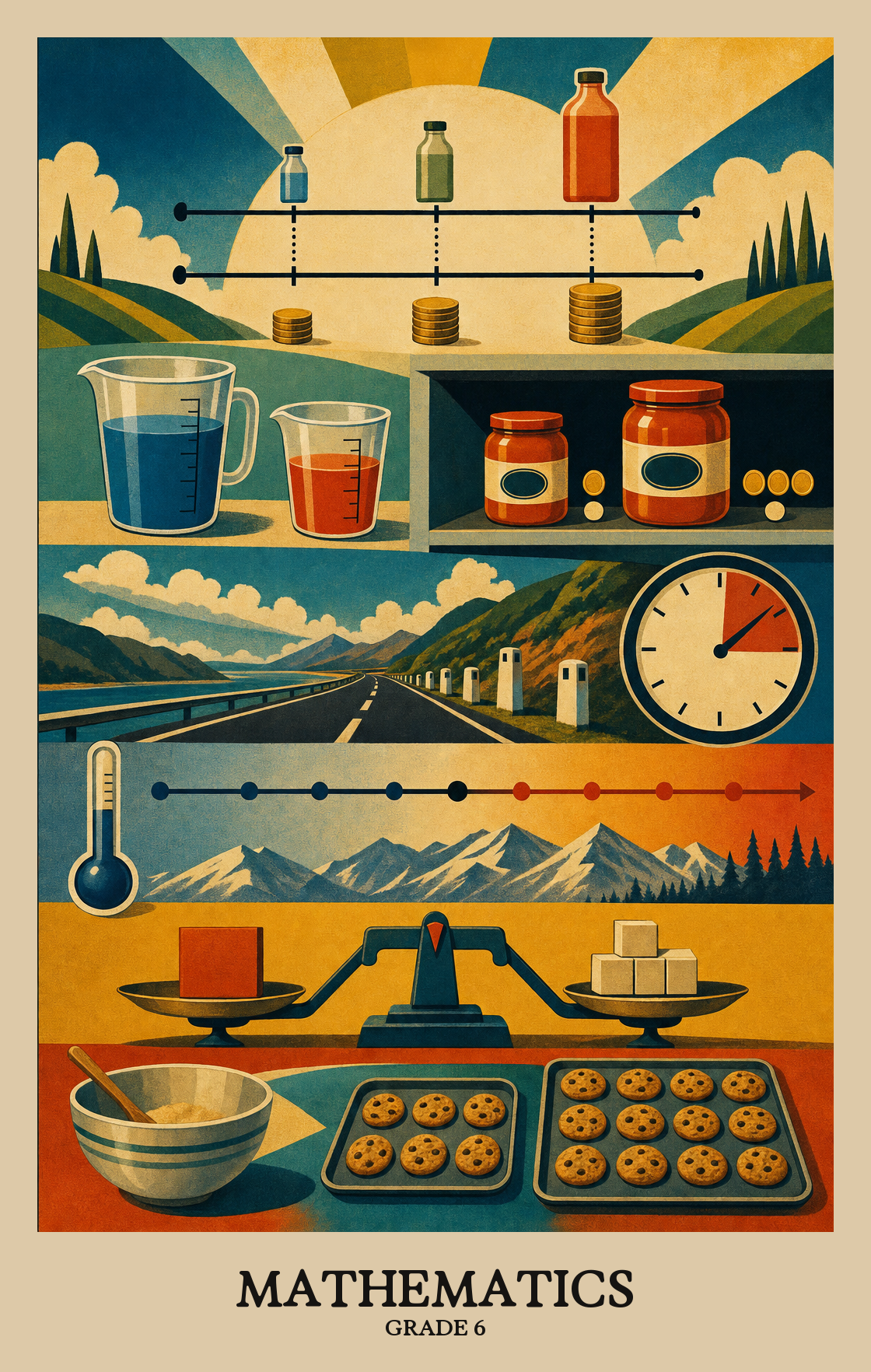
Students start the year comparing amounts using ratios, like 3 cups of flour for every 2 cups of sugar. They use these comparisons to find unit prices, speeds, and percents in everyday situations.
Students learn how to divide a fraction by a fraction and work fluently with decimals. They figure out questions like how many half-cup servings fit in a bag of rice.
Students extend the number line below zero to handle temperatures, elevations, and bank balances. They plot points on a full coordinate grid and compare positive and negative values.
Students start using letters to stand in for unknown numbers. They write and solve simple equations and learn to read expressions like 3x + 4 as a recipe with steps.
Students find the area of triangles and other shapes by cutting them into familiar pieces. They also measure the surface and volume of boxes and prisms using nets and cubes.
Students close the year by collecting data and describing what it shows. They build dot plots, histograms, and box plots, and learn when the average or the middle value tells a better story.
Students read a problem carefully, figure out what it's actually asking, and keep trying even when the first approach doesn't work.
Students take a real situation (like splitting a lunch bill) and turn it into numbers and symbols to solve it, then translate the answer back into plain language that makes sense in context.
Students explain why their math answer is correct, step by step, then look at a classmate's reasoning and point out where it holds up or falls apart.
Students use math to make sense of real situations: splitting a bill, reading a chart, or figuring out if a sale price is worth it. They pick the right tools and numbers, work through the problem, and check whether the answer makes sense.
Students choose the right tool for the math problem in front of them, whether that means a calculator, a quick estimate, or pencil and paper. The point is knowing which one fits and why.
Students use the right math words, label their answers with correct units, and check that their calculations are exact. Saying "I got 4" is different from saying "I got 4 centimeters," and this standard is why that distinction matters.
Students learn to spot patterns and hidden structure in math problems, then use what they notice as a shortcut. Recognizing that 6 x 7 has the same structure as 6 groups of 7 objects is one example of this habit in action.
Students notice when the same steps keep showing up in a problem and use that pattern to find a shortcut or write a general rule. It's the habit of asking "why does this keep working the same way?"
| Standard | Definition | Code |
|---|---|---|
| Make Sense of Problems | Students read a problem carefully, figure out what it's actually asking, and keep trying even when the first approach doesn't work. | DE-MATH.MP.6.1 |
| Reason Abstractly | Students take a real situation (like splitting a lunch bill) and turn it into numbers and symbols to solve it, then translate the answer back into plain language that makes sense in context. | DE-MATH.MP.6.2 |
| Construct Arguments | Students explain why their math answer is correct, step by step, then look at a classmate's reasoning and point out where it holds up or falls apart. | DE-MATH.MP.6.3 |
| Model with Mathematics | Students use math to make sense of real situations: splitting a bill, reading a chart, or figuring out if a sale price is worth it. They pick the right tools and numbers, work through the problem, and check whether the answer makes sense. | DE-MATH.MP.6.4 |
| Use Tools Strategically | Students choose the right tool for the math problem in front of them, whether that means a calculator, a quick estimate, or pencil and paper. The point is knowing which one fits and why. | DE-MATH.MP.6.5 |
| Attend to Precision | Students use the right math words, label their answers with correct units, and check that their calculations are exact. Saying "I got 4" is different from saying "I got 4 centimeters," and this standard is why that distinction matters. | DE-MATH.MP.6.6 |
| Use Structure | Students learn to spot patterns and hidden structure in math problems, then use what they notice as a shortcut. Recognizing that 6 x 7 has the same structure as 6 groups of 7 objects is one example of this habit in action. | DE-MATH.MP.6.7 |
| Express Regularity | Students notice when the same steps keep showing up in a problem and use that pattern to find a shortcut or write a general rule. It's the habit of asking "why does this keep working the same way?" | DE-MATH.MP.6.8 |
Students work with whole numbers, fractions, and negative numbers together, using what they know about how numbers are built to solve grade-level problems.
Sixth graders write and solve expressions using addition, subtraction, multiplication, and division. They translate real-world problems into math sentences and work through multi-step calculations.
Students read and build tables, graphs, and basic statistical summaries to make sense of real data. This standard covers the full cycle: collecting numbers, displaying them clearly, and drawing conclusions from what the display shows.
Students sort, describe, and measure flat shapes like triangles and rectangles alongside solid shapes like cubes and cylinders. They use geometric reasoning to explain what makes each shape different from the rest.
Students use ratios to solve everyday problems, like figuring out how far a car travels in a set time or how much of each ingredient to use when doubling a recipe. The math connects two quantities and scales them up or down.
| Standard | Definition | Code |
|---|---|---|
| Counting and Number | Students work with whole numbers, fractions, and negative numbers together, using what they know about how numbers are built to solve grade-level problems. | DE-MATH.K8.6.1 |
| Operations and Algebraic Thinking | Sixth graders write and solve expressions using addition, subtraction, multiplication, and division. They translate real-world problems into math sentences and work through multi-step calculations. | DE-MATH.K8.6.2 |
| Measurement and Data | Students read and build tables, graphs, and basic statistical summaries to make sense of real data. This standard covers the full cycle: collecting numbers, displaying them clearly, and drawing conclusions from what the display shows. | DE-MATH.K8.6.3 |
| Geometry | Students sort, describe, and measure flat shapes like triangles and rectangles alongside solid shapes like cubes and cylinders. They use geometric reasoning to explain what makes each shape different from the rest. | DE-MATH.K8.6.4 |
| Ratios and Proportional Relationships | Students use ratios to solve everyday problems, like figuring out how far a car travels in a set time or how much of each ingredient to use when doubling a recipe. The math connects two quantities and scales them up or down. | DE-MATH.K8.6.5 |
Delaware's spring summative math test for grades 3 through 8, aligned to the Delaware Math Standards.
Students should be comfortable with ratios, rates, and percents, dividing fractions by fractions, working with positive and negative numbers on a number line, and writing simple equations with a variable. They should also find the area of triangles and read basic data displays like dot plots and box plots.
Cooking and shopping are the easiest practice. Doubling a recipe, splitting a bill, or figuring out 20 percent off a price all use the same reasoning. Ask students to explain how they got the answer, not just the number.
It means questions like how many half cups fit in three cups, or how many quarter hours fit in two hours. Students often find it strange that the answer gets bigger. Acting it out with measuring cups or a ruler helps it click.
Start with ratio language and tables before moving to unit rate and percent. Negative numbers and the coordinate plane fit well in the middle of the year, and expressions and equations build on that work. Save statistics and area for later, after students are fluent with rational number operations.
Dividing fractions by fractions, signed number operations, and the difference between an expression and an equation are the common sticking points. Percent problems also surface gaps in ratio reasoning. Build in short spiral reviews rather than one long reteach unit.
Ask them to draw a picture or model the problem with coins, blocks, or a number line. Have them say the problem in their own words before doing any math. If they are still stuck, ask what they tried and what part felt confusing, then stop there.
Students are ready when they can solve a percent or ratio problem two different ways, plot and compare positive and negative numbers, and write an equation for a word problem. They should also explain their reasoning out loud, not just produce a correct answer.