My place in the community
Students start the year close to home. They learn what makes a community, who lives and works in it, and how their school and neighborhood fit together.
This is the year social studies stretches beyond the classroom to the neighborhood. Students start asking real questions about how their community works, who makes the rules, and why places look the way they do. They learn to read simple maps, talk about needs and wants, and hear stories about people who shaped Washington. By spring, students can name a few community helpers, point to home on a map, and explain one rule and why it matters.
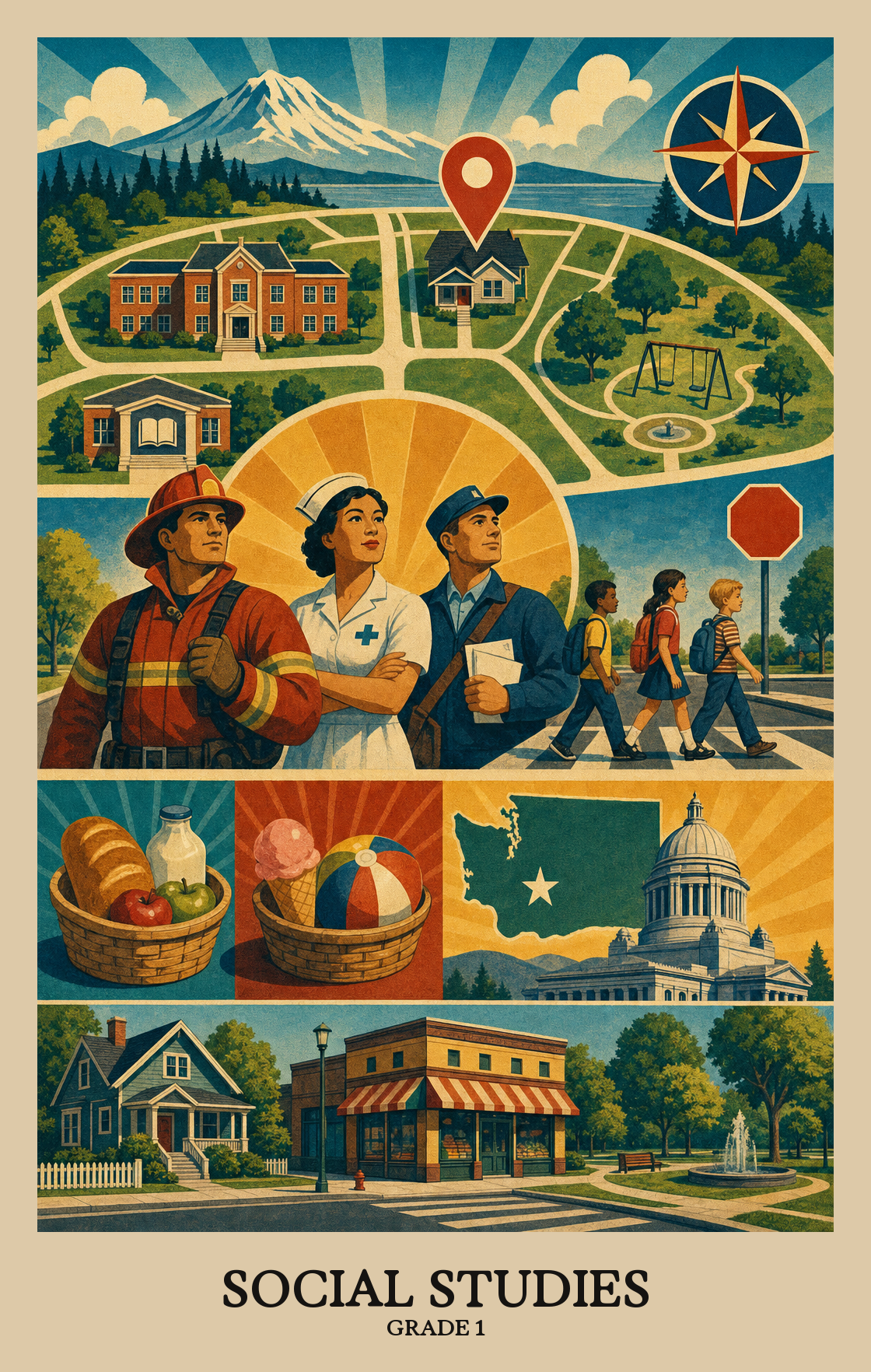
Students start the year close to home. They learn what makes a community, who lives and works in it, and how their school and neighborhood fit together.
Students look at why we have rules and how people make decisions together. They practice taking turns, sharing ideas, and treating classmates fairly.
Students learn to read simple maps and globes. They find their school, their city, and other places, and notice how land and weather shape where people live.
Students sort needs from wants and see why people cannot have everything. They talk about saving, spending, and the choices families make every day.
Students compare life long ago with life today using pictures, objects, and short stories. They meet people from DC and the country whose choices still matter now.
Students ask their own questions about topics like community helpers, maps, holidays, or money. The questions they form help guide what they learn next.
Students use maps, timelines, and simple money or voting examples to look into questions about people, places, and communities. The idea is to use real social studies tools, not just recall facts.
Students look at pictures, books, or articles to decide whether a source can be trusted, then use what they find to back up what they say.
Students share what they learned about a question by writing, drawing, or speaking, then decide on a small action to take, like signing a petition or writing a letter.
| Standard | Definition | Code |
|---|---|---|
| Develop Questions | Students ask their own questions about topics like community helpers, maps, holidays, or money. The questions they form help guide what they learn next. | DC-SS.INQ.1.1 |
| Apply Disciplinary Tools | Students use maps, timelines, and simple money or voting examples to look into questions about people, places, and communities. The idea is to use real social studies tools, not just recall facts. | DC-SS.INQ.1.2 |
| Evaluate Sources and Use Evidence | Students look at pictures, books, or articles to decide whether a source can be trusted, then use what they find to back up what they say. | DC-SS.INQ.1.3 |
| Communicate and Take Action | Students share what they learned about a question by writing, drawing, or speaking, then decide on a small action to take, like signing a petition or writing a letter. | DC-SS.INQ.1.4 |
Students learn what local, state, and federal governments actually do and how they are set up. They look at real institutions like city councils, courts, and Congress to see why each level of government exists.
Students learn why American government is set up so no single person holds all the power. They connect those ideas, like fair laws and individual rights, to real events from history and today.
Students learn what it means to be a good citizen, like following rules, treating others fairly, and having a say in classroom decisions. They practice the kinds of habits people use to take part in their community and government.
| Standard | Definition | Code |
|---|---|---|
| Government Institutions | Students learn what local, state, and federal governments actually do and how they are set up. They look at real institutions like city councils, courts, and Congress to see why each level of government exists. | DC-SS.CIV.1.1 |
| Foundational Principles | Students learn why American government is set up so no single person holds all the power. They connect those ideas, like fair laws and individual rights, to real events from history and today. | DC-SS.CIV.1.2 |
| Citizenship and Participation | Students learn what it means to be a good citizen, like following rules, treating others fairly, and having a say in classroom decisions. They practice the kinds of habits people use to take part in their community and government. | DC-SS.CIV.1.3 |
Scarcity means there is not enough of something for everyone who wants it. Students learn how having less of a resource, or a reward for making a certain choice, changes what people decide to buy, save, or do.
Stores and markets use prices to decide who gets what. When multiple sellers offer the same thing, they compete to attract buyers, which affects what things cost and how much is available.
Students learn what to do with money: when to save it, when to spend it, and what it means to borrow or invest. Real choices like putting coins in a piggy bank or buying something at a store make these ideas concrete.
| Standard | Definition | Code |
|---|---|---|
| Economic Decision Making | Scarcity means there is not enough of something for everyone who wants it. Students learn how having less of a resource, or a reward for making a certain choice, changes what people decide to buy, save, or do. | DC-SS.ECON.1.1 |
| Markets and Exchange | Stores and markets use prices to decide who gets what. When multiple sellers offer the same thing, they compete to attract buyers, which affects what things cost and how much is available. | DC-SS.ECON.1.2 |
| Personal Finance | Students learn what to do with money: when to save it, when to spend it, and what it means to borrow or invest. Real choices like putting coins in a piggy bank or buying something at a store make these ideas concrete. | DC-SS.ECON.1.3 |
Students look at maps, photos, and simple geographic tools to explore what different places look like and how people live in them.
Students look at how their neighborhood, weather, and landscape affect how people live there, and how people in turn change those same places by building roads, farms, or towns.
Students look at why people move from place to place and how those moves spread ideas, goods, and ways of life to new areas.
| Standard | Definition | Code |
|---|---|---|
| Geographic Representations | Students look at maps, photos, and simple geographic tools to explore what different places look like and how people live in them. | DC-SS.GEO.1.1 |
| Human-Environment Interaction | Students look at how their neighborhood, weather, and landscape affect how people live there, and how people in turn change those same places by building roads, farms, or towns. | DC-SS.GEO.1.2 |
| Movement and Connections | Students look at why people move from place to place and how those moves spread ideas, goods, and ways of life to new areas. | DC-SS.GEO.1.3 |
Students learn about important people and events that shaped Washington, D.C., and explain how the city connects to the rest of the country's story.
Students look at how the United States changed over time, from the first colonial settlements to today, and notice what stayed the same along the way.
Students look at two or more ancient civilizations or major historical events and describe how they were alike, different, and why those events still matter today.
Students look at old photos, letters, or books to figure out what happened in the past, then explain what they found using the sources as proof. They also think about how different people may have seen the same event.
| Standard | Definition | Code |
|---|---|---|
| District of Columbia History | Students learn about important people and events that shaped Washington, D.C., and explain how the city connects to the rest of the country's story. | DC-SS.HIST.1.1 |
| United States History | Students look at how the United States changed over time, from the first colonial settlements to today, and notice what stayed the same along the way. | DC-SS.HIST.1.2 |
| World History | Students look at two or more ancient civilizations or major historical events and describe how they were alike, different, and why those events still matter today. | DC-SS.HIST.1.3 |
| Historical Reasoning | Students look at old photos, letters, or books to figure out what happened in the past, then explain what they found using the sources as proof. They also think about how different people may have seen the same event. | DC-SS.HIST.1.4 |
Federally administered sample-based assessment in reading, mathematics, science, and writing. NAEP results inform state-by-state comparisons rather than individual student or school accountability.
Students learn about their school, family, and neighborhood as a starting point for bigger ideas. They ask questions about how people live and work together, look at simple maps and pictures, and begin to notice how rules, places, and money shape everyday life.
Talk about the neighborhood on walks and errands. Point out street signs, jobs people do, and where food and goods come from. Look at a simple map of the city together, or read a picture book about a real person from the past and ask what was different back then.
Students learn that DC has leaders, laws, and landmarks, and that the country has leaders too. The focus is on basics: who makes rules, why rules exist, and how people work together to solve problems in a classroom, a neighborhood, or a city.
A common arc starts close to home and moves outward: self and school, then family and neighborhood, then the city and country. Inquiry skills, map work, and history vocabulary can be woven into each unit instead of taught as separate blocks.
Reading maps and using direction words often need extra practice, as does telling the difference between needs and wants. Students also need repeated practice telling past from present and explaining why something happened, not just what happened.
Mostly through classroom life: following shared rules, taking turns, voting on small choices, and helping solve problems with classmates. At home, students can practice the same skills by sharing chores, making family decisions together, and helping a neighbor.
Students learn that people cannot have everything they want, so they make choices. They talk about saving coins, spending on needs, and the jobs that bring goods to a store. A piggy bank or a small allowance gives plenty to talk about at home.
Old photographs, simple letters, songs, and short interviews work well. Students look closely, describe what they see, and guess what life was like. The goal is noticing details and asking questions, not analyzing documents the way an older student would.
By spring, students should be able to ask a question about a place or event, find clues in a picture or short text, and explain an answer in a sentence or two. They should also use basic map words and describe how rules and choices affect a community.