Asking questions like a scientist
Students start the year by noticing the world around them and asking questions they can actually test. They learn to look closely, sort what they see, and talk about it with classmates.
This is the year science becomes a habit of asking questions and looking for answers. Students notice patterns in the world around them, like how light and sound travel, how plants and animals grow, and how the sky changes through the day and year. They start sketching what they see, testing simple ideas, and explaining what happened using what they noticed. By spring, students can ask a question about something they observed and point to evidence that helps answer it.
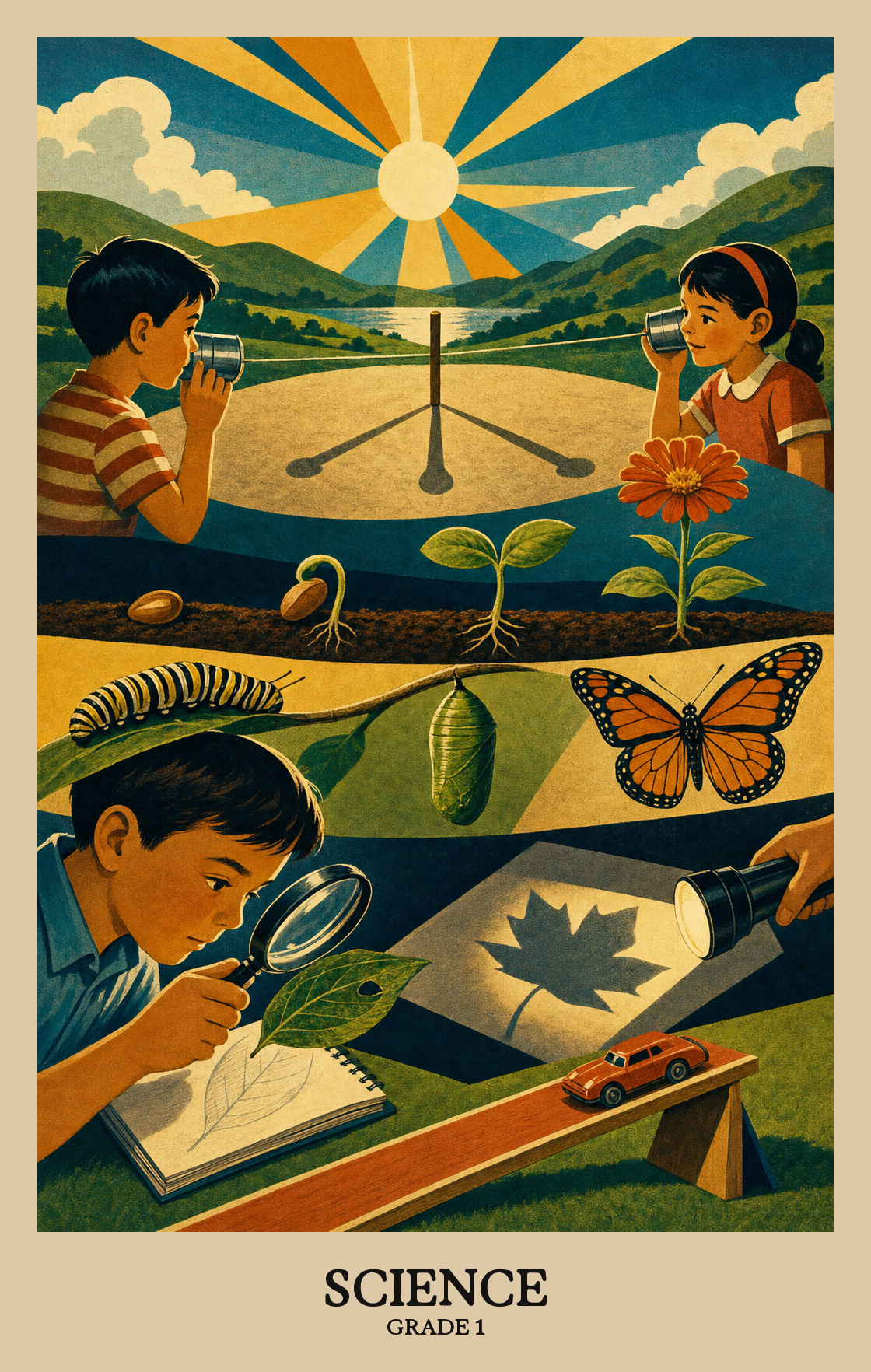
Students start the year by noticing the world around them and asking questions they can actually test. They learn to look closely, sort what they see, and talk about it with classmates.
Students explore what makes objects move, what happens when you push or pull, and how light and sound travel. They try simple experiments with flashlights, instruments, and ramps.
Students look at what living things need to survive and how baby animals grow up to look like their parents. They compare seeds, leaves, and animal families.
Students watch the sun, moon, and stars and track how the sky changes through the day and across seasons. They notice patterns in weather and daylight.
Students wrap up the year as young engineers. They name a small problem, sketch an idea, build it from everyday materials, and try it out to see what works.
Students learn to ask "why" and "how" questions about the world around them, then figure out which ones can actually be tested or solved. It's the habit of wondering with a purpose.
Students draw or build simple models to show how something in nature works or how a design solves a problem. A model might be a drawing of a cloud, a diagram of a plant, or a sketch of a bridge.
Students plan a simple test, gather information from it, and use what they find to check whether their idea holds up.
Students look at information collected during an investigation and describe what they notice. They spot patterns, like which plant grew tallest or which material got wettest fastest.
Students use counting, simple math, or basic patterns to explain what they observed. For example, they might count how many seeds sprouted or compare measurements to decide which object is heavier.
Students look at what they observed or tested, then use that evidence to explain why something happened or to come up with a way to fix a problem.
Students look at two possible explanations or solutions, then use what they observed or tested to argue which one holds up better.
Students gather facts from books, pictures, or a teacher's explanation, then share what they found through drawings, words, or simple charts.
| Standard | Definition | Code |
|---|---|---|
| Asking Questions and Defining Problems | Students learn to ask "why" and "how" questions about the world around them, then figure out which ones can actually be tested or solved. It's the habit of wondering with a purpose. | DC-SCI.SEP.1.1 |
| Developing and Using Models | Students draw or build simple models to show how something in nature works or how a design solves a problem. A model might be a drawing of a cloud, a diagram of a plant, or a sketch of a bridge. | DC-SCI.SEP.1.2 |
| Planning and Carrying Out Investigations | Students plan a simple test, gather information from it, and use what they find to check whether their idea holds up. | DC-SCI.SEP.1.3 |
| Analyzing and Interpreting Data | Students look at information collected during an investigation and describe what they notice. They spot patterns, like which plant grew tallest or which material got wettest fastest. | DC-SCI.SEP.1.4 |
| Mathematics and Computational Thinking | Students use counting, simple math, or basic patterns to explain what they observed. For example, they might count how many seeds sprouted or compare measurements to decide which object is heavier. | DC-SCI.SEP.1.5 |
| Constructing Explanations | Students look at what they observed or tested, then use that evidence to explain why something happened or to come up with a way to fix a problem. | DC-SCI.SEP.1.6 |
| Engaging in Argument from Evidence | Students look at two possible explanations or solutions, then use what they observed or tested to argue which one holds up better. | DC-SCI.SEP.1.7 |
| Communicating Information | Students gather facts from books, pictures, or a teacher's explanation, then share what they found through drawings, words, or simple charts. | DC-SCI.SEP.1.8 |
Students touch, sort, and describe everyday materials to figure out what they are made of and why they behave the way they do. They learn that the stuff around them has structure, even when it is too small to see.
Students push, pull, and nudge objects to see what makes them move, speed up, slow down, or stay still. Simple experiments show why a heavy block is harder to shift than a light one.
Students explore how energy shows up in different forms, like light, heat, and sound, and notice what happens when energy moves from one place to another. They also observe that energy is not lost, just changed.
Students explore how waves move energy from place to place, like sound traveling through air or light bouncing off a mirror. They also look at how waves carry information, the way a phone call or a radio signal does.
| Standard | Definition | Code |
|---|---|---|
| Matter and Interactions | Students touch, sort, and describe everyday materials to figure out what they are made of and why they behave the way they do. They learn that the stuff around them has structure, even when it is too small to see. | DC-SCI.PS.1.1 |
| Motion and Stability | Students push, pull, and nudge objects to see what makes them move, speed up, slow down, or stay still. Simple experiments show why a heavy block is harder to shift than a light one. | DC-SCI.PS.1.2 |
| Energy | Students explore how energy shows up in different forms, like light, heat, and sound, and notice what happens when energy moves from one place to another. They also observe that energy is not lost, just changed. | DC-SCI.PS.1.3 |
| Waves and Information | Students explore how waves move energy from place to place, like sound traveling through air or light bouncing off a mirror. They also look at how waves carry information, the way a phone call or a radio signal does. | DC-SCI.PS.1.4 |
Students look at how living things are built and how they work, from tiny parts inside a plant or animal to the bigger systems that keep it alive.
Students look at how plants, animals, and other living things in a place depend on each other for food and survival. They explore how energy moves from the sun to plants to animals and back into the soil.
Students look at plants or animals and notice which features (like leaf shape or fur color) get passed from parents to offspring, and which ones turn out different.
Students look closely at plants and animals to see what makes them alike and what makes them different. Over time, living things change in ways that help them survive.
| Standard | Definition | Code |
|---|---|---|
| Structures and Processes | Students look at how living things are built and how they work, from tiny parts inside a plant or animal to the bigger systems that keep it alive. | DC-SCI.LS.1.1 |
| Ecosystems | Students look at how plants, animals, and other living things in a place depend on each other for food and survival. They explore how energy moves from the sun to plants to animals and back into the soil. | DC-SCI.LS.1.2 |
| Heredity | Students look at plants or animals and notice which features (like leaf shape or fur color) get passed from parents to offspring, and which ones turn out different. | DC-SCI.LS.1.3 |
| Biological Evolution | Students look closely at plants and animals to see what makes them alike and what makes them different. Over time, living things change in ways that help them survive. | DC-SCI.LS.1.4 |
Students look at patterns in how the sun, moon, and stars move across the sky, and learn how Earth fits into the larger solar system.
Students look at how land, water, air, and living things work together on Earth. They explore what happens when one part changes and how that affects the others.
Students look at how people change the land, water, and air around them, and what happens when floods, storms, or other natural events disrupt everyday life.
| Standard | Definition | Code |
|---|---|---|
| Earth's Place in the Universe | Students look at patterns in how the sun, moon, and stars move across the sky, and learn how Earth fits into the larger solar system. | DC-SCI.ESS.1.1 |
| Earth's Systems | Students look at how land, water, air, and living things work together on Earth. They explore what happens when one part changes and how that affects the others. | DC-SCI.ESS.1.2 |
| Earth and Human Activity | Students look at how people change the land, water, and air around them, and what happens when floods, storms, or other natural events disrupt everyday life. | DC-SCI.ESS.1.3 |
Students look at a problem, come up with ideas to fix it, then test and improve their best idea. It's the same loop engineers use: try it, see what breaks, make it better.
Students explore how inventions change everyday life and how people's needs shape what engineers build next.
| Standard | Definition | Code |
|---|---|---|
| Engineering Design | Students look at a problem, come up with ideas to fix it, then test and improve their best idea. It's the same loop engineers use: try it, see what breaks, make it better. | DC-SCI.ETS.1.1 |
| Links Among Engineering, Technology, and Society | Students explore how inventions change everyday life and how people's needs shape what engineers build next. | DC-SCI.ETS.1.2 |
Alternate assessment for students with the most significant cognitive disabilities, given in grades 3-8 and high school in ELA, math, and science.
Students explore the world by asking questions, watching closely, and trying things out. They look at plants, animals, weather, light, sound, and how objects move. Most of the work happens through hands-on activities and simple drawings rather than reading from a textbook.
Take a few minutes on a walk to notice the weather, the moon, or how a shadow changes. Ask what students think will happen before pouring water, dropping a ball, or planting a seed. Curiosity counts more than getting the right answer.
Many teachers start with life science in the fall while plants and insects are easy to observe outside. Earth and sky topics fit well in winter when weather shifts are obvious. Save longer build-and-test projects for spring once routines for working in pairs are solid.
Not really. Students should be able to describe what they saw and what they think happened in their own words. Words like push, pull, melt, grow, and shadow matter more than formal terms at this age.
By spring, students can ask a question, run a simple test, and say what they noticed using a drawing or a sentence. They can compare two things, point to patterns like day and night, and offer a reason for what they think.
Recording observations and using evidence to back up an idea are the hardest lifts. Students often jump to a guess without looking carefully first. Short, repeated cycles of observe, draw, and share build this habit faster than one long lesson.
Plan for a few small design challenges spread across the year rather than one big unit. Building a shelter for a toy animal or a ramp for a ball lets students test, fix, and test again. These projects also pull in life, earth, and physical science ideas.
Look for a student who notices things, asks why, and is willing to try an idea even when it might not work. Being able to describe a simple cause and effect, like sun melting ice, is a strong sign. Confidence with observing matters more than facts memorized.