Thinking and working like a scientist
Students start the year learning how real science gets done. They ask testable questions, plan experiments, collect data, and back up claims with evidence instead of guesses.
This is the year science stops being about memorizing facts and starts being about building explanations from evidence. Students dig into how atoms make up everything, how energy moves, how living things pass down traits, and how Earth fits into a much bigger universe. They also learn to design and test solutions to real problems, the way engineers do. By spring, students can read a science claim, weigh the evidence behind it, and explain whether it holds up.
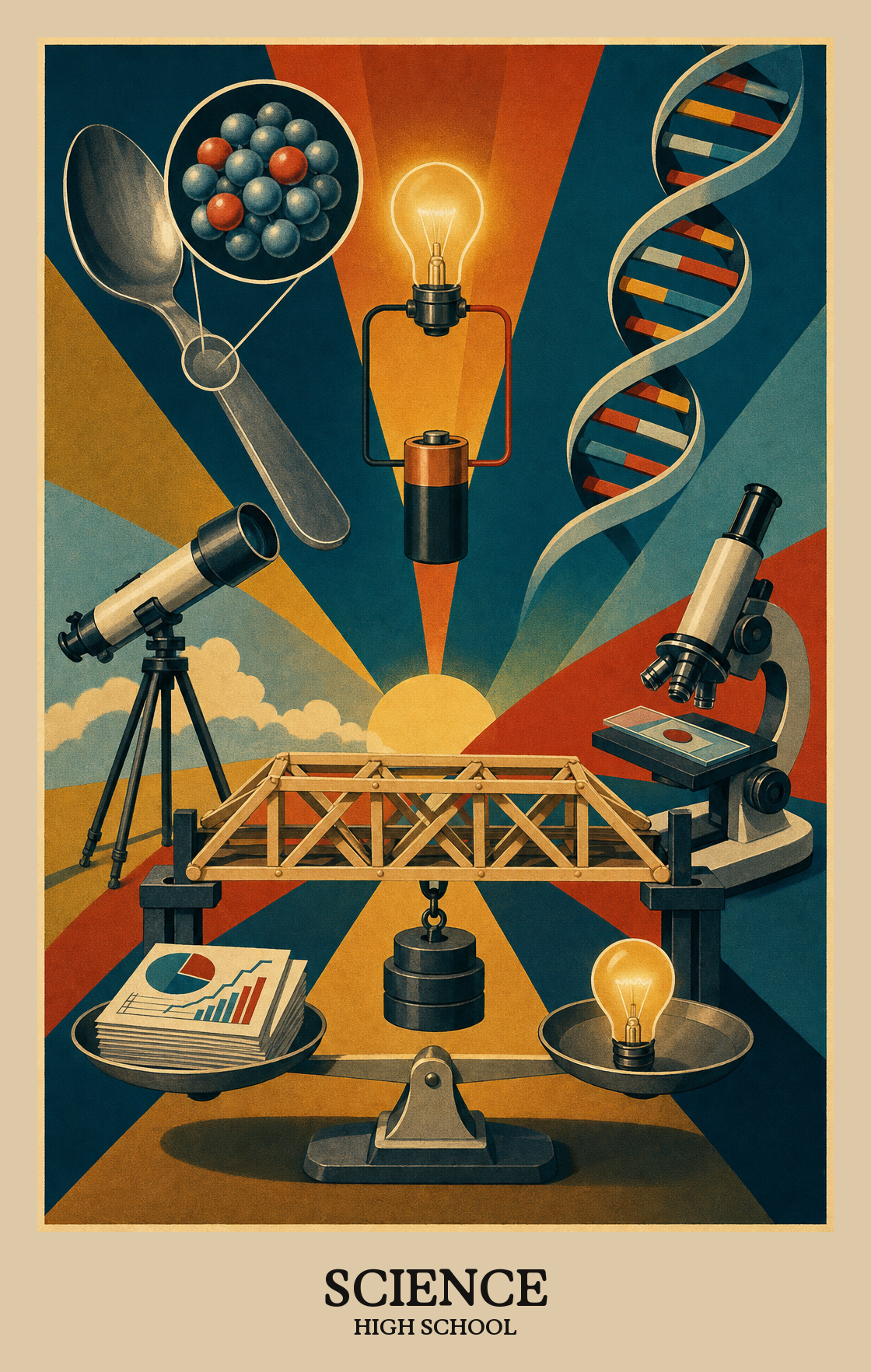
Students start the year learning how real science gets done. They ask testable questions, plan experiments, collect data, and back up claims with evidence instead of guesses.
Students dig into the physical world. They look at what atoms do, how forces move objects, and how energy shifts from one form to another, like heat into motion or light into electricity.
Students study how waves carry sound, light, and signals. They see how the same ideas show up in music, phone screens, medical scans, and the wifi at home.
Students explore how cells, bodies, and whole ecosystems keep going. They track how matter and energy move through food webs and how organisms depend on each other to survive.
Students look at why family members share traits and why species change over long stretches of time. They work with DNA basics, inheritance patterns, and the evidence behind evolution.
Students close the year with the big picture. They study Earth's systems, its place in the solar system, and how human choices about climate, land, and resources shape what comes next.
Students learn to turn a curiosity or a real-world problem into a question that can actually be tested or built. The focus is on framing problems precisely enough that an experiment or a design can answer them.
Students build diagrams, simulations, or physical models to show how a system or process works, then use those models to explain patterns or test ideas.
Students design and run their own experiments to collect real data, then use that data to check whether their original idea holds up.
Students look at data from experiments or research and pull out what it actually means. They spot patterns, compare results, and explain what the numbers or observations are telling them.
Students use math, data, and calculations to back up scientific explanations. This might mean running numbers to test a hypothesis, analyzing a dataset, or using a model to show why a conclusion holds up.
Students build written or oral explanations for a science phenomenon by tying their reasoning directly to data, observations, or established science principles. The explanation has to hold up against the evidence, not just sound plausible.
Students look at two or more scientific explanations or proposed solutions, then use real data and reasoning to argue which one holds up better. The focus is on the evidence, not just the opinion.
Students read scientific sources, judge how reliable they are, and explain findings clearly to others. This practice shows up across every science topic, from lab reports to research presentations.
| Standard | Definition | Code |
|---|---|---|
| Asking Questions and Defining Problems High School | Students learn to turn a curiosity or a real-world problem into a question that can actually be tested or built. The focus is on framing problems precisely enough that an experiment or a design can answer them. | DE-SCI.SEP.9-12.1 |
| Developing and Using Models High School | Students build diagrams, simulations, or physical models to show how a system or process works, then use those models to explain patterns or test ideas. | DE-SCI.SEP.9-12.2 |
| Planning and Carrying Out Investigations High School | Students design and run their own experiments to collect real data, then use that data to check whether their original idea holds up. | DE-SCI.SEP.9-12.3 |
| Analyzing and Interpreting Data High School | Students look at data from experiments or research and pull out what it actually means. They spot patterns, compare results, and explain what the numbers or observations are telling them. | DE-SCI.SEP.9-12.4 |
| Mathematics and Computational Thinking High School | Students use math, data, and calculations to back up scientific explanations. This might mean running numbers to test a hypothesis, analyzing a dataset, or using a model to show why a conclusion holds up. | DE-SCI.SEP.9-12.5 |
| Constructing Explanations High School | Students build written or oral explanations for a science phenomenon by tying their reasoning directly to data, observations, or established science principles. The explanation has to hold up against the evidence, not just sound plausible. | DE-SCI.SEP.9-12.6 |
| Engaging in Argument from Evidence High School | Students look at two or more scientific explanations or proposed solutions, then use real data and reasoning to argue which one holds up better. The focus is on the evidence, not just the opinion. | DE-SCI.SEP.9-12.7 |
| Communicating Information High School | Students read scientific sources, judge how reliable they are, and explain findings clearly to others. This practice shows up across every science topic, from lab reports to research presentations. | DE-SCI.SEP.9-12.8 |
Students examine what atoms and molecules are made of and how they interact to explain everyday physical phenomena, like why materials change state or conduct heat.
Students study how objects speed up, slow down, and stay balanced by applying Newton's laws and conservation rules. They run investigations to explain why things move the way they do, from a rolling ball to a braking car.
Students trace how energy changes form and moves from one object to another, and confirm that the total amount of energy in a system stays the same before and after any change.
Students study how waves carry energy and information from one place to another, then explore real applications like radio signals, medical imaging, or fiber-optic cables.
| Standard | Definition | Code |
|---|---|---|
| Matter and Interactions High School | Students examine what atoms and molecules are made of and how they interact to explain everyday physical phenomena, like why materials change state or conduct heat. | DE-SCI.PS.9-12.1 |
| Motion and Stability High School | Students study how objects speed up, slow down, and stay balanced by applying Newton's laws and conservation rules. They run investigations to explain why things move the way they do, from a rolling ball to a braking car. | DE-SCI.PS.9-12.2 |
| Energy High School | Students trace how energy changes form and moves from one object to another, and confirm that the total amount of energy in a system stays the same before and after any change. | DE-SCI.PS.9-12.3 |
| Waves and Information High School | Students study how waves carry energy and information from one place to another, then explore real applications like radio signals, medical imaging, or fiber-optic cables. | DE-SCI.PS.9-12.4 |
Students examine how living things are built and how they work, starting with cells and zooming out to organs and whole-body systems. The goal is to see how structure at every level connects to function.
Students trace how energy moves through a food web and how materials like carbon and water cycle through living and nonliving parts of an ecosystem. They also study how organisms compete, cooperate, and depend on each other within a community.
Students study how traits like eye color or height pass from parents to offspring, and why siblings can look different even when they share the same parents. This covers the rules of inheritance and the sources of variation.
Students examine how all living things share common traits while also differing in important ways, then explore what drives those differences over time, including natural selection and genetic change.
| Standard | Definition | Code |
|---|---|---|
| Structures and Processes High School | Students examine how living things are built and how they work, starting with cells and zooming out to organs and whole-body systems. The goal is to see how structure at every level connects to function. | DE-SCI.LS.9-12.1 |
| Ecosystems High School | Students trace how energy moves through a food web and how materials like carbon and water cycle through living and nonliving parts of an ecosystem. They also study how organisms compete, cooperate, and depend on each other within a community. | DE-SCI.LS.9-12.2 |
| Heredity High School | Students study how traits like eye color or height pass from parents to offspring, and why siblings can look different even when they share the same parents. This covers the rules of inheritance and the sources of variation. | DE-SCI.LS.9-12.3 |
| Biological Evolution High School | Students examine how all living things share common traits while also differing in important ways, then explore what drives those differences over time, including natural selection and genetic change. | DE-SCI.LS.9-12.4 |
Students study where Earth sits in the solar system and how the planets move, while also tracing how Earth itself formed and changed over billions of years.
Students examine how Earth's land, water, air, and living things connect and affect one another. A volcanic eruption, a rainstorm, or a dying forest can set off changes that ripple across all four systems.
Students examine how things like burning fuel or clearing land change Earth's air, water, and soil, and how earthquakes, floods, and wildfires put communities at risk.
| Standard | Definition | Code |
|---|---|---|
| Earth's Place in the Universe High School | Students study where Earth sits in the solar system and how the planets move, while also tracing how Earth itself formed and changed over billions of years. | DE-SCI.ESS.9-12.1 |
| Earth's Systems High School | Students examine how Earth's land, water, air, and living things connect and affect one another. A volcanic eruption, a rainstorm, or a dying forest can set off changes that ripple across all four systems. | DE-SCI.ESS.9-12.2 |
| Earth and Human Activity High School | Students examine how things like burning fuel or clearing land change Earth's air, water, and soil, and how earthquakes, floods, and wildfires put communities at risk. | DE-SCI.ESS.9-12.3 |
Students identify a real-world problem, brainstorm solutions, build or model a design, then test and improve it until it works better.
Students examine how bridges get built, how apps change daily habits, and how public needs push engineers to solve new problems. Each shapes the others in a continuous back-and-forth.
| Standard | Definition | Code |
|---|---|---|
| Engineering Design High School | Students identify a real-world problem, brainstorm solutions, build or model a design, then test and improve it until it works better. | DE-SCI.ETS.9-12.1 |
| Links Among Engineering, Technology, and Society High School | Students examine how bridges get built, how apps change daily habits, and how public needs push engineers to solve new problems. Each shapes the others in a continuous back-and-forth. | DE-SCI.ETS.9-12.2 |
High school science assessment administered once after completion of NGSS-aligned high school science coursework.
Federally administered sample-based assessment in reading, mathematics, science, and writing. NAEP results inform state-by-state comparisons rather than individual student or school accountability.
Students work across four areas: physical science (atoms, forces, energy, and waves), life science (cells, ecosystems, genetics, and evolution), earth and space science (the planet and the universe), and engineering. They also build science skills like running experiments, analyzing data, and arguing from evidence.
Ask students to explain what they did in lab that day and why it worked the way it did. Watch a short science video together and pick it apart. Even cooking, gardening, or fixing something around the house gives students a chance to predict, test, and revise their thinking.
Yes, math shows up often. Students graph data, calculate rates, work with formulas, and use units. If math feels shaky, practicing algebra basics and reading graphs will pay off in every science class.
Most schools run biology, chemistry, and physics or earth science across three or four years. Whatever the order, plan to revisit the science practices each year so students get stronger at investigation, modeling, and argument over time, not just in one course.
Energy transfer, the particle nature of matter, and natural selection trip students up year after year. Students often memorize a definition without picturing what is actually happening. Plan extra time for models, diagrams, and student explanations on these topics.
Students should name a clear question, describe what they did well enough that someone else could repeat it, show their data in a table or graph, and explain what the data means. The argument should rest on the evidence, not on what the student expected to find.
Give students two competing explanations for the same phenomenon and ask which one the data supports. Have them critique each other's reasoning out loud. Over time, students stop saying "I think" and start saying "the data shows."
Ask the student to read the question out loud and explain what it is asking before touching the answer. Have them point to notes, the textbook, or a worked example from class. The goal is to help them find the thread, not to give the answer.
By the end of high school, students should be able to read a science article and summarize it, design a simple experiment, and back up a claim with data. If they can teach a younger sibling how something works using a clear example, that is a good sign.