Maps and the places we live
Students start the year as geographers. They read maps, locate their town and state, and notice how the land, weather, and water shape the way people live and work in different places.
This is the year students start seeing how their community fits into a bigger picture. Students learn that government has different jobs at the city, state, and national levels, and that citizens have both rights and responsibilities. They read maps, track how people change the land around them, and use timelines to ask why things happened in the past. By spring, students can explain how a personal choice involves trading one thing for another.
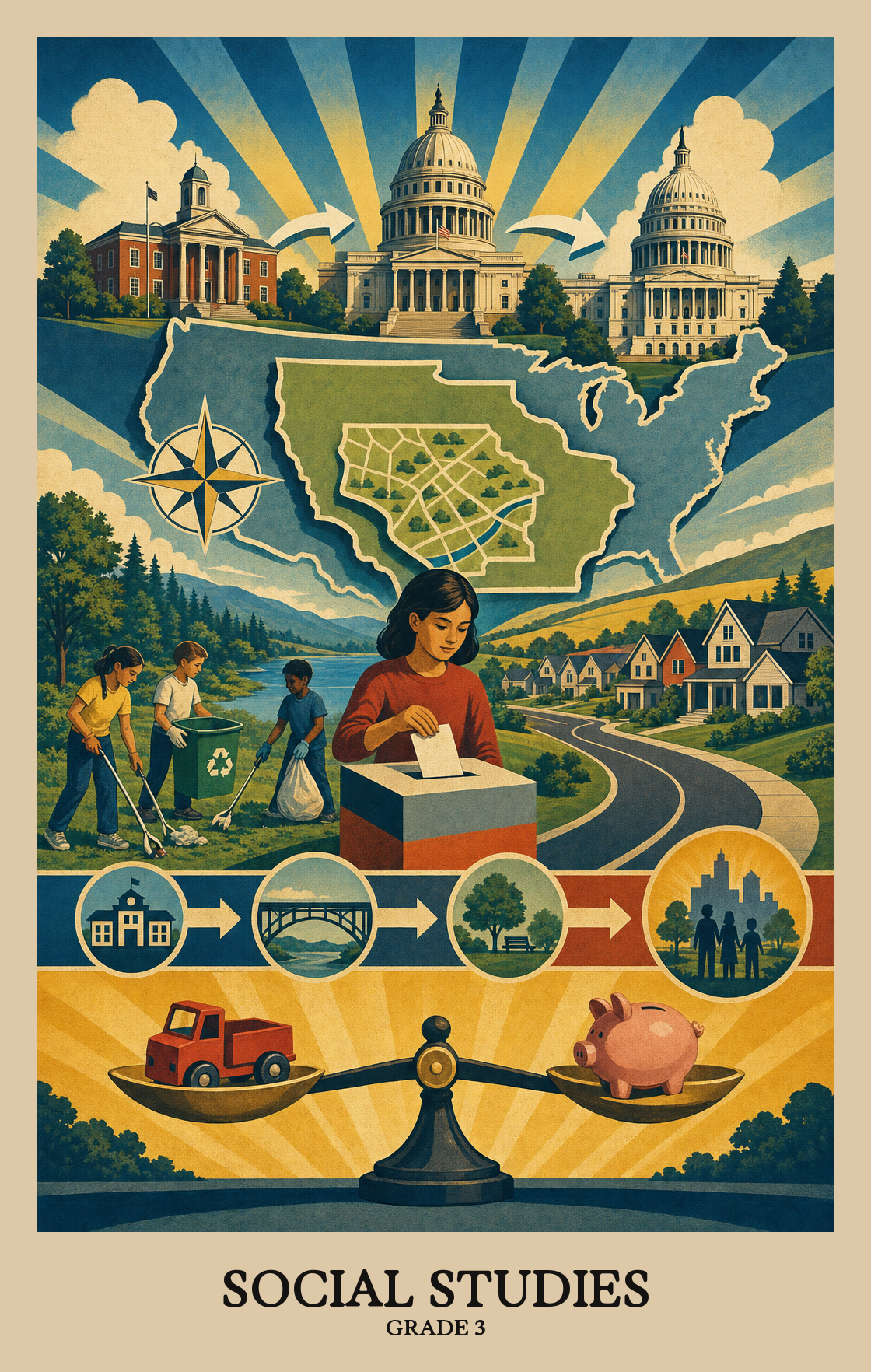
Students start the year as geographers. They read maps, locate their town and state, and notice how the land, weather, and water shape the way people live and work in different places.
Students look at how neighborhoods and regions connect to each other. They learn that families and communities have their own traditions, languages, and stories, and that places change when people move, build, or share ideas.
Students learn who makes the rules at the city, state, and country level, and why. They talk about fairness, voting, and the rights and jobs of citizens, and practice speaking up in respectful ways.
Students think like shoppers and small business owners. They weigh wants against needs, see why prices go up or down, and trace how goods travel from one place to another before reaching a store shelf.
Students step back in time. They use timelines, old photos, and short documents to ask who lived here before, what changed, and how the choices of past people still shape life in Delaware today.
Government is split into branches and levels so no single person holds all the power. Students learn what each part does, from the local mayor's office up to the federal government in Washington.
Students read founding documents like the Constitution and Declaration of Independence to find the core ideas behind American government: things like equality, freedom, and the right to vote.
Citizens in a democracy have rights (like free speech) and responsibilities (like following laws and participating in their community). Students learn what it means to be an active, informed citizen.
Students practice the skills that make someone a useful neighbor and community member: listening, speaking up, and working with others to solve local problems.
| Standard | Definition | Code |
|---|---|---|
| Government | Government is split into branches and levels so no single person holds all the power. Students learn what each part does, from the local mayor's office up to the federal government in Washington. | DE-SS.CIV.3.1 |
| Politics | Students read founding documents like the Constitution and Declaration of Independence to find the core ideas behind American government: things like equality, freedom, and the right to vote. | DE-SS.CIV.3.2 |
| Citizenship | Citizens in a democracy have rights (like free speech) and responsibilities (like following laws and participating in their community). Students learn what it means to be an active, informed citizen. | DE-SS.CIV.3.3 |
| Participation | Students practice the skills that make someone a useful neighbor and community member: listening, speaking up, and working with others to solve local problems. | DE-SS.CIV.3.4 |
When something is scarce, there isn't enough for everyone, so people have to choose. Students learn to weigh the cost of a choice against what they gain, like deciding whether spending money on one thing means giving up something else.
Students look at how people, businesses, and the government all affect each other in a market economy. They explore why prices rise and fall, what motivates buyers and sellers, and how government rules can change what gets made, bought, or sold.
Students look at how different societies decide who makes goods, who owns businesses, and how prices get set. They also explain why those rules shift as communities grow or face new challenges.
Students learn how money works in daily life, from saving and spending to how a family's choices connect to businesses and people in other communities. They start to see why what we buy and sell ties us to the wider world.
| Standard | Definition | Code |
|---|---|---|
| Microeconomics | When something is scarce, there isn't enough for everyone, so people have to choose. Students learn to weigh the cost of a choice against what they gain, like deciding whether spending money on one thing means giving up something else. | DE-SS.ECON.3.1 |
| Macroeconomics | Students look at how people, businesses, and the government all affect each other in a market economy. They explore why prices rise and fall, what motivates buyers and sellers, and how government rules can change what gets made, bought, or sold. | DE-SS.ECON.3.2 |
| Economic Systems | Students look at how different societies decide who makes goods, who owns businesses, and how prices get set. They also explain why those rules shift as communities grow or face new challenges. | DE-SS.ECON.3.3 |
| Personal Finance and Interdependence | Students learn how money works in daily life, from saving and spending to how a family's choices connect to businesses and people in other communities. They start to see why what we buy and sell ties us to the wider world. | DE-SS.ECON.3.4 |
Students build a mental picture of the world around them, then use maps, globes, and other tools to explore what different places and regions look like and how they connect.
Students look at how people change the land around them (by building roads, farming, or draining wetlands) and what those changes do to nearby wildlife and neighborhoods.
Students compare how people in different parts of the world live, dress, celebrate, and build communities. They look at what makes each place distinct, from its traditions to its landscape.
Students learn that a region is a group of places that share something in common, like climate, language, or land type. They look at how regions connect to each other, from a neighborhood scale up to a continent.
| Standard | Definition | Code |
|---|---|---|
| Maps and Mental Maps | Students build a mental picture of the world around them, then use maps, globes, and other tools to explore what different places and regions look like and how they connect. | DE-SS.GEO.3.1 |
| Environment | Students look at how people change the land around them (by building roads, farming, or draining wetlands) and what those changes do to nearby wildlife and neighborhoods. | DE-SS.GEO.3.2 |
| Places and Cultures | Students compare how people in different parts of the world live, dress, celebrate, and build communities. They look at what makes each place distinct, from its traditions to its landscape. | DE-SS.GEO.3.3 |
| Regions | Students learn that a region is a group of places that share something in common, like climate, language, or land type. They look at how regions connect to each other, from a neighborhood scale up to a continent. | DE-SS.GEO.3.4 |
Students put historical events in order and look for patterns, asking why things happened and how life stayed the same or changed over time.
Students look at original documents, photos, or artifacts alongside history books and articles, then compare what different sources say about the same event.
Students look at old photos, maps, or written accounts and explain how the same event can look different depending on who's telling the story.
Students learn about major events in Delaware, U.S., and world history. They build a factual foundation for understanding how people and places changed over time.
| Standard | Definition | Code |
|---|---|---|
| Chronology | Students put historical events in order and look for patterns, asking why things happened and how life stayed the same or changed over time. | DE-SS.HIST.3.1 |
| Analysis | Students look at original documents, photos, or artifacts alongside history books and articles, then compare what different sources say about the same event. | DE-SS.HIST.3.2 |
| Interpretation | Students look at old photos, maps, or written accounts and explain how the same event can look different depending on who's telling the story. | DE-SS.HIST.3.3 |
| Content | Students learn about major events in Delaware, U.S., and world history. They build a factual foundation for understanding how people and places changed over time. | DE-SS.HIST.3.4 |
Federally administered sample-based assessment in reading, mathematics, science, and writing. NAEP results inform state-by-state comparisons rather than individual student or school accountability.
Students explore four big areas: how government works, how money and choices work, how to read maps and understand places, and how the past connects to today. Most lessons connect these ideas to Delaware and to students' own communities.
Talk about what they learned at dinner and connect it to real life. Point out a mayor's name on the news, look at a map before a road trip, or talk about why a family chose one purchase over another. Five minutes of conversation makes the classroom lessons stick.
Students should be able to name the three branches and explain that government works at city, state, and national levels. They should also describe basic rights and responsibilities of citizens, like voting, following laws, and speaking up about issues that matter to them.
Many teachers anchor the year in geography and community first, then move into history, government, and economics as students build vocabulary. Pulling Delaware examples through every strand keeps the content concrete and gives students something to return to.
Pick one topic they mentioned and find a short video, a library book, or a local place to visit. A trip to a state park, a historical marker, or even the grocery store can turn a textbook idea into something real. Curiosity grows when the topic feels close to home.
Map skills and chronological thinking tend to need repeated practice. Reading a legend, understanding scale, and ordering events on a timeline are harder than they look. Short, frequent practice works better than one long unit.
At this age, economics is about choices and trade-offs. Students learn that they cannot have everything, that prices and supply affect what people buy, and that saving and spending are real decisions. Letting kids help plan a small purchase at home reinforces the same ideas.
Start with one short, visual source: a photograph, a letter, an old map, or an object. Ask what they notice, what they wonder, and who might have made it. Building this habit early pays off when sources get harder in later grades.
By spring, students should read a basic map, place events in order on a timeline, explain why people make economic choices, and describe how local and state government affect daily life. They should also be able to back up an idea with something they read or saw.