Multiplication and division basics
Students learn what it means to multiply and divide. They work with groups of objects, arrays, and equal sharing, and start tying these ideas to real situations like packing snacks or splitting a deck of cards.
This is the year math shifts from adding and subtracting to multiplying and dividing. Students learn their times tables and use them to solve everyday problems, like figuring out how many cookies are on five plates of six. They also meet fractions for the first time, seeing them as equal parts of a whole. By spring, students can recall most multiplication facts up to ten and name a fraction shown on a number line.
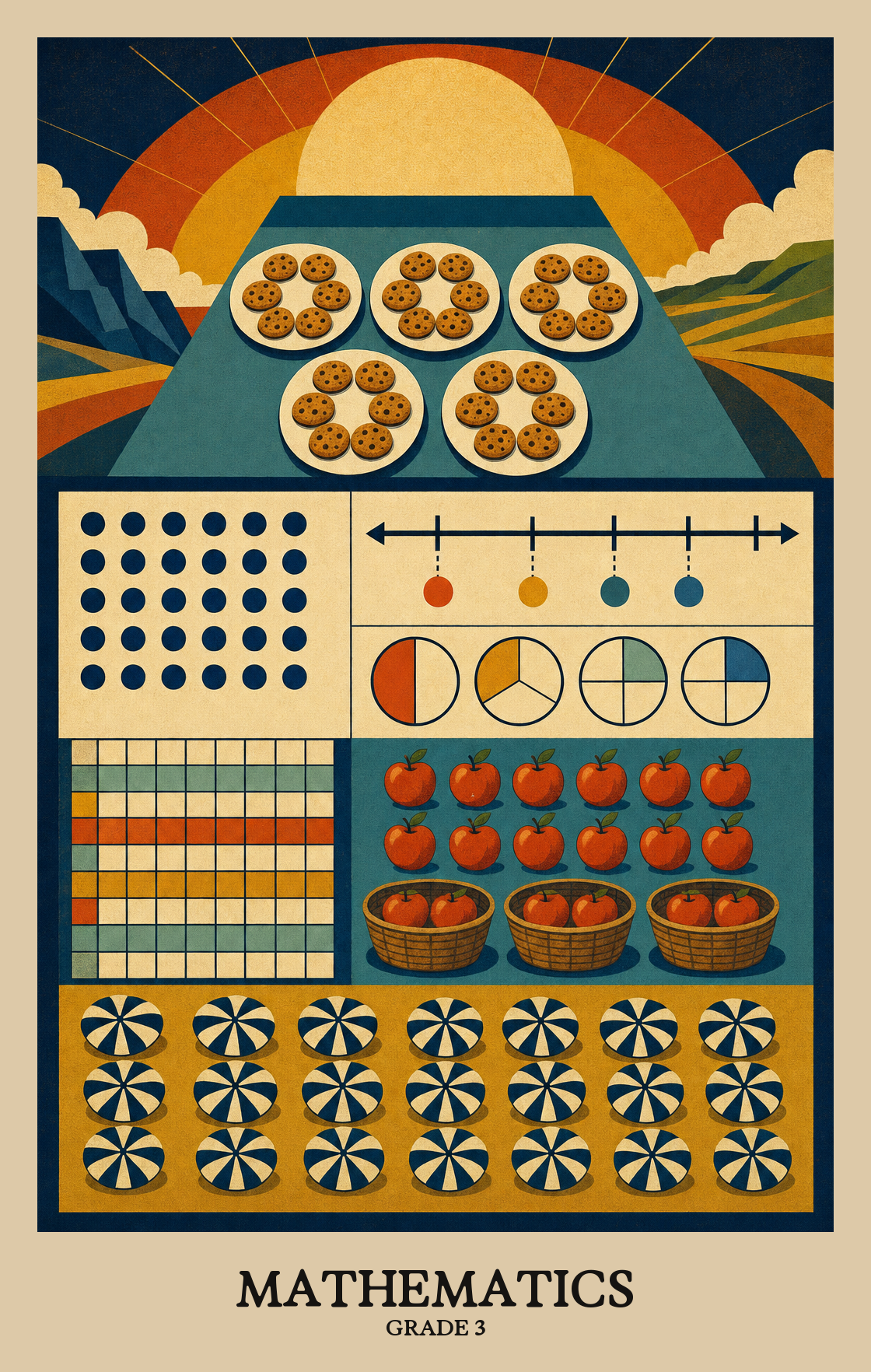
Students learn what it means to multiply and divide. They work with groups of objects, arrays, and equal sharing, and start tying these ideas to real situations like packing snacks or splitting a deck of cards.
Students build quick recall of multiplication and division facts through 10. They notice patterns in the times tables and use what they know to figure out facts they have not memorized yet.
Students start treating fractions like real numbers, not just slices of pizza. They place fractions on a number line, compare halves and fourths, and see when two fractions name the same amount.
Students add and subtract within 1,000 and round numbers to the nearest ten or hundred. They use these skills to solve word problems with larger amounts, like points in a game or pages in a book.
Students tell time to the minute, measure with rulers, and find the weight or volume of everyday objects. They read bar graphs and picture graphs and answer questions about what the data shows.
Students sort shapes by their sides and angles and find the area and perimeter of rectangles. They see how area connects to multiplication by counting squares inside a shape.
Students read a math problem carefully, figure out what it's actually asking, and keep trying even when the first approach doesn't work.
Students take a word problem and translate it into numbers and symbols to solve it, then explain what the answer actually means in real life.
Students explain why their math answer is correct and listen carefully to a classmate's reasoning to spot any mistakes. They practice defending their thinking, not just getting the right answer.
Students use math to make sense of real situations, like figuring out how many chairs fit in a room or splitting a snack equally. They draw pictures, write number sentences, or use objects to show their thinking.
Students choose the right tool for a math problem, whether that means reaching for a ruler, using estimation, or working it out on paper.
Students use the right math words, label their answers with the correct units (inches, minutes, dollars), and check that their calculations are exact. Getting the details right is part of solving the problem.
Students learn to spot patterns and hidden structure in math problems, like noticing that a multiplication table has a symmetry or that breaking a shape into smaller pieces makes it easier to measure.
Students notice when the same steps keep showing up in different problems and use that pattern as a shortcut. Instead of solving each problem from scratch, they spot the repeating logic and apply it more efficiently.
| Standard | Definition | Code |
|---|---|---|
| Make Sense of Problems | Students read a math problem carefully, figure out what it's actually asking, and keep trying even when the first approach doesn't work. | DE-MATH.MP.3.1 |
| Reason Abstractly | Students take a word problem and translate it into numbers and symbols to solve it, then explain what the answer actually means in real life. | DE-MATH.MP.3.2 |
| Construct Arguments | Students explain why their math answer is correct and listen carefully to a classmate's reasoning to spot any mistakes. They practice defending their thinking, not just getting the right answer. | DE-MATH.MP.3.3 |
| Model with Mathematics | Students use math to make sense of real situations, like figuring out how many chairs fit in a room or splitting a snack equally. They draw pictures, write number sentences, or use objects to show their thinking. | DE-MATH.MP.3.4 |
| Use Tools Strategically | Students choose the right tool for a math problem, whether that means reaching for a ruler, using estimation, or working it out on paper. | DE-MATH.MP.3.5 |
| Attend to Precision | Students use the right math words, label their answers with the correct units (inches, minutes, dollars), and check that their calculations are exact. Getting the details right is part of solving the problem. | DE-MATH.MP.3.6 |
| Use Structure | Students learn to spot patterns and hidden structure in math problems, like noticing that a multiplication table has a symmetry or that breaking a shape into smaller pieces makes it easier to measure. | DE-MATH.MP.3.7 |
| Express Regularity | Students notice when the same steps keep showing up in different problems and use that pattern as a shortcut. Instead of solving each problem from scratch, they spot the repeating logic and apply it more efficiently. | DE-MATH.MP.3.8 |
Third graders work with whole numbers, fractions, and basic number relationships. They count, compare, and reason about numbers to solve grade-level problems.
Students practice adding, subtracting, multiplying, and dividing to solve word problems and write number sentences that show their thinking.
Students read and build charts and graphs to answer questions about real data, like how many students chose each lunch option or how rainfall changed over a week.
Students sort and measure flat shapes (like squares and triangles) and solid shapes (like cubes and cylinders). They use what they notice about sides, angles, and faces to explain why shapes belong in different groups.
Ratio reasoning shows up in Grade 3 as comparing groups: twice as many, half as many, three times as much. Students use that thinking to solve word problems about real situations like sharing snacks or counting objects in equal groups.
| Standard | Definition | Code |
|---|---|---|
| Counting and Number | Third graders work with whole numbers, fractions, and basic number relationships. They count, compare, and reason about numbers to solve grade-level problems. | DE-MATH.K8.3.1 |
| Operations and Algebraic Thinking | Students practice adding, subtracting, multiplying, and dividing to solve word problems and write number sentences that show their thinking. | DE-MATH.K8.3.2 |
| Measurement and Data | Students read and build charts and graphs to answer questions about real data, like how many students chose each lunch option or how rainfall changed over a week. | DE-MATH.K8.3.3 |
| Geometry | Students sort and measure flat shapes (like squares and triangles) and solid shapes (like cubes and cylinders). They use what they notice about sides, angles, and faces to explain why shapes belong in different groups. | DE-MATH.K8.3.4 |
| Ratios and Proportional Relationships | Ratio reasoning shows up in Grade 3 as comparing groups: twice as many, half as many, three times as much. Students use that thinking to solve word problems about real situations like sharing snacks or counting objects in equal groups. | DE-MATH.K8.3.5 |
Delaware's spring summative math test for grades 3 through 8, aligned to the Delaware Math Standards.
Students should know their multiplication and division facts up through 10 times 10, solve word problems using all four operations, and understand fractions as equal parts of a whole. They should also tell time to the minute and measure lengths with a ruler.
Practice the times tables in short bursts, five minutes a day. Use everyday groups: six eggs in a carton times two cartons, four wheels on three cars. Skip counting out loud while walking or driving also builds the same muscle.
Students should see a fraction as a piece of something whole, like one slice of a pizza cut into four equal slices. Cutting sandwiches, pouring water into measuring cups, and folding paper into equal parts at home all help. Equal parts is the key idea.
Start with equal groups and arrays so students see what multiplication means before drilling facts. Build the easier fact families first (2s, 5s, 10s), then 3s, 4s, and 9s using patterns, then the harder middle facts. Division comes in as the missing-factor partner once multiplication feels solid.
Word problems with two steps, the difference between area and perimeter, and fractions with unlike wholes are the common sticking points. Many students also confuse multiplication and division when the unknown is in different spots. Plan to revisit these in short cycles rather than one long unit.
Read the problem out loud together and ask what is happening before reaching for numbers. Acting it out with coins, blocks, or drawings makes the math visible. The goal is for students to explain the story in their own words first, then write the number sentence.
By spring, students should recall most multiplication facts quickly, solve two-step word problems, compare simple fractions like one half and one third, and find the area of a rectangle by multiplying its sides. Fluency with these means fourth grade math will sit on solid ground.
Yes, fact recall matters this year, but understanding has to come first. Students who only memorize without seeing the groups behind the facts tend to forget them by fourth grade. Mix flashcards or games with arrays and skip counting so the facts stick.