Maps and where we live
Students start the year learning how to read simple maps and globes. They locate their town, their state, and their country, and notice how land and water shape where people live.
This is the year students start to see how their own community fits into a bigger picture. They learn what leaders do, why people trade goods and money, and how to read a simple map to find places near and far. Students also begin to ask why things happened in the past and how life has changed over time. By spring, they can name a right and a responsibility of being a citizen and point out their town, state, and country on a map.
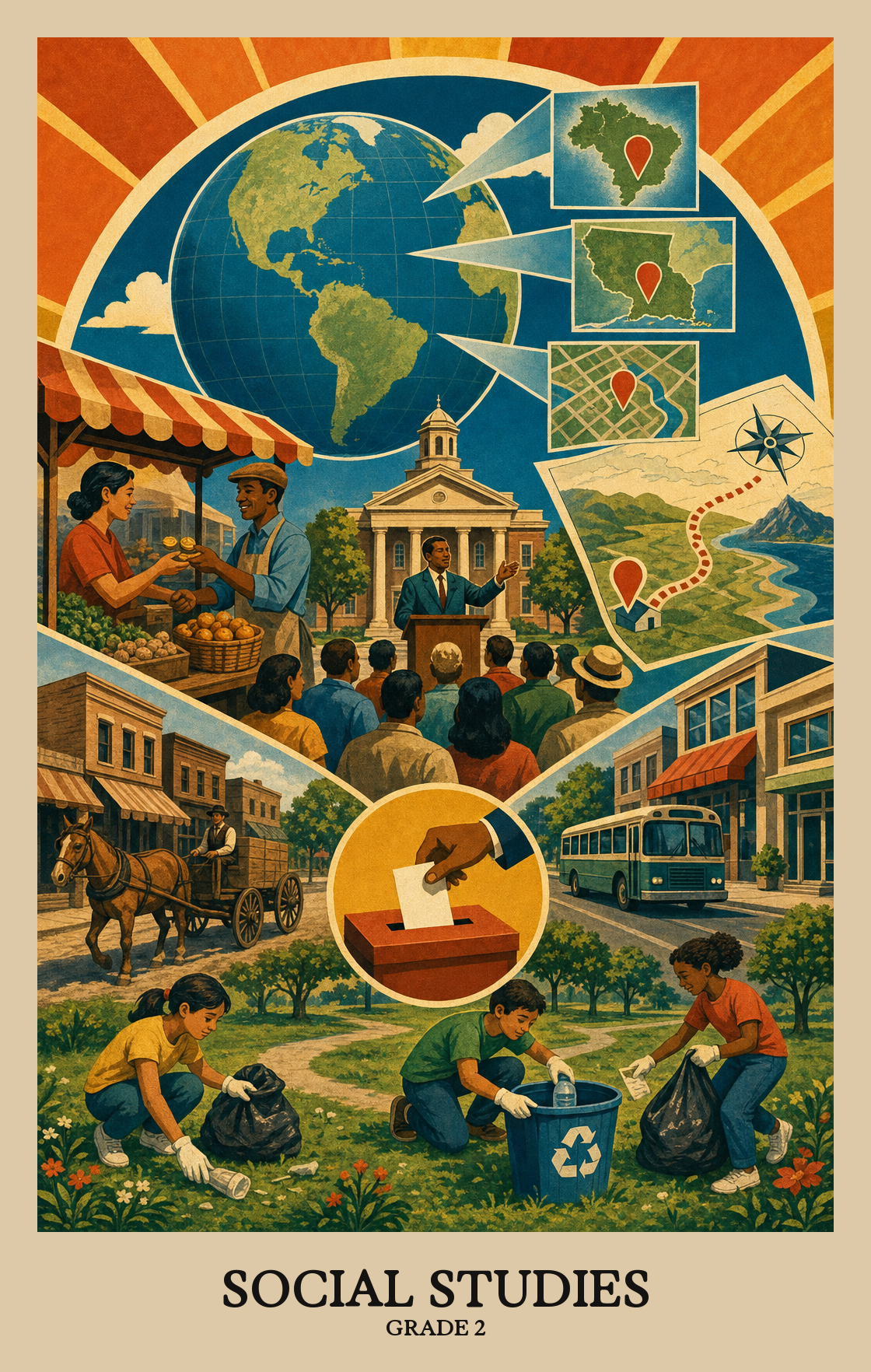
Students start the year learning how to read simple maps and globes. They locate their town, their state, and their country, and notice how land and water shape where people live.
Students look at how people live in different places and what makes each community feel like home. They compare daily life, traditions, and the ways neighborhoods change over time.
Students learn what a government does and why communities need rules. They talk about the rights and jobs of citizens, from voting to helping neighbors, and try out fair ways to make group decisions.
Students explore why people cannot have everything they want and how families and businesses make choices. They practice spending and saving and see how workers, shops, and customers depend on each other.
Students step back in time to look at people and events that shaped Delaware and the country. They use pictures, objects, and short readings to put events in order and notice what changed and what stayed the same.
Government is split into branches and levels so no single person holds all the power. Students learn what each part does, from the local mayor's office up to the national government in Washington.
Students look at the core ideas behind American democracy, like freedom and equality, and see how those ideas show up in documents such as the Constitution and the Declaration of Independence.
Citizens have rights (like free speech) and responsibilities (like following rules and treating others fairly). Students learn what it means to be an active, contributing member of a community and a democracy.
Students practice the skills of a good neighbor and community member: listening to others, sharing opinions respectfully, and working with a group to solve a problem.
| Standard | Definition | Code |
|---|---|---|
| Government | Government is split into branches and levels so no single person holds all the power. Students learn what each part does, from the local mayor's office up to the national government in Washington. | DE-SS.CIV.2.1 |
| Politics | Students look at the core ideas behind American democracy, like freedom and equality, and see how those ideas show up in documents such as the Constitution and the Declaration of Independence. | DE-SS.CIV.2.2 |
| Citizenship | Citizens have rights (like free speech) and responsibilities (like following rules and treating others fairly). Students learn what it means to be an active, contributing member of a community and a democracy. | DE-SS.CIV.2.3 |
| Participation | Students practice the skills of a good neighbor and community member: listening to others, sharing opinions respectfully, and working with a group to solve a problem. | DE-SS.CIV.2.4 |
When something is scarce, there isn't enough for everyone, so people have to choose. Students learn to weigh what they gain against what they give up when they spend, save, or trade.
Students learn how prices, choices, and rules shape what gets bought and sold. They look at how people, businesses, and the government each play a role in a market economy.
Students look at how different communities decide who makes things, who sells them, and who gets to buy them. They also explore why those rules shift as communities grow or face new problems.
Students learn how money works in everyday life, from saving and spending to how families, stores, and other countries depend on each other to get the goods and services they need.
| Standard | Definition | Code |
|---|---|---|
| Microeconomics | When something is scarce, there isn't enough for everyone, so people have to choose. Students learn to weigh what they gain against what they give up when they spend, save, or trade. | DE-SS.ECON.2.1 |
| Macroeconomics | Students learn how prices, choices, and rules shape what gets bought and sold. They look at how people, businesses, and the government each play a role in a market economy. | DE-SS.ECON.2.2 |
| Economic Systems | Students look at how different communities decide who makes things, who sells them, and who gets to buy them. They also explore why those rules shift as communities grow or face new problems. | DE-SS.ECON.2.3 |
| Personal Finance and Interdependence | Students learn how money works in everyday life, from saving and spending to how families, stores, and other countries depend on each other to get the goods and services they need. | DE-SS.ECON.2.4 |
Students learn to read maps and use them to explore places in the world around them. They build their own mental picture of where things are, from their neighborhood to farther-away regions.
Students look at how people change the land around them (building roads, clearing forests) and how those changes affect neighborhoods, animals, and plants nearby.
Students compare how people in different communities live, including the foods they eat, the languages they speak, and the traditions they celebrate. Every place people call home has its own history and way of life.
Students learn that regions are areas grouped by what they share, like climate, language, or land features. They explore how regions connect to each other, from neighborhoods up to states and countries.
| Standard | Definition | Code |
|---|---|---|
| Maps and Mental Maps | Students learn to read maps and use them to explore places in the world around them. They build their own mental picture of where things are, from their neighborhood to farther-away regions. | DE-SS.GEO.2.1 |
| Environment | Students look at how people change the land around them (building roads, clearing forests) and how those changes affect neighborhoods, animals, and plants nearby. | DE-SS.GEO.2.2 |
| Places and Cultures | Students compare how people in different communities live, including the foods they eat, the languages they speak, and the traditions they celebrate. Every place people call home has its own history and way of life. | DE-SS.GEO.2.3 |
| Regions | Students learn that regions are areas grouped by what they share, like climate, language, or land features. They explore how regions connect to each other, from neighborhoods up to states and countries. | DE-SS.GEO.2.4 |
Students put events in order and think about why things happened. They look at how life has stayed the same over time and how it has changed.
Students look at real historical sources, like old photos, letters, and books, to figure out what happened in the past and why.
Students look at pictures, documents, or stories from the past and explain how two people might remember the same event differently based on who they were and what they experienced.
Students learn about important events in Delaware, United States, and world history. They build a picture of how people and places changed over time.
| Standard | Definition | Code |
|---|---|---|
| Chronology | Students put events in order and think about why things happened. They look at how life has stayed the same over time and how it has changed. | DE-SS.HIST.2.1 |
| Analysis | Students look at real historical sources, like old photos, letters, and books, to figure out what happened in the past and why. | DE-SS.HIST.2.2 |
| Interpretation | Students look at pictures, documents, or stories from the past and explain how two people might remember the same event differently based on who they were and what they experienced. | DE-SS.HIST.2.3 |
| Content | Students learn about important events in Delaware, United States, and world history. They build a picture of how people and places changed over time. | DE-SS.HIST.2.4 |
Federally administered sample-based assessment in reading, mathematics, science, and writing. NAEP results inform state-by-state comparisons rather than individual student or school accountability.
Students learn about four big areas: how government works, how money and trade work, how maps and places work, and how the past connects to today. Most lessons stay close to home, looking at the neighborhood, the town, and Delaware before zooming out.
Talk about everyday choices that match the topics. Look at a map before a car trip, count change at the store, ask who makes the rules in different places, and share family stories from when grandparents were young. Ten minutes of real conversation does a lot.
Maps teach students to think about where things are and why that matters. By spring, students should be able to read a simple map key, point out land and water, and describe their own neighborhood using directions like north, south, east, and west.
Students learn that people cannot buy everything they want, so they have to choose. Practice this at home by giving a small budget for a treat at the store. Talk about what costs more, what costs less, and why someone might save instead of spend.
A common approach is to anchor each quarter in one strand while weaving the others through it. Geography works well early because maps support every other topic. History tends to land best later, once students have language for community, rules, and change.
Map directions and the difference between needs and wants come back again and again. Cause and effect in history also takes repeated practice. Plan short review moments in morning meeting or transitions rather than full reteach lessons.
Keep sources short and visual. Old photographs, a single artifact, a family recipe, or a one-sentence quote give plenty to talk about. Ask what students notice, what they wonder, and what the source tells them about life back then.
By the end of the year, students can describe their community, read a basic map, explain a rule and why it exists, tell the difference between a need and a want, and put a few events in order on a timeline. They should also know some basic Delaware history.
Tie it to something they care about. Visit a local park, library, or historic spot and ask questions while you are there. Watch a short kid-friendly video about a place or person and let students pick what to learn about next.