Building numbers to 1,000
Students learn to count, read, and write numbers up to 1,000. They start to see how hundreds, tens, and ones fit together, and they compare numbers to tell which is larger.
This is the year math grows past counting and starts thinking in groups of ten. Students add and subtract within 100 in their heads and within 1,000 on paper, and they learn why borrowing and carrying actually work. They measure with rulers, tell time on a clock, count coins, and read simple bar graphs. By spring, students can solve a two-step word problem about money or length and explain their thinking out loud.
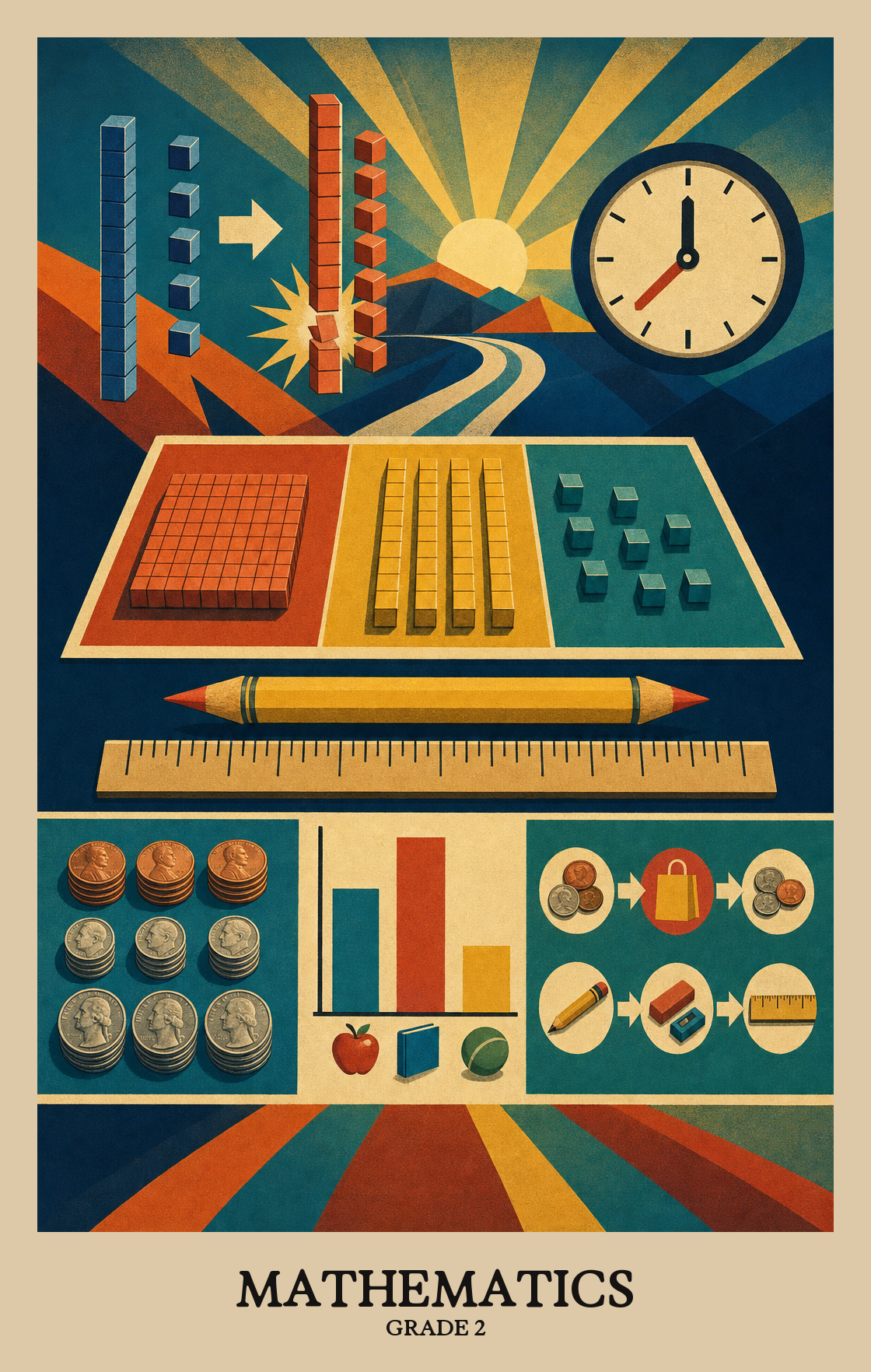
Students learn to count, read, and write numbers up to 1,000. They start to see how hundreds, tens, and ones fit together, and they compare numbers to tell which is larger.
Students get quick with addition and subtraction within 20 and start working with larger numbers up to 100. Expect to hear them explain their thinking out loud at the kitchen table.
Students use rulers in inches and centimeters, tell time on a clock to the nearest five minutes, and count coins and dollar bills to solve everyday money problems.
Students name and draw shapes by their sides and corners, then split rectangles and circles into halves, thirds, and fourths. This is the first taste of fractions.
Students read picture graphs and bar graphs and use them to answer questions. They pull together the year's skills to solve two-step word problems with bigger numbers.
Students read a math problem carefully, figure out what it is asking, and keep trying even when the first approach does not work.
Students take a word problem and turn it into numbers and symbols to solve it, then translate the answer back into a real-world meaning. Math and the situation it describes stay connected.
Students explain why their math answer makes sense and listen to how classmates solved the same problem. They practice disagreeing politely and asking questions when someone else's reasoning doesn't add up.
Students use math to figure out real problems, like splitting a snack equally or counting change at a store. The math connects to something that actually matters outside the classroom.
Students choose the right tool for the job, whether that means using a ruler, counting on their fingers, estimating, or picking up a pencil. The point is knowing which tool fits the problem.
Students use the right math words and pay attention to units like inches or minutes when solving problems. Getting the labels right matters as much as getting the number right.
Students spot patterns and rules hiding inside math problems, like noticing that adding in any order gives the same answer, then use that shortcut to solve new problems faster.
Students notice when the same steps keep showing up in a problem and use that pattern as a shortcut. Instead of starting from scratch each time, they spot what repeats and apply it.
| Standard | Definition | Code |
|---|---|---|
| Make Sense of Problems | Students read a math problem carefully, figure out what it is asking, and keep trying even when the first approach does not work. | DE-MATH.MP.2.1 |
| Reason Abstractly | Students take a word problem and turn it into numbers and symbols to solve it, then translate the answer back into a real-world meaning. Math and the situation it describes stay connected. | DE-MATH.MP.2.2 |
| Construct Arguments | Students explain why their math answer makes sense and listen to how classmates solved the same problem. They practice disagreeing politely and asking questions when someone else's reasoning doesn't add up. | DE-MATH.MP.2.3 |
| Model with Mathematics | Students use math to figure out real problems, like splitting a snack equally or counting change at a store. The math connects to something that actually matters outside the classroom. | DE-MATH.MP.2.4 |
| Use Tools Strategically | Students choose the right tool for the job, whether that means using a ruler, counting on their fingers, estimating, or picking up a pencil. The point is knowing which tool fits the problem. | DE-MATH.MP.2.5 |
| Attend to Precision | Students use the right math words and pay attention to units like inches or minutes when solving problems. Getting the labels right matters as much as getting the number right. | DE-MATH.MP.2.6 |
| Use Structure | Students spot patterns and rules hiding inside math problems, like noticing that adding in any order gives the same answer, then use that shortcut to solve new problems faster. | DE-MATH.MP.2.7 |
| Express Regularity | Students notice when the same steps keep showing up in a problem and use that pattern as a shortcut. Instead of starting from scratch each time, they spot what repeats and apply it. | DE-MATH.MP.2.8 |
Second graders work with whole numbers up to 1,000, learning how place value works and how to count forward and backward. They also take first steps with fractions, like splitting a shape or a group of objects into equal parts.
Second graders add, subtract, multiply, and divide to solve word problems. They write number sentences to show what's happening in a problem and figure out the missing piece.
Students read and build simple charts and graphs, then answer questions about what the data shows. They compare totals, find differences, and draw basic conclusions from the information in front of them.
Students sort and describe flat shapes (like squares and circles) and solid shapes (like cubes and cones) by their sides, corners, and faces. They also measure and group shapes by what makes them alike or different.
Ratio reasoning shows up in grade 2 as early comparison work. Students figure out how many times more or bigger one group is than another, using objects, drawings, or simple numbers to make the comparison.
| Standard | Definition | Code |
|---|---|---|
| Counting and Number | Second graders work with whole numbers up to 1,000, learning how place value works and how to count forward and backward. They also take first steps with fractions, like splitting a shape or a group of objects into equal parts. | DE-MATH.K8.2.1 |
| Operations and Algebraic Thinking | Second graders add, subtract, multiply, and divide to solve word problems. They write number sentences to show what's happening in a problem and figure out the missing piece. | DE-MATH.K8.2.2 |
| Measurement and Data | Students read and build simple charts and graphs, then answer questions about what the data shows. They compare totals, find differences, and draw basic conclusions from the information in front of them. | DE-MATH.K8.2.3 |
| Geometry | Students sort and describe flat shapes (like squares and circles) and solid shapes (like cubes and cones) by their sides, corners, and faces. They also measure and group shapes by what makes them alike or different. | DE-MATH.K8.2.4 |
| Ratios and Proportional Relationships | Ratio reasoning shows up in grade 2 as early comparison work. Students figure out how many times more or bigger one group is than another, using objects, drawings, or simple numbers to make the comparison. | DE-MATH.K8.2.5 |
Delaware's spring summative math test for grades 3 through 8, aligned to the Delaware Math Standards.
Students should add and subtract numbers within 100 quickly and accurately, count and group up to 1,000, tell time to the nearest five minutes, and measure with a ruler in inches and centimeters. They should also solve word problems with one or two steps.
Count coins from a jar, read the clock together at dinner, or measure a snack with a ruler. Word problems work too: if there are 14 grapes and 6 get eaten, how many are left? Short and steady beats long and rare.
Ask what the problem is about before asking for an answer. Pull out objects like coins, beans, or buttons so the numbers feel real. Let students draw a picture or count on fingers. Getting the right answer slowly is better than memorizing a trick.
Very important. By the end of the year, sums and differences within 20 should come from memory, not finger counting. Five minutes of flashcards or a quick card game most days makes a real difference by spring.
Start the fall with fluency within 20 and place value to 100. Move into adding and subtracting two-digit numbers using place value and open number lines before introducing the standard algorithm. Save three-digit work and money problems for spring, once regrouping is solid.
Regrouping across the tens place trips up the most students, especially in subtraction. Telling time past the half hour and reading a ruler that does not start at zero also need extra cycles. Build in short review every few weeks instead of one long unit at the end.
Word problems should show up almost every day, not as a separate unit. Mix problem types so students cannot guess the operation from the wording. Two-step problems with a missing start or change number are the hardest and need the most practice.
Students should add and subtract within 100 on paper without counting, explain why regrouping works using tens and ones, measure and compare lengths, and read a bar graph. They should also solve a two-step word problem and check whether the answer makes sense.