Thinking like a scientist
Students start the year learning how scientists work. They ask questions they can actually test, plan simple experiments, and record what they notice so the results mean something.
This is the year science shifts from watching the world to testing ideas about it. Students plan small investigations, collect data, and use that data to explain what they see, whether it's how a plant grows, how energy moves, or how a rock changed over time. They also start sketching their own fixes for real problems and improving the design after each try. By spring, they can run a simple experiment and point to the evidence behind their answer.
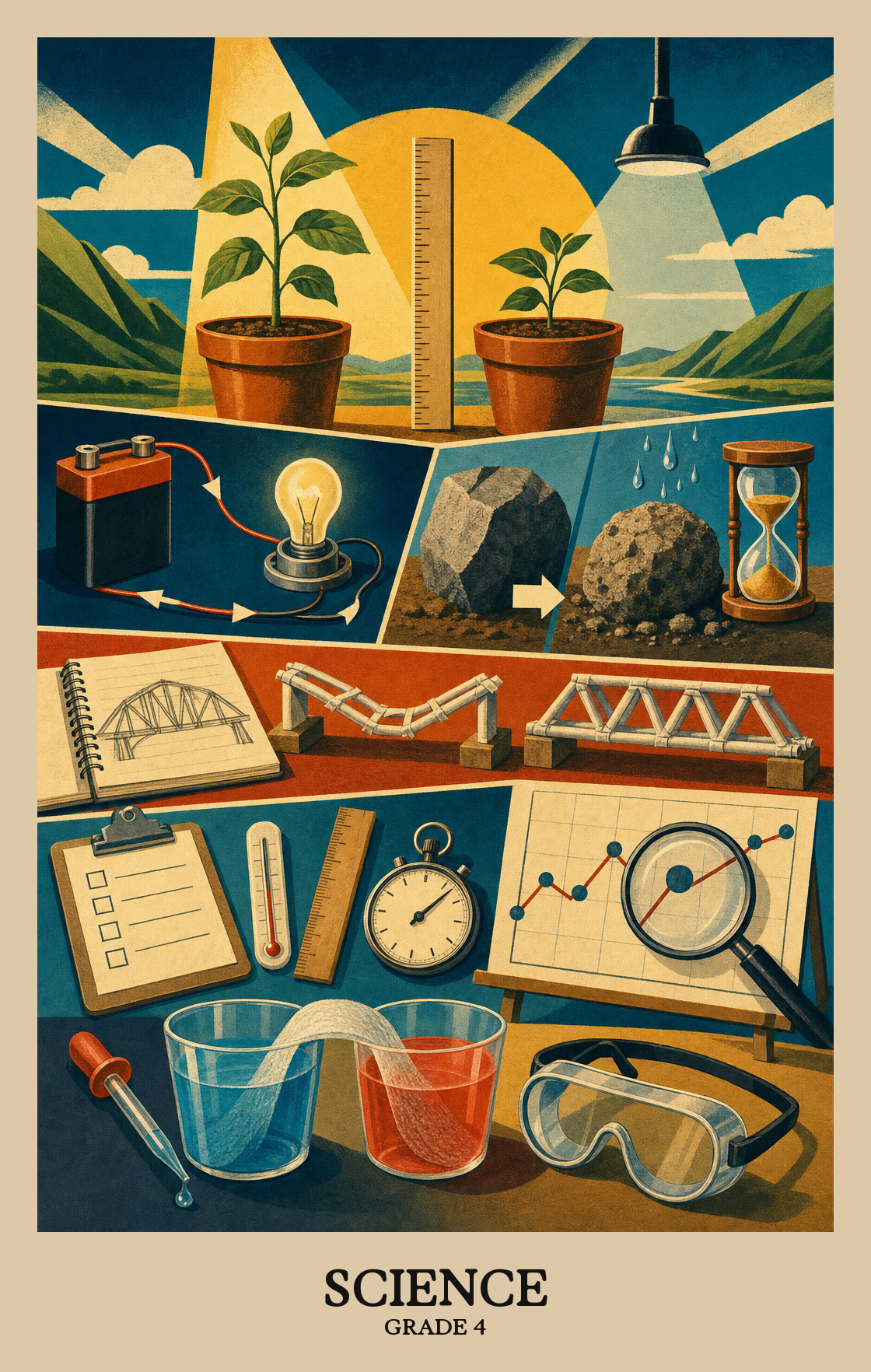
Students start the year learning how scientists work. They ask questions they can actually test, plan simple experiments, and record what they notice so the results mean something.
Students explore how things move, how energy moves from one place to another, and how waves carry sound and light. Expect questions at home about collisions, speed, and why echoes happen.
Students study how living things are built and how they depend on each other. They look at how plants and animals get what they need, how traits pass from parents to offspring, and how living things change over long stretches of time.
Students look at Earth as a system of rock, water, air, and living things. They track patterns in the sky, study how landforms change, and consider how people affect the planet and prepare for storms and earthquakes.
Students wrap up the year by acting like engineers. They define a real problem, sketch possible fixes, build and test a model, and improve the design based on what the test shows.
Students come up with questions that can be tested with an experiment or a problem that could be solved by building or designing something.
Students build or draw a model, like a diagram or a physical replica, to show how something works or why something happens. The model is a tool for thinking, not just decoration.
Students plan a test, collect data, and use what they find to check whether their idea holds up. This is the core of how scientists work, and fourth graders practice it hands-on.
Students look at data from an experiment and explain what it means. They spot patterns, like whether a plant grew faster with more sunlight, and use those patterns to answer a question.
Students use numbers, measurements, and simple calculations to back up their science ideas. Instead of just describing what happened in an investigation, they show it with data.
Students take what they observed or measured and use it to explain why something happened. They back up every explanation with real evidence, not just a guess.
Students look at two different explanations or solutions, then use evidence to argue which one holds up better. The focus is on backing a position with data, not just an opinion.
Students read science articles or diagrams, decide what information is accurate and useful, then share what they learned in writing or a presentation.
| Standard | Definition | Code |
|---|---|---|
| Asking Questions and Defining Problems | Students come up with questions that can be tested with an experiment or a problem that could be solved by building or designing something. | DE-SCI.SEP.4.1 |
| Developing and Using Models | Students build or draw a model, like a diagram or a physical replica, to show how something works or why something happens. The model is a tool for thinking, not just decoration. | DE-SCI.SEP.4.2 |
| Planning and Carrying Out Investigations | Students plan a test, collect data, and use what they find to check whether their idea holds up. This is the core of how scientists work, and fourth graders practice it hands-on. | DE-SCI.SEP.4.3 |
| Analyzing and Interpreting Data | Students look at data from an experiment and explain what it means. They spot patterns, like whether a plant grew faster with more sunlight, and use those patterns to answer a question. | DE-SCI.SEP.4.4 |
| Mathematics and Computational Thinking | Students use numbers, measurements, and simple calculations to back up their science ideas. Instead of just describing what happened in an investigation, they show it with data. | DE-SCI.SEP.4.5 |
| Constructing Explanations | Students take what they observed or measured and use it to explain why something happened. They back up every explanation with real evidence, not just a guess. | DE-SCI.SEP.4.6 |
| Engaging in Argument from Evidence | Students look at two different explanations or solutions, then use evidence to argue which one holds up better. The focus is on backing a position with data, not just an opinion. | DE-SCI.SEP.4.7 |
| Communicating Information | Students read science articles or diagrams, decide what information is accurate and useful, then share what they learned in writing or a presentation. | DE-SCI.SEP.4.8 |
Students examine what everyday materials are made of and explore how tiny particles interact to explain why things behave the way they do, like why ice melts or sugar dissolves in water.
Students explore how pushes and pulls affect whether objects move, speed up, or stay still. They test real examples to see patterns in how force and motion work together.
Students explore how energy shows up as heat, light, sound, and motion, and how it moves from one object to another. They also learn that energy doesn't disappear when it seems to, it just changes form.
Students explore how waves (like sound and light) carry energy from one place to another. They also look at how waves are used to send information, like in radios or phones.
| Standard | Definition | Code |
|---|---|---|
| Matter and Interactions | Students examine what everyday materials are made of and explore how tiny particles interact to explain why things behave the way they do, like why ice melts or sugar dissolves in water. | DE-SCI.PS.4.1 |
| Motion and Stability | Students explore how pushes and pulls affect whether objects move, speed up, or stay still. They test real examples to see patterns in how force and motion work together. | DE-SCI.PS.4.2 |
| Energy | Students explore how energy shows up as heat, light, sound, and motion, and how it moves from one object to another. They also learn that energy doesn't disappear when it seems to, it just changes form. | DE-SCI.PS.4.3 |
| Waves and Information | Students explore how waves (like sound and light) carry energy from one place to another. They also look at how waves are used to send information, like in radios or phones. | DE-SCI.PS.4.4 |
Students learn how living things are built and how they work, starting with the tiny cells inside them and moving up to whole body systems like digestion or circulation.
Students trace how food, water, and nutrients move through an ecosystem, from plants to animals to decomposers. They also study how living things in a community depend on and affect each other.
Students look at traits like eye color, height, or leaf shape and figure out which ones were passed down from parents and which ones just vary from one individual to the next.
Students compare living things to find patterns in how they are similar and how they differ. They also learn why some traits help animals and plants survive long enough to pass those traits on.
| Standard | Definition | Code |
|---|---|---|
| Structures and Processes | Students learn how living things are built and how they work, starting with the tiny cells inside them and moving up to whole body systems like digestion or circulation. | DE-SCI.LS.4.1 |
| Ecosystems | Students trace how food, water, and nutrients move through an ecosystem, from plants to animals to decomposers. They also study how living things in a community depend on and affect each other. | DE-SCI.LS.4.2 |
| Heredity | Students look at traits like eye color, height, or leaf shape and figure out which ones were passed down from parents and which ones just vary from one individual to the next. | DE-SCI.LS.4.3 |
| Biological Evolution | Students compare living things to find patterns in how they are similar and how they differ. They also learn why some traits help animals and plants survive long enough to pass those traits on. | DE-SCI.LS.4.4 |
Students study where Earth sits in the solar system and how the sun, moon, and planets move in predictable patterns. They also look at how Earth itself has changed over a very long time.
Students learn how Earth's land, water, air, and living things connect and affect each other. They look at how a rainstorm shapes soil, how plants filter air, and how those systems push and pull on one another.
Students explore how things people do, like building roads or burning fuel, change the land, water, and air around them. They also look at how earthquakes, floods, and storms disrupt daily life.
| Standard | Definition | Code |
|---|---|---|
| Earth's Place in the Universe | Students study where Earth sits in the solar system and how the sun, moon, and planets move in predictable patterns. They also look at how Earth itself has changed over a very long time. | DE-SCI.ESS.4.1 |
| Earth's Systems | Students learn how Earth's land, water, air, and living things connect and affect each other. They look at how a rainstorm shapes soil, how plants filter air, and how those systems push and pull on one another. | DE-SCI.ESS.4.2 |
| Earth and Human Activity | Students explore how things people do, like building roads or burning fuel, change the land, water, and air around them. They also look at how earthquakes, floods, and storms disrupt daily life. | DE-SCI.ESS.4.3 |
Students identify a real problem, sketch or build possible fixes, then test each one and improve it until the best solution works.
Students explore how the tools and inventions people build shape everyday life, and how the needs of everyday life push engineers to build new ones.
| Standard | Definition | Code |
|---|---|---|
| Engineering Design | Students identify a real problem, sketch or build possible fixes, then test each one and improve it until the best solution works. | DE-SCI.ETS.4.1 |
| Links Among Engineering, Technology, and Society | Students explore how the tools and inventions people build shape everyday life, and how the needs of everyday life push engineers to build new ones. | DE-SCI.ETS.4.2 |
Federally administered sample-based assessment in reading, mathematics, science, and writing. NAEP results inform state-by-state comparisons rather than individual student or school accountability.
Students do real investigations instead of just reading about science. They ask questions, run small experiments, collect data, and explain what the results mean. Topics include forces and motion, energy, plants and animals, ecosystems, Earth's systems, and basic engineering design.
Notice the science already around the house. Ask why ice melts faster on the counter than in the freezer, why a ball rolls farther on tile than carpet, or what plants in the yard need to grow. Five minutes of wondering out loud builds the habit of asking and testing.
Less than parents expect. Students should be able to talk about force, energy, matter, habitat, and cycle using their own words and examples. Knowing what a word means in a real situation matters more than reciting a textbook definition.
Most teachers anchor each unit in a phenomenon students can observe, then layer in the science practices across the year. A common path is matter and energy first, then forces and motion, then life science and ecosystems, with Earth science and an engineering design challenge near the end.
Planning a fair test and analyzing data tend to be the hardest. Students often change more than one variable at a time or jump to a conclusion before looking at the numbers. Short, repeated investigations work better than one big project.
Build something simple and test it. A paper airplane, a ramp for toy cars, or a small bridge from index cards all work. Have students change one thing, like the wing shape or ramp height, and see what happens. That is real engineering thinking.
Quite a bit. Students record what they did, draw labeled diagrams, and write short explanations that use evidence from their data. Sentences like "I think this happened because the data showed..." become a regular habit.
Ready students can ask a testable question, plan a simple investigation, and explain a result using evidence. They can also read a chart or diagram and pull out a pattern. If those habits are solid, the heavier middle school content has somewhere to land.
Usually it means the science feels disconnected from anything real. Try a hands-on moment at home: float and sink different objects, watch shadows move across an afternoon, or plant a seed in a cup. Curiosity tends to come back once students get to touch something.