Place value to one million
Students work with bigger numbers, reading and writing them up to the millions. They compare numbers, round to estimate, and start to see how each digit's place changes its value.
This is the year math stretches into bigger numbers and starts treating fractions as real quantities. Students work with numbers in the thousands, get faster at multiplying and dividing, and compare fractions like 3/4 and 5/8 instead of just naming them. They also measure and classify shapes by their angles and sides. By spring, students can solve a multi-step word problem and add fractions with the same bottom number.
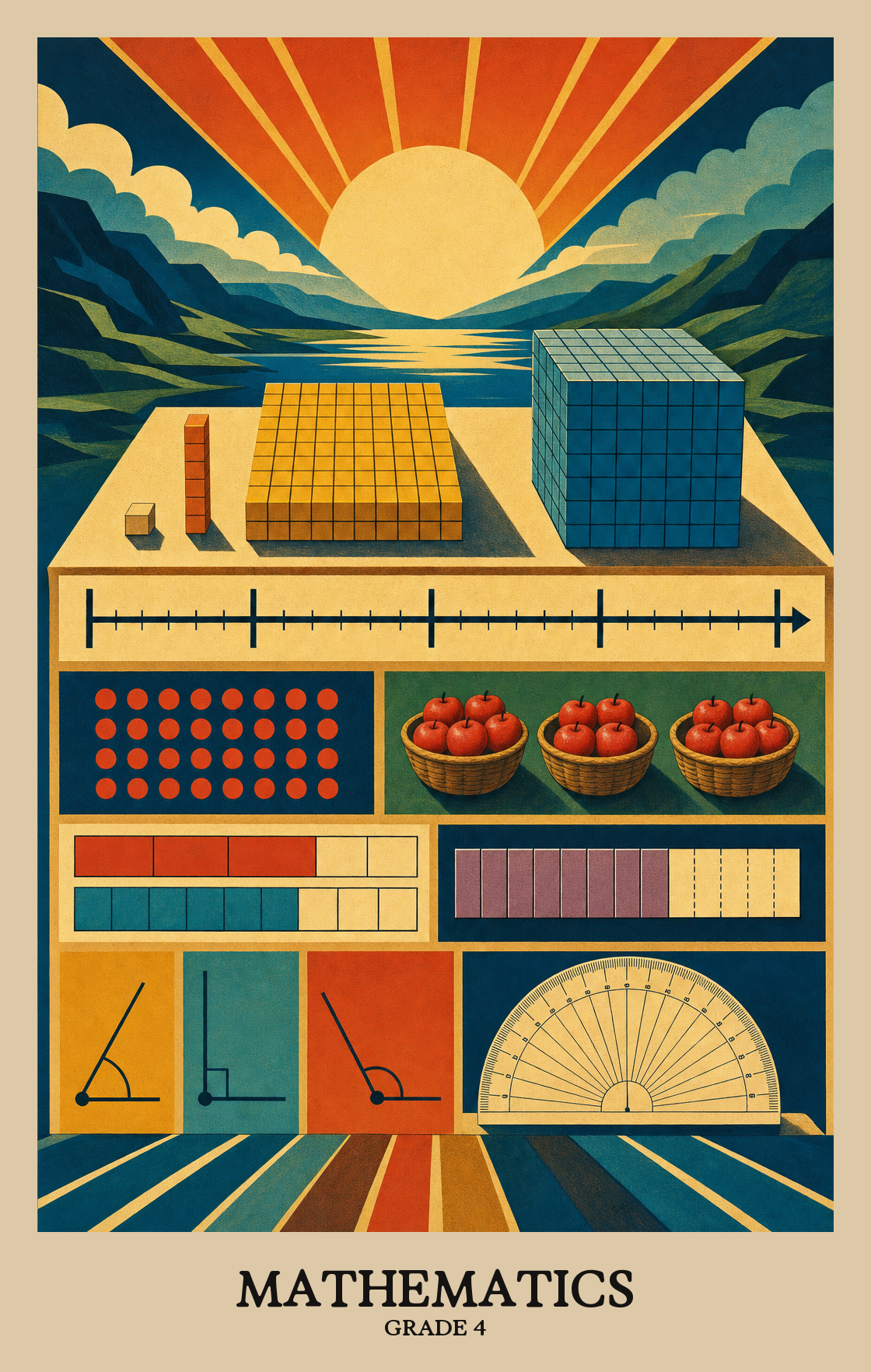
Students work with bigger numbers, reading and writing them up to the millions. They compare numbers, round to estimate, and start to see how each digit's place changes its value.
Students multiply larger numbers and divide with remainders. Word problems become a bigger part of the work, so students decide which operation fits and check that the answer makes sense.
Students compare fractions, find equivalent ones, and add and subtract fractions that share a denominator. They also start connecting fractions to decimals like 0.5 and 0.25.
Students measure with rulers and protractors, convert between units like feet and inches, and sort shapes by their sides and angles. They also find area and perimeter of rectangles in real situations.
Students extend number and shape patterns, read line plots and tables, and pull it all together in multi-step word problems. They explain their thinking and check whether an answer is reasonable.
Students read a math problem carefully, figure out what it's actually asking, and keep trying even when the first approach doesn't work.
Students take a real problem (like splitting a pizza) and turn it into numbers and equations to solve it. Then they check that the answer still makes sense back in the real world.
Students explain why their math answer is correct, then listen to a classmate's explanation and say whether they agree or disagree, and why. The focus is on reasoning out loud, not just getting the right answer.
Students use math to make sense of real situations, like figuring out how much something costs or whether there's enough time to finish a task. They draw pictures, write equations, or build charts to work through the problem.
Students choose the right tool for the math problem in front of them, whether that means reaching for a calculator, sketching it out on paper, or making a quick estimate in their head.
Students use the right math words, label answers with the correct units (inches, minutes, dollars), and check their calculations carefully.
Students spot patterns and rules hiding inside numbers, shapes, and problems, then use those patterns as shortcuts. Noticing that multiplication facts follow a pattern, for example, is exactly this skill.
Students notice when the same steps keep showing up in a problem and use that pattern as a shortcut. Instead of starting over each time, they explain the rule they found.
| Standard | Definition | Code |
|---|---|---|
| Make Sense of Problems | Students read a math problem carefully, figure out what it's actually asking, and keep trying even when the first approach doesn't work. | DE-MATH.MP.4.1 |
| Reason Abstractly | Students take a real problem (like splitting a pizza) and turn it into numbers and equations to solve it. Then they check that the answer still makes sense back in the real world. | DE-MATH.MP.4.2 |
| Construct Arguments | Students explain why their math answer is correct, then listen to a classmate's explanation and say whether they agree or disagree, and why. The focus is on reasoning out loud, not just getting the right answer. | DE-MATH.MP.4.3 |
| Model with Mathematics | Students use math to make sense of real situations, like figuring out how much something costs or whether there's enough time to finish a task. They draw pictures, write equations, or build charts to work through the problem. | DE-MATH.MP.4.4 |
| Use Tools Strategically | Students choose the right tool for the math problem in front of them, whether that means reaching for a calculator, sketching it out on paper, or making a quick estimate in their head. | DE-MATH.MP.4.5 |
| Attend to Precision | Students use the right math words, label answers with the correct units (inches, minutes, dollars), and check their calculations carefully. | DE-MATH.MP.4.6 |
| Use Structure | Students spot patterns and rules hiding inside numbers, shapes, and problems, then use those patterns as shortcuts. Noticing that multiplication facts follow a pattern, for example, is exactly this skill. | DE-MATH.MP.4.7 |
| Express Regularity | Students notice when the same steps keep showing up in a problem and use that pattern as a shortcut. Instead of starting over each time, they explain the rule they found. | DE-MATH.MP.4.8 |
Fourth graders work with whole numbers, fractions, and basic number patterns. They count, compare, and reason about numbers to solve problems that show up in everyday life, like splitting a pizza or reading a number line.
Students use addition, subtraction, multiplication, and division to solve word problems and write number sentences that show their thinking.
Students read and build bar graphs, line plots, and tables to answer questions about real data. They also start drawing conclusions from what the numbers show.
Students sort, name, and measure flat and solid shapes, such as squares, triangles, and cubes. They use what they know about sides, angles, and faces to explain how shapes are alike or different.
Students use ratio thinking to solve everyday problems, like figuring out how many items you get for a set price or how ingredients scale up in a recipe. They apply this skill to both real situations and math problems.
| Standard | Definition | Code |
|---|---|---|
| Counting and Number | Fourth graders work with whole numbers, fractions, and basic number patterns. They count, compare, and reason about numbers to solve problems that show up in everyday life, like splitting a pizza or reading a number line. | DE-MATH.K8.4.1 |
| Operations and Algebraic Thinking | Students use addition, subtraction, multiplication, and division to solve word problems and write number sentences that show their thinking. | DE-MATH.K8.4.2 |
| Measurement and Data | Students read and build bar graphs, line plots, and tables to answer questions about real data. They also start drawing conclusions from what the numbers show. | DE-MATH.K8.4.3 |
| Geometry | Students sort, name, and measure flat and solid shapes, such as squares, triangles, and cubes. They use what they know about sides, angles, and faces to explain how shapes are alike or different. | DE-MATH.K8.4.4 |
| Ratios and Proportional Relationships | Students use ratio thinking to solve everyday problems, like figuring out how many items you get for a set price or how ingredients scale up in a recipe. They apply this skill to both real situations and math problems. | DE-MATH.K8.4.5 |
Delaware's spring summative math test for grades 3 through 8, aligned to the Delaware Math Standards.
Federally administered sample-based assessment in reading, mathematics, science, and writing. NAEP results inform state-by-state comparisons rather than individual student or school accountability.
Students should be comfortable with multiplication and division facts, multi-digit addition and subtraction, and multiplying larger numbers by one-digit numbers. They should also compare fractions, add fractions with the same bottom number, and solve word problems that take more than one step.
Practice multiplication facts in the car or at dinner, especially the harder ones like 6, 7, 8, and 9. Cooking, measuring, and counting change are quick ways to bring fractions and money into real life without it feeling like homework.
Fourth grade math leans hard on quick recall. When students have to stop and figure out 7 times 8, they lose track of the bigger problem. Five minutes of fact practice a few nights a week pays off all year.
Students compare fractions, find equal fractions like one-half and two-fourths, and add fractions that share the same bottom number. Folding paper, cutting pizza, or measuring with a ruler at home makes this much easier to picture.
Start with place value and multi-digit operations, then move into multiplication and division strategies, then fractions, then measurement and geometry. Fractions usually need the biggest block of time. Word problems should run through every unit, not sit at the end.
Long division, equivalent fractions, and multi-step word problems. Many students also wobble on area versus perimeter and on reading the remainder in a division problem. Plan for spiral review on these into spring.
Ask students to read it twice and say what the question is asking in their own words. Then ask what they already know and what they need to find. Drawing a picture or acting it out with coins or snacks often unlocks it.
Students can multiply a four-digit number by a one-digit number, divide with remainders, compare fractions with different bottoms, and solve two-step word problems with reasoning they can explain. They should also measure with a ruler and protractor and know basic shape properties.