Thinking like a scientist
Students start the year learning how scientists work. They ask questions about things they notice, plan simple tests, and record what happens so they can talk about it later.
This is the year science becomes about asking questions and testing them, not just learning facts. Students plan small investigations, look for patterns in what they see, and explain results using evidence. They study weather, animals, forces like push and pull, and how the land changes over time. By spring, they can ask a science question, run a simple test, and tell a parent what the results show.
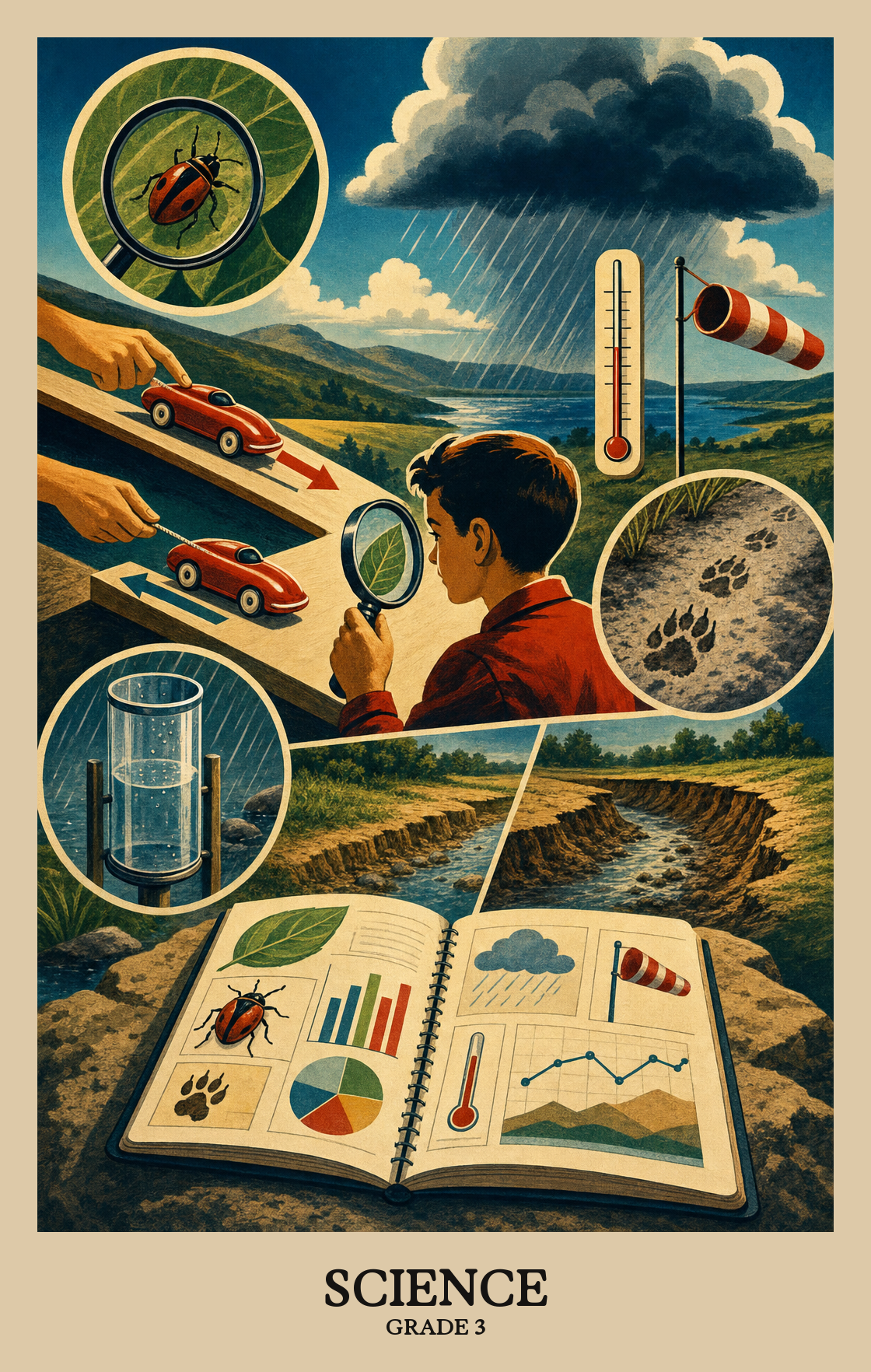
Students start the year learning how scientists work. They ask questions about things they notice, plan simple tests, and record what happens so they can talk about it later.
Students push, pull, and roll objects to see what makes them speed up, slow down, or change direction. They also explore how energy moves through light, sound, and heat.
Students look at plants and animals and the places they live. They notice how living things get what they need from their surroundings and how traits pass from parents to their young.
Students track the sun, moon, and weather over time. They look for patterns in the sky and on the ground, and they study how land, water, and air shape the places people live.
Students take on a design challenge. They pick a problem worth solving, sketch ideas, build a model, test it, and make changes when something does not work.
Students learn to ask questions that science can actually test and spot problems that engineering can solve. It's the habit of turning curiosity into something worth investigating.
Students build or draw a simple model (like a diagram or labeled sketch) to show how something in nature works or how a design solves a problem.
Students plan a test, collect information, and check whether their idea holds up. This is how scientists figure out if they are right.
Reading a chart or table, students look for patterns in the numbers or results and explain what those patterns mean.
Students use counting, measuring, and simple math to back up what they notice in science. Instead of just saying something seems bigger or heavier, they use numbers to show it.
Students use what they observed or measured to explain why something happened. The explanation has to be backed by real evidence, not just a guess.
Students look at two different explanations or solutions, then use facts and observations to argue which one holds up better. Think of it as a science debate backed by real evidence, not just opinion.
Students read scientific information from books, diagrams, or charts, decide what it means, and explain it to others in words or pictures.
| Standard | Definition | Code |
|---|---|---|
| Asking Questions and Defining Problems | Students learn to ask questions that science can actually test and spot problems that engineering can solve. It's the habit of turning curiosity into something worth investigating. | CT-SCI.SEP.3.1 |
| Developing and Using Models | Students build or draw a simple model (like a diagram or labeled sketch) to show how something in nature works or how a design solves a problem. | CT-SCI.SEP.3.2 |
| Planning and Carrying Out Investigations | Students plan a test, collect information, and check whether their idea holds up. This is how scientists figure out if they are right. | CT-SCI.SEP.3.3 |
| Analyzing and Interpreting Data | Reading a chart or table, students look for patterns in the numbers or results and explain what those patterns mean. | CT-SCI.SEP.3.4 |
| Mathematics and Computational Thinking | Students use counting, measuring, and simple math to back up what they notice in science. Instead of just saying something seems bigger or heavier, they use numbers to show it. | CT-SCI.SEP.3.5 |
| Constructing Explanations | Students use what they observed or measured to explain why something happened. The explanation has to be backed by real evidence, not just a guess. | CT-SCI.SEP.3.6 |
| Engaging in Argument from Evidence | Students look at two different explanations or solutions, then use facts and observations to argue which one holds up better. Think of it as a science debate backed by real evidence, not just opinion. | CT-SCI.SEP.3.7 |
| Communicating Information | Students read scientific information from books, diagrams, or charts, decide what it means, and explain it to others in words or pictures. | CT-SCI.SEP.3.8 |
Students look closely at what everyday materials are made of and explore why some substances mix, dissolve, or change when they interact with each other.
Students explore how pushes and pulls make objects speed up, slow down, or change direction. They look at what keeps things steady and what sets them moving.
Students explore how energy shows up in different forms, like heat, light, and sound, and trace where it goes when something moves, glows, or makes noise. Energy doesn't disappear; it just changes from one form to another.
Students study how waves, like sound and light, carry energy and information from one place to another. They look at real examples, such as how a phone screen or a speaker works.
| Standard | Definition | Code |
|---|---|---|
| Matter and Interactions | Students look closely at what everyday materials are made of and explore why some substances mix, dissolve, or change when they interact with each other. | CT-SCI.PS.3.1 |
| Motion and Stability | Students explore how pushes and pulls make objects speed up, slow down, or change direction. They look at what keeps things steady and what sets them moving. | CT-SCI.PS.3.2 |
| Energy | Students explore how energy shows up in different forms, like heat, light, and sound, and trace where it goes when something moves, glows, or makes noise. Energy doesn't disappear; it just changes from one form to another. | CT-SCI.PS.3.3 |
| Waves and Information | Students study how waves, like sound and light, carry energy and information from one place to another. They look at real examples, such as how a phone screen or a speaker works. | CT-SCI.PS.3.4 |
Students look at how living things are built and how they work, from the tiny cells inside them to the organs and body systems those cells make up.
Students trace how food, water, and energy move through a living community, from plants to animals to decomposers. They also look at how organisms depend on each other to survive.
Students look at traits like eye color, leaf shape, or fur pattern and figure out which ones got passed down from parents and which ones vary across a family.
Students compare living things to spot what they share and what makes each one different. That investigation builds toward understanding why life on Earth looks the way it does today.
| Standard | Definition | Code |
|---|---|---|
| Structures and Processes | Students look at how living things are built and how they work, from the tiny cells inside them to the organs and body systems those cells make up. | CT-SCI.LS.3.1 |
| Ecosystems | Students trace how food, water, and energy move through a living community, from plants to animals to decomposers. They also look at how organisms depend on each other to survive. | CT-SCI.LS.3.2 |
| Heredity | Students look at traits like eye color, leaf shape, or fur pattern and figure out which ones got passed down from parents and which ones vary across a family. | CT-SCI.LS.3.3 |
| Biological Evolution | Students compare living things to spot what they share and what makes each one different. That investigation builds toward understanding why life on Earth looks the way it does today. | CT-SCI.LS.3.4 |
Students explore where Earth sits in the solar system and how the sun, moon, and planets follow predictable patterns as they move. They also look at how Earth itself has changed over a very long time.
Students study how Earth's land, water, air, and living things connect and affect each other. They look at how a rainstorm shapes soil, how plants filter air, and how one change ripples through the rest.
Students learn how people change the land, air, and water around them, and how events like floods, earthquakes, and wildfires affect where and how people live.
| Standard | Definition | Code |
|---|---|---|
| Earth's Place in the Universe | Students explore where Earth sits in the solar system and how the sun, moon, and planets follow predictable patterns as they move. They also look at how Earth itself has changed over a very long time. | CT-SCI.ESS.3.1 |
| Earth's Systems | Students study how Earth's land, water, air, and living things connect and affect each other. They look at how a rainstorm shapes soil, how plants filter air, and how one change ripples through the rest. | CT-SCI.ESS.3.2 |
| Earth and Human Activity | Students learn how people change the land, air, and water around them, and how events like floods, earthquakes, and wildfires affect where and how people live. | CT-SCI.ESS.3.3 |
Students spot a problem, sketch out a few ways to fix it, then test their ideas and improve them until one works well enough to use.
Students explore how inventions change everyday life and how the needs of a community shape what engineers build next.
| Standard | Definition | Code |
|---|---|---|
| Engineering Design | Students spot a problem, sketch out a few ways to fix it, then test their ideas and improve them until one works well enough to use. | CT-SCI.ETS.3.1 |
| Links Among Engineering, Technology, and Society | Students explore how inventions change everyday life and how the needs of a community shape what engineers build next. | CT-SCI.ETS.3.2 |
Federally administered sample-based assessment in reading, mathematics, science, and writing. NAEP results inform state-by-state comparisons rather than individual student or school accountability.
Science this year is mostly hands-on. Students ask questions, run small experiments, look at what happened, and try to explain why. They cover living things, weather and Earth, forces and motion, and simple engineering projects where they build something and improve it.
Notice things together and ask why. Watch ice melt in a glass, track the weather for a week, plant a seed in a cup, or build a paper bridge that holds pennies. Five minutes of wondering out loud teaches more than a worksheet.
Science at this age is not about right answers. It is about guessing, testing, and changing your mind when something surprises you. Praise the guess and the try, not the result, and the confidence usually comes back.
A common path is to start with life science in the fall while the weather is still good for outdoor observation, move to Earth and weather in winter, and finish with physical science and an engineering build in spring. The practices like asking questions and using evidence run through every unit.
Two areas tend to stick: telling the difference between an observation and a guess, and using evidence to back up an explanation instead of just stating an opinion. Build short routines around both from week one and revisit them in every unit.
Some words matter, like habitat, force, energy, and evidence. But memorizing long lists is not the point. Students should be able to use a word correctly when they explain what they saw, not recite a definition on a quiz.
A clear problem, a simple design students drew first, a build using everyday materials, and at least one round of testing and fixing. The fixing part matters most. A first try that fails and a second try that works better is a success.
By spring, students should be able to ask a testable question, plan a simple investigation, record what happened, and explain the result using what they saw. If they can do that with a new topic they have not studied, they are ready.