Multiplication and division basics
Students learn what it means to multiply and divide with small numbers. They work with groups of objects, arrays, and simple word problems to see how the two operations connect.
This is the year math shifts from adding and subtracting to thinking in groups. Students learn their multiplication and division facts and start using them to solve word problems. They also meet fractions for the first time, seeing that a half or a third names a real piece of a whole. By spring, students can recall basic times tables and split a shape into equal parts they can name.
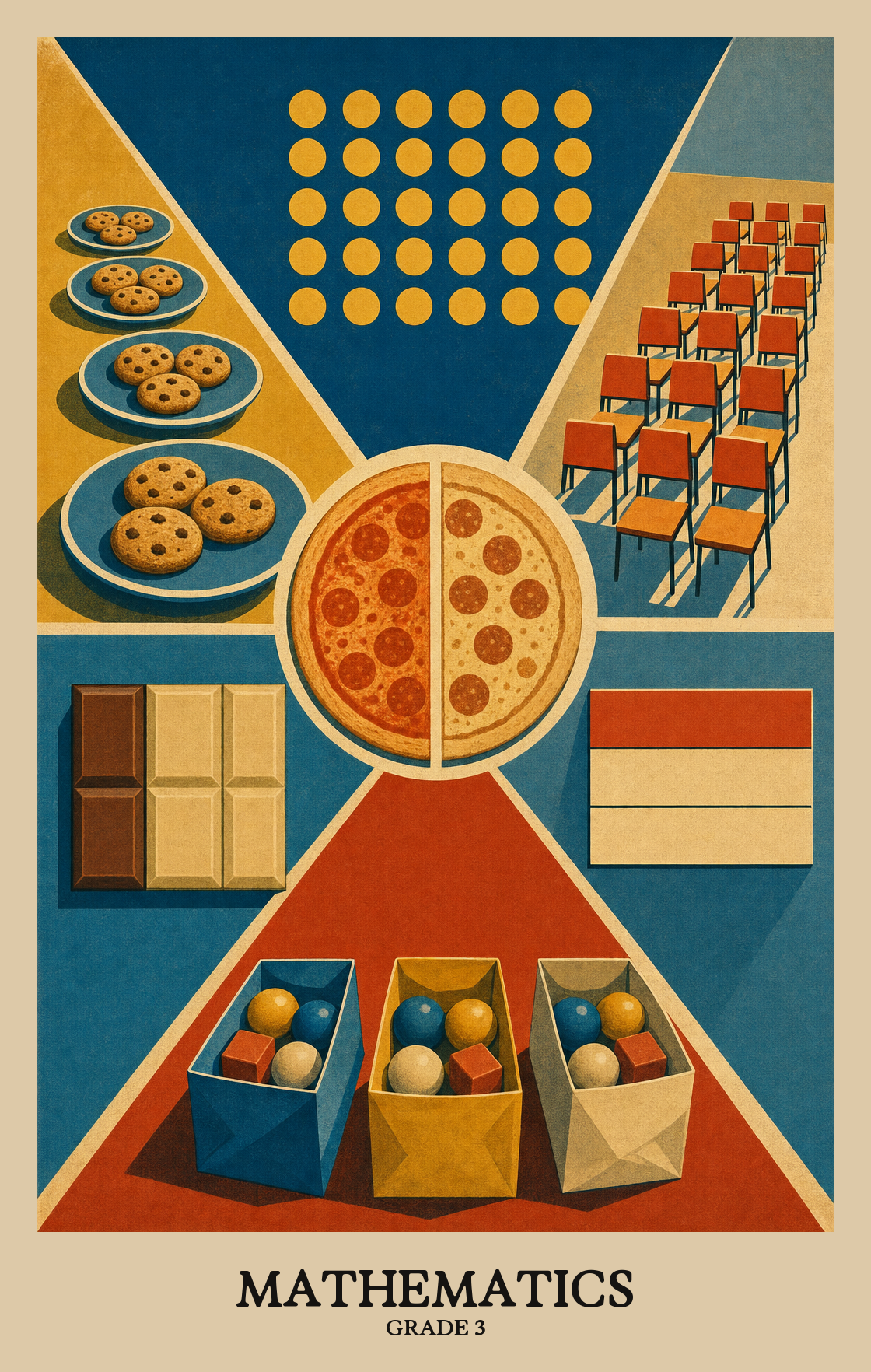
Students learn what it means to multiply and divide with small numbers. They work with groups of objects, arrays, and simple word problems to see how the two operations connect.
Students memorize their times tables up to 10 and notice patterns in the numbers. By the end of this stretch, most basic multiplication and division facts should come quickly.
Students start treating fractions like halves and fourths as real numbers, not just pieces of a pizza. They place fractions on a number line and figure out when two fractions are equal.
Students tell time to the minute, measure with rulers, and find the area of rectangles by counting squares. They also read bar graphs and picture graphs to answer questions.
Students sort shapes by their sides and angles and find the perimeter around a figure. They also explain their thinking out loud and check whether another student's answer makes sense.
Students read a math problem carefully, figure out what it's asking, and keep trying even when the first attempt doesn't work.
Students take a word problem and strip it down to numbers and symbols to solve it, then translate the answer back into real-world terms. Math thinking moves in both directions.
Students explain why their math answer is correct and listen to classmates' reasoning to decide whether it holds up.
Students use math to make sense of real situations, like figuring out how many plates to set for dinner or how long a car trip will take. They draw pictures, write number sentences, or build charts to show their thinking.
Students choose the right tool for the math problem in front of them. That might mean reaching for a ruler, using mental math, or working it out on paper.
Students use the right math words, label answers with correct units (like inches or dollars), and check their calculations carefully.
Students look for patterns and hidden rules in numbers and shapes, then use those patterns as shortcuts to solve problems faster.
Students notice when the same math steps keep appearing and use that pattern to find a faster or more reliable method. Instead of starting from scratch each time, they apply what they spotted.
| Standard | Definition | Code |
|---|---|---|
| Make Sense of Problems | Students read a math problem carefully, figure out what it's asking, and keep trying even when the first attempt doesn't work. | CT-MATH.MP.3.1 |
| Reason Abstractly | Students take a word problem and strip it down to numbers and symbols to solve it, then translate the answer back into real-world terms. Math thinking moves in both directions. | CT-MATH.MP.3.2 |
| Construct Arguments | Students explain why their math answer is correct and listen to classmates' reasoning to decide whether it holds up. | CT-MATH.MP.3.3 |
| Model with Mathematics | Students use math to make sense of real situations, like figuring out how many plates to set for dinner or how long a car trip will take. They draw pictures, write number sentences, or build charts to show their thinking. | CT-MATH.MP.3.4 |
| Use Tools Strategically | Students choose the right tool for the math problem in front of them. That might mean reaching for a ruler, using mental math, or working it out on paper. | CT-MATH.MP.3.5 |
| Attend to Precision | Students use the right math words, label answers with correct units (like inches or dollars), and check their calculations carefully. | CT-MATH.MP.3.6 |
| Use Structure | Students look for patterns and hidden rules in numbers and shapes, then use those patterns as shortcuts to solve problems faster. | CT-MATH.MP.3.7 |
| Express Regularity | Students notice when the same math steps keep appearing and use that pattern to find a faster or more reliable method. Instead of starting from scratch each time, they apply what they spotted. | CT-MATH.MP.3.8 |
Third graders work with whole numbers, simple fractions, and the number line to make sense of how numbers relate to each other and where they fall in order.
Students practice all four operations (adding, subtracting, multiplying, dividing) to solve word problems and write number sentences that show what happened in the problem.
Students read and build bar graphs, picture graphs, and simple tables to answer questions about data. They explain what the numbers show and spot differences between groups.
Students sort and describe shapes like squares, triangles, and boxes by their sides, angles, and faces. They also measure parts of those shapes, like the length of a side or the size of a corner.
Ratio reasoning shows up in Grade 3 mostly as equal groups and simple comparisons. Students use that thinking to solve everyday problems, like figuring out how many apples are in four bags if each bag holds six.
| Standard | Definition | Code |
|---|---|---|
| Counting and Number | Third graders work with whole numbers, simple fractions, and the number line to make sense of how numbers relate to each other and where they fall in order. | CT-MATH.K8.3.1 |
| Operations and Algebraic Thinking | Students practice all four operations (adding, subtracting, multiplying, dividing) to solve word problems and write number sentences that show what happened in the problem. | CT-MATH.K8.3.2 |
| Measurement and Data | Students read and build bar graphs, picture graphs, and simple tables to answer questions about data. They explain what the numbers show and spot differences between groups. | CT-MATH.K8.3.3 |
| Geometry | Students sort and describe shapes like squares, triangles, and boxes by their sides, angles, and faces. They also measure parts of those shapes, like the length of a side or the size of a corner. | CT-MATH.K8.3.4 |
| Ratios and Proportional Relationships | Ratio reasoning shows up in Grade 3 mostly as equal groups and simple comparisons. Students use that thinking to solve everyday problems, like figuring out how many apples are in four bags if each bag holds six. | CT-MATH.K8.3.5 |
Connecticut's spring summative math test for grades 3 through 8, aligned to the Connecticut Core Standards for Mathematics.
Students should know multiplication and division facts through 10, understand fractions as equal parts of a whole, tell time to the minute, and measure length and weight with the right tool. They should also solve word problems that take more than one step.
Five minutes a day beats a long session once a week. Practice a small set of facts with flashcards, a deck of cards, or quick questions in the car. Mix in division too, since 6 times 4 and 24 divided by 4 are the same fact family.
Students should see a fraction as equal parts of one whole, like a pizza cut into four equal slices. Cooking, folding paper, and sharing snacks are good ways to practice halves, thirds, fourths, sixths, and eighths at home.
Start with equal groups and arrays so students see what multiplication means before drilling facts. Build the easier facts first (2s, 5s, 10s), then 3s and 4s, then the harder ones. Connect division to multiplication from the start so students learn fact families together.
Fractions on a number line, word problems with two steps, and the difference between area and perimeter tend to need the most time. Building extra practice into spiral review through the spring helps more than reteaching a full unit later.
Ask them to read it once for the story and once for the question. Have them draw a picture or act it out with coins or blocks before reaching for an equation. Getting unstuck matters more than getting the answer fast.
Cooking uses fractions and measurement. Shopping uses addition, subtraction, and estimation. Board games and card games build mental math. Ten minutes built into something already happening beats a worksheet at the kitchen table.
Ready students can multiply and divide within 100 from memory, place fractions on a number line, solve two-step word problems, and explain their thinking with a picture or an equation. Confidence with these signals readiness more than speed on a timed test.