Asking questions like a researcher
Students learn how to start an investigation by asking strong questions and planning how to answer them. They begin checking whether a source is trustworthy before they believe what it says.
This is the year social studies opens up to the wider world. Students step beyond their own town and country to study early civilizations, world regions, and how geography shapes the way people live. They learn to ask their own questions, weigh sources, and back up what they say with evidence. By spring, students can read a map, explain how a past society worked, and write a short argument supported by facts from real sources.
Students learn how to start an investigation by asking strong questions and planning how to answer them. They begin checking whether a source is trustworthy before they believe what it says.
Students read maps, photos, and charts to study places around the globe. They look at how mountains, rivers, and climate shape where people live and how people change the land in return.
Students follow how people move between regions and how ideas, food, language, and religion travel with them. They start to see how distant places are tied together through trade and culture.
Students compare life in different historical eras and look at the same event through more than one set of eyes. They use real documents and artifacts as evidence when they explain what happened and why.
Students look at how prices, jobs, and competition shape what gets made and bought. They also practice everyday money skills like saving, spending, and thinking through the cost of a choice before making it.
Students study how local, state, and national governments work and how laws get made. They practice taking a position on a real issue, backing it with evidence, and speaking up in their school or community.
Students write a big guiding question about a history or civics topic, then plan the smaller questions they will research to answer it. The goal is a line of investigation that holds together from start to finish.
Students pull from civics, economics, geography, and history to find and make sense of information for a research question. Each subject gives them a different lens to look through.
Students look at where a source comes from and decide how much to trust it. Then they use what they find to back up a claim in writing.
Students research an issue, share what they found in writing or a presentation, and then take a real step to address it, like writing a letter or joining a school effort.
| Standard | Definition | Code |
|---|---|---|
| Develop Questions and Plan Inquiries | Students write a big guiding question about a history or civics topic, then plan the smaller questions they will research to answer it. The goal is a line of investigation that holds together from start to finish. | CT-SS.INQ.6.1 |
| Apply Disciplinary Concepts and Tools | Students pull from civics, economics, geography, and history to find and make sense of information for a research question. Each subject gives them a different lens to look through. | CT-SS.INQ.6.2 |
| Evaluate Sources and Use Evidence | Students look at where a source comes from and decide how much to trust it. Then they use what they find to back up a claim in writing. | CT-SS.INQ.6.3 |
| Communicate Conclusions and Take Informed Action | Students research an issue, share what they found in writing or a presentation, and then take a real step to address it, like writing a letter or joining a school effort. | CT-SS.INQ.6.4 |
Students learn what governments actually do and how they're organized, from their town council up to Congress and international bodies. The focus is on why each level exists and what problems it's meant to solve.
Students practice the habits that keep a community fair: listening to different views, following shared rules, and weighing what's good for the group, not just themselves. These habits apply at school, in their neighborhood, and in how government works.
Students take a real news issue and work through how laws, rules, or government processes apply to it. The focus is on practicing the steps citizens use to think through public decisions, not just memorizing how government works.
| Standard | Definition | Code |
|---|---|---|
| Civic and Political Institutions | Students learn what governments actually do and how they're organized, from their town council up to Congress and international bodies. The focus is on why each level exists and what problems it's meant to solve. | CT-SS.CIV.6.1 |
| Participation and Deliberation | Students practice the habits that keep a community fair: listening to different views, following shared rules, and weighing what's good for the group, not just themselves. These habits apply at school, in their neighborhood, and in how government works. | CT-SS.CIV.6.2 |
| Processes, Rules, and Laws | Students take a real news issue and work through how laws, rules, or government processes apply to it. The focus is on practicing the steps citizens use to think through public decisions, not just memorizing how government works. | CT-SS.CIV.6.3 |
Students weigh the trade-offs of a choice, like whether spending money on one thing means giving up something else. They use that thinking to decide which option makes the most sense given the costs and benefits.
Markets are where buyers and sellers meet to trade goods and services. Students study how prices rise and fall based on supply and demand, and how competition between sellers shapes what gets made, how much it costs, and who gets it.
Governments set tax and spending rules, central banks adjust interest rates, and trade between countries all shape whether prices rise, jobs are available, and businesses grow. Students learn how these forces connect to everyday economic life.
Students learn to make basic money decisions: how to save, when to spend, what credit costs, and how investing can grow money over time.
| Standard | Definition | Code |
|---|---|---|
| Economic Decision Making | Students weigh the trade-offs of a choice, like whether spending money on one thing means giving up something else. They use that thinking to decide which option makes the most sense given the costs and benefits. | CT-SS.ECON.6.1 |
| Exchange and Markets | Markets are where buyers and sellers meet to trade goods and services. Students study how prices rise and fall based on supply and demand, and how competition between sellers shapes what gets made, how much it costs, and who gets it. | CT-SS.ECON.6.2 |
| The National and Global Economy | Governments set tax and spending rules, central banks adjust interest rates, and trade between countries all shape whether prices rise, jobs are available, and businesses grow. Students learn how these forces connect to everyday economic life. | CT-SS.ECON.6.3 |
| Personal Financial Literacy | Students learn to make basic money decisions: how to save, when to spend, what credit costs, and how investing can grow money over time. | CT-SS.ECON.6.4 |
Students use maps, photos, and location data to explore how places look, how regions differ, and how people interact with their surroundings.
Students study how a place's landscape, climate, and resources affect the way people live there, and how people in turn change that same environment through farming, building, and other activity.
Students look at why people move to new places, where they settle, and how ideas like food, language, and customs spread from one region to another.
Students look at how countries influence each other through trade, shared customs, and political decisions. They explain why what happens in one part of the world can shape daily life somewhere else.
| Standard | Definition | Code |
|---|---|---|
| Geographic Representations | Students use maps, photos, and location data to explore how places look, how regions differ, and how people interact with their surroundings. | CT-SS.GEO.6.1 |
| Human-Environment Interaction | Students study how a place's landscape, climate, and resources affect the way people live there, and how people in turn change that same environment through farming, building, and other activity. | CT-SS.GEO.6.2 |
| Movement and Migration | Students look at why people move to new places, where they settle, and how ideas like food, language, and customs spread from one region to another. | CT-SS.GEO.6.3 |
| Global Interconnections | Students look at how countries influence each other through trade, shared customs, and political decisions. They explain why what happens in one part of the world can shape daily life somewhere else. | CT-SS.GEO.6.4 |
Students compare how societies changed or stayed the same across different time periods and places. They look at what caused shifts in government, culture, or daily life and what held steady across generations.
Students look at the same historical event through different eyes, asking why people at the time saw it differently. Understanding those gaps changes how students read history.
Students read primary and secondary sources, then use specific details from those sources to back up a historical claim. The focus is on judging whether a source is reliable and relevant before using it as evidence.
Students look at why a historical event happened and what changed because of it, then build an argument backed by evidence from real sources.
| Standard | Definition | Code |
|---|---|---|
| Change, Continuity, and Context | Students compare how societies changed or stayed the same across different time periods and places. They look at what caused shifts in government, culture, or daily life and what held steady across generations. | CT-SS.HIST.6.1 |
| Perspectives | Students look at the same historical event through different eyes, asking why people at the time saw it differently. Understanding those gaps changes how students read history. | CT-SS.HIST.6.2 |
| Historical Sources and Evidence | Students read primary and secondary sources, then use specific details from those sources to back up a historical claim. The focus is on judging whether a source is reliable and relevant before using it as evidence. | CT-SS.HIST.6.3 |
| Causation and Argumentation | Students look at why a historical event happened and what changed because of it, then build an argument backed by evidence from real sources. | CT-SS.HIST.6.4 |
Federally administered sample-based assessment in reading, mathematics, science, and writing. NAEP results inform state-by-state comparisons rather than individual student or school accountability.
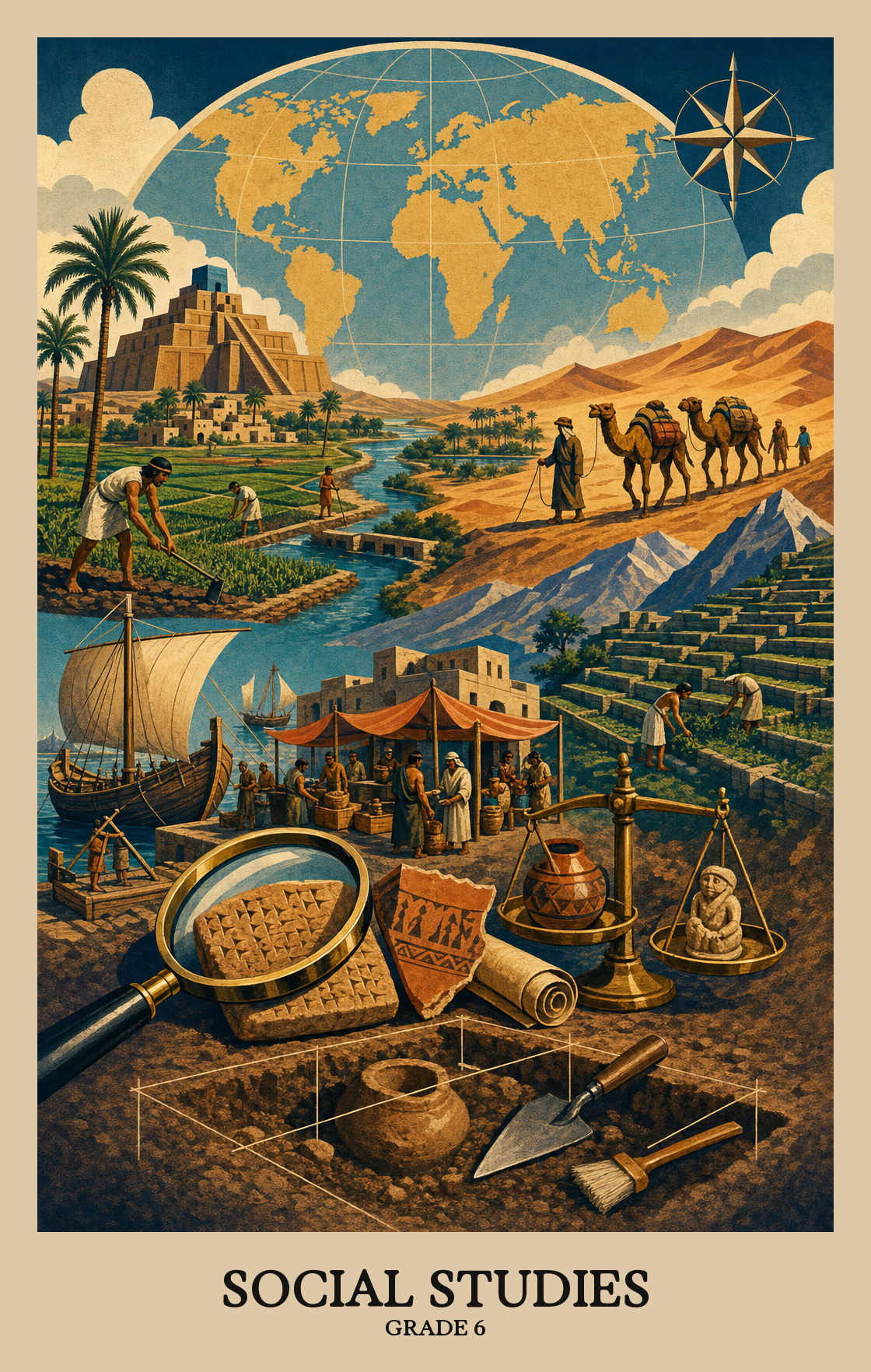
Students study world regions and civilizations through four lenses: civics, economics, geography, and history. They learn to ask good questions about a topic, find information, weigh sources, and back up their answers with evidence from what they read.
Talk about the news at dinner. Pick one story and ask who is involved, where it happened, and why people disagree. Pull up a map on a phone and find the place together. Ten minutes of this a few times a week builds real background knowledge.
Most students find history dull when it feels like a list of names and dates. Try a short documentary, a historical novel, or a museum visit tied to whatever the class is studying. Ask what surprised them. Curiosity beats memorization at this age.
By the end of the year, students should be able to read a short primary source, say who wrote it and when, and explain what the author might be leaving out. They should also cite specific lines from a source when making a claim in writing or discussion.
Most sixth grade teams anchor the year in geography and history of world regions, then weave civics and economics into each unit. Studying ancient river civilizations alongside trade, governance, and physical maps lets the four strands reinforce each other instead of sitting in separate boxes.
No. Memorizing a few key places and time periods helps, but the bigger goal is understanding how geography, government, and money shape how people live. A child who can explain why a river mattered to an ancient city is doing real social studies work.
Two areas tend to lag: writing a claim supported by specific evidence, and reading a map or chart with care instead of glancing at it. Building short, repeated routines for both, once a week, pays off more than a single big unit on either skill.
Sixth graders are ready to talk about saving, spending, and the trade-offs behind small choices. At home, let students help plan a grocery trip or a birthday budget. In class, short case studies about scarcity and choice connect personal finance to the broader economics standards.
A ready student can research a question over several days, use at least two sources, and write a short argument that names evidence and acknowledges another view. They can also locate major world regions on a map and explain one reason a place developed the way it did.