Ratios and rates
Students start the year comparing quantities, like three cups of flour to two cups of sugar. They use ratios and rates to solve everyday problems involving prices, recipes, and speeds.
This is the year math shifts from working with whole numbers to thinking in ratios and rates. Students compare prices per ounce, figure out unit rates, and start using letters to stand in for numbers in simple equations. They also begin dividing fractions and working with negative numbers on a number line. By spring, students can solve a problem like "if 3 pounds of apples cost $6, how much for 5 pounds" and explain their reasoning.
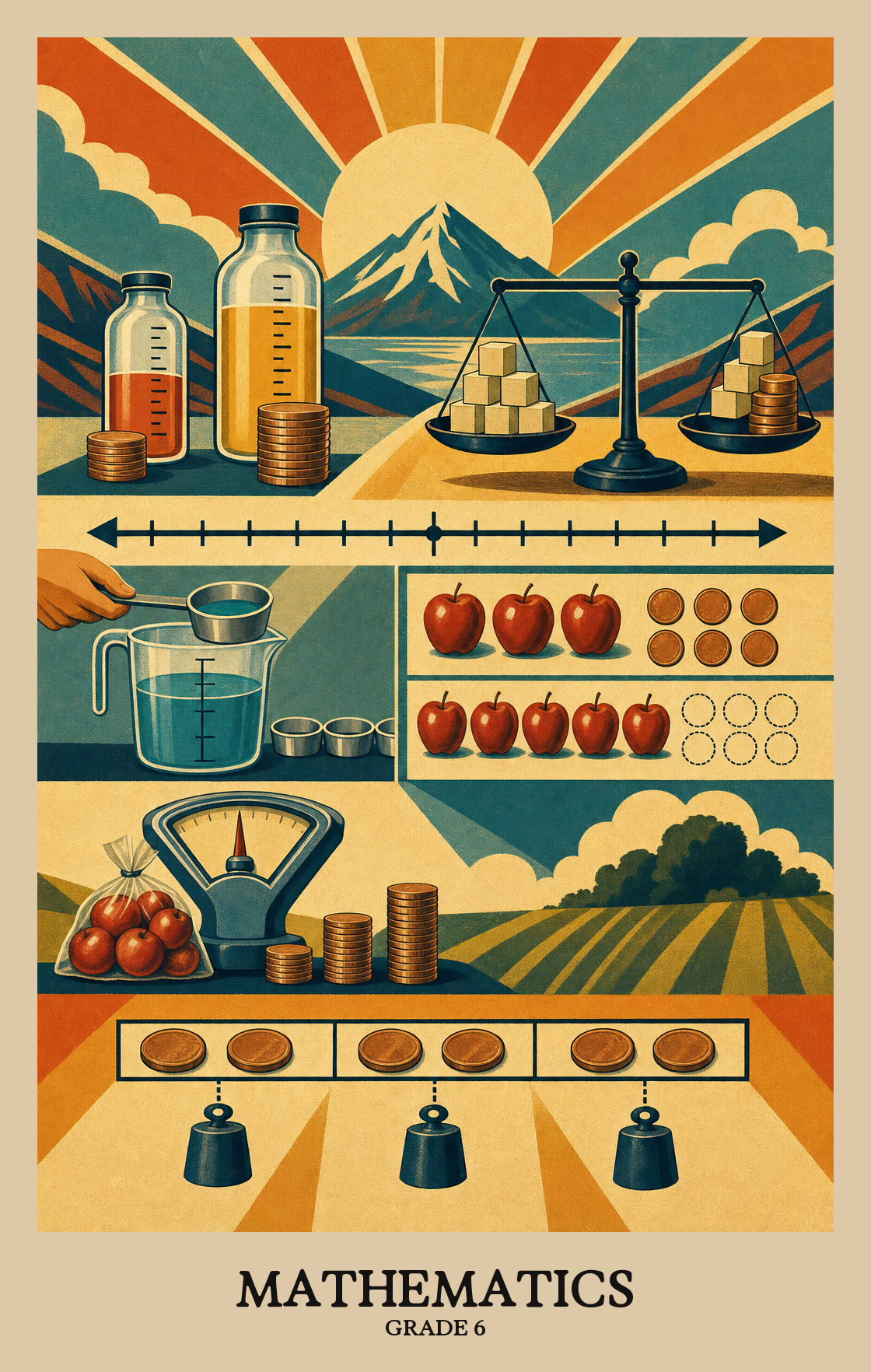
Students start the year comparing quantities, like three cups of flour to two cups of sugar. They use ratios and rates to solve everyday problems involving prices, recipes, and speeds.
Students divide fractions by fractions and work fluently with decimals. They build the number sense behind splitting a recipe in half or figuring out how many small pieces fit in a larger one.
Students extend the number line below zero to include negatives. They place points on a coordinate grid in all four directions and use negatives to describe things like temperature and elevation.
Students start using letters to stand for unknown numbers. They write and solve simple equations, which is the first real taste of algebra many parents remember from middle school.
Students find the area of triangles and other shapes, then move to three dimensions. They calculate the surface area and volume of boxes and prisms using nets and unit cubes.
Students close the year by collecting data and describing it with measures like mean and median. They read and build graphs that summarize a set of numbers, not just a single value.
Students read a problem carefully, figure out what it's actually asking, and keep trying even when the first approach doesn't work. The goal is sticking with a hard problem long enough to find a path through it.
Students take a real-world problem and strip it down to numbers and symbols to solve it, then translate the answer back into what it means in real life.
Students explain how they solved a math problem and say why their answer makes sense. They also listen to classmates' reasoning and point out where it holds up or where it breaks down.
Students use math to make sense of real situations, like figuring out a budget, reading a graph, or splitting a bill. The math comes from the real world, and the answer goes back to it.
Students choose the right tool for the math in front of them: a calculator, a quick estimate in their head, or pencil and paper. The choice depends on what the problem actually needs.
Students choose the right math words, label answers with the correct units (like inches or dollars), and check that calculations are exact. Sloppy shortcuts lead to wrong answers, so precision matters at every step.
Students look for patterns and hidden structure in math problems, like noticing that multiplying any number by zero always gives zero. Spotting that kind of pattern helps students solve new problems without starting from scratch each time.
Students notice when the same steps keep showing up in a problem and use that pattern to find a shortcut or write a general rule. Instead of redoing the same work, they ask why it keeps working.
| Standard | Definition | Code |
|---|---|---|
| Make Sense of Problems | Students read a problem carefully, figure out what it's actually asking, and keep trying even when the first approach doesn't work. The goal is sticking with a hard problem long enough to find a path through it. | CT-MATH.MP.6.1 |
| Reason Abstractly | Students take a real-world problem and strip it down to numbers and symbols to solve it, then translate the answer back into what it means in real life. | CT-MATH.MP.6.2 |
| Construct Arguments | Students explain how they solved a math problem and say why their answer makes sense. They also listen to classmates' reasoning and point out where it holds up or where it breaks down. | CT-MATH.MP.6.3 |
| Model with Mathematics | Students use math to make sense of real situations, like figuring out a budget, reading a graph, or splitting a bill. The math comes from the real world, and the answer goes back to it. | CT-MATH.MP.6.4 |
| Use Tools Strategically | Students choose the right tool for the math in front of them: a calculator, a quick estimate in their head, or pencil and paper. The choice depends on what the problem actually needs. | CT-MATH.MP.6.5 |
| Attend to Precision | Students choose the right math words, label answers with the correct units (like inches or dollars), and check that calculations are exact. Sloppy shortcuts lead to wrong answers, so precision matters at every step. | CT-MATH.MP.6.6 |
| Use Structure | Students look for patterns and hidden structure in math problems, like noticing that multiplying any number by zero always gives zero. Spotting that kind of pattern helps students solve new problems without starting from scratch each time. | CT-MATH.MP.6.7 |
| Express Regularity | Students notice when the same steps keep showing up in a problem and use that pattern to find a shortcut or write a general rule. Instead of redoing the same work, they ask why it keeps working. | CT-MATH.MP.6.8 |
Sixth graders work with whole numbers, fractions, and negative numbers to solve problems. They understand how these numbers relate to each other on a number line and use that thinking across math topics.
Students use addition, subtraction, multiplication, and division to write expressions and solve word problems. They move between written descriptions and math notation to show what a problem means.
Students read and build tables, graphs, and basic statistical summaries to make sense of real data. They use those tools to spot patterns, compare groups, and draw conclusions from numbers.
Students sort, describe, and measure flat and solid shapes, such as triangles, rectangles, and boxes, using what they know about angles, sides, and area. The focus shifts from basic naming to reasoning about why shapes belong to certain groups.
Students use ratios to solve everyday problems, like figuring out how many cups of juice to mix with water when scaling a recipe, or comparing prices to find the better deal. The math connects multiplication and division to real situations.
| Standard | Definition | Code |
|---|---|---|
| Counting and Number | Sixth graders work with whole numbers, fractions, and negative numbers to solve problems. They understand how these numbers relate to each other on a number line and use that thinking across math topics. | CT-MATH.K8.6.1 |
| Operations and Algebraic Thinking | Students use addition, subtraction, multiplication, and division to write expressions and solve word problems. They move between written descriptions and math notation to show what a problem means. | CT-MATH.K8.6.2 |
| Measurement and Data | Students read and build tables, graphs, and basic statistical summaries to make sense of real data. They use those tools to spot patterns, compare groups, and draw conclusions from numbers. | CT-MATH.K8.6.3 |
| Geometry | Students sort, describe, and measure flat and solid shapes, such as triangles, rectangles, and boxes, using what they know about angles, sides, and area. The focus shifts from basic naming to reasoning about why shapes belong to certain groups. | CT-MATH.K8.6.4 |
| Ratios and Proportional Relationships | Students use ratios to solve everyday problems, like figuring out how many cups of juice to mix with water when scaling a recipe, or comparing prices to find the better deal. The math connects multiplication and division to real situations. | CT-MATH.K8.6.5 |
Connecticut's spring summative math test for grades 3 through 8, aligned to the Connecticut Core Standards for Mathematics.
Sixth grade is a big shift toward ratios, rates, and percents. Students also start using negative numbers, work with longer expressions that include letters like x, and learn to divide fractions by fractions. Statistics shows up too, with questions about typical values and spread.
Ask them to explain the problem in their own words before touching numbers. A lot of sixth-grade trouble is reading, not math. Sketching a quick picture or a simple table often unsticks the problem faster than redoing the steps.
Ratios compare two amounts, like 3 cups of flour for every 2 cups of sugar. Students learn to scale recipes, figure out unit prices at the store, and answer questions like how far a car goes in one hour. Cooking and shopping are great practice.
Yes. Fluency with facts up to 12 by 12 makes ratios, fractions, and percents much faster to work through. If facts are shaky, five minutes of practice a few nights a week pays off for the rest of the year.
Start with ratio language and tables before moving to unit rate and percent. Students need time to see the same ratio shown as a table, a double number line, and a graph. Percent lands more easily once unit rate is solid.
Dividing fractions by fractions, signed numbers on a number line, and writing expressions from word problems. Plan extra practice and short warmups across the year rather than one long unit. Mixing these into later topics keeps them from fading.
Students can solve a multi-step ratio or percent problem, add and subtract with negatives, evaluate an expression for a given value, and find the area of a triangle or other shape made of rectangles and triangles. They can also pick a fair way to describe a set of data.
Ask them to solve a percent problem from a store flyer, divide a recipe in half when one ingredient is a fraction, and explain what negative seven means on a thermometer. If those feel reasonable by June, they are in good shape.