Who I am and my class
Students start the year talking about themselves, their families, and the classmates they sit next to. They learn classroom rules and what it means to take turns, listen, and help each other.
This is the year students start noticing the world beyond their family. Students learn what it means to be part of a classroom and a neighborhood, with rules to follow and jobs to do. They look at simple maps, talk about needs and wants, and hear stories about people from long ago. By spring, students can name a class rule, point out their home on a basic map, and explain why people trade or share.
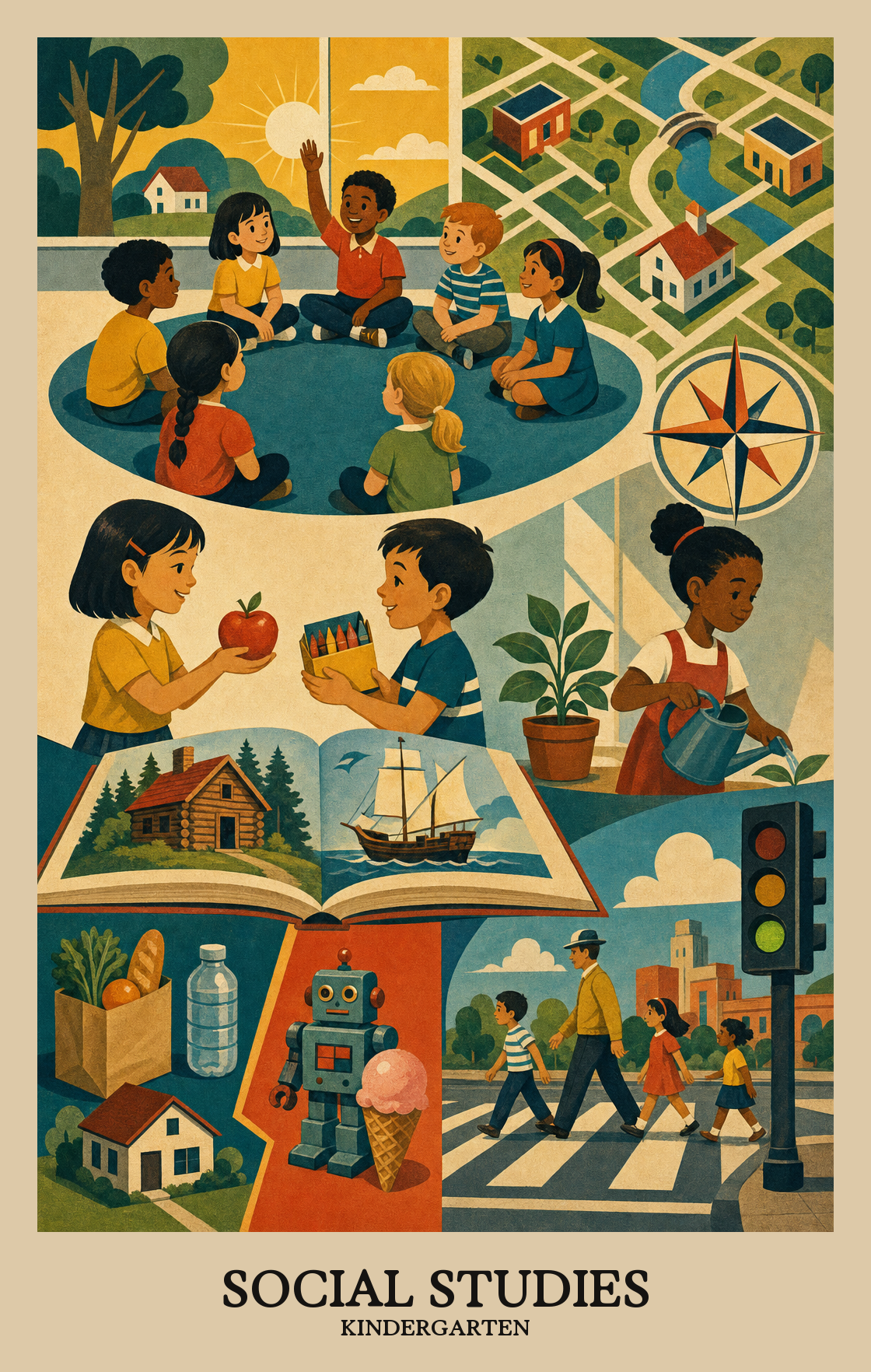
Students start the year talking about themselves, their families, and the classmates they sit next to. They learn classroom rules and what it means to take turns, listen, and help each other.
Students look at the people and jobs that keep a school running, from the principal to the bus driver. They begin asking questions about how groups make decisions and solve problems together.
Students use simple maps and pictures to find places they know, like the playground, the library, and their home. They notice what the land looks like outside and how weather changes what people do.
Students sort what people need from what people want, and talk about how families spend and save. They practice making choices and explaining why one option might be better than another.
Students compare how life looked for kids long ago with how it looks now, using photos, stories, and objects. They start to see that things change over time and that people remember the past in different ways.
Students put it all together by thinking about a problem at school or in their neighborhood and what they could do about it. They share what they learned through drawings, talking, or acting it out.
Students come up with questions about people, places, and events that they want to keep exploring. The class then decides how to find answers.
Students use basic ideas from civics, economics, geography, and history to find and think about information that answers a question they are exploring.
Students look at a photo, book, or story and decide whether it can be trusted. Then they use what they found to back up what they think.
Students share what they found out by drawing, talking, or writing, then do something about it, like making a sign or telling a classmate what they learned.
| Standard | Definition | Code |
|---|---|---|
| Develop Questions and Plan Inquiries | Students come up with questions about people, places, and events that they want to keep exploring. The class then decides how to find answers. | CT-SS.INQ.K.1 |
| Apply Disciplinary Concepts and Tools | Students use basic ideas from civics, economics, geography, and history to find and think about information that answers a question they are exploring. | CT-SS.INQ.K.2 |
| Evaluate Sources and Use Evidence | Students look at a photo, book, or story and decide whether it can be trusted. Then they use what they found to back up what they think. | CT-SS.INQ.K.3 |
| Communicate Conclusions and Take Informed Action | Students share what they found out by drawing, talking, or writing, then do something about it, like making a sign or telling a classmate what they learned. | CT-SS.INQ.K.4 |
Kindergartners learn what a community helper like a mayor, police officer, or school principal actually does and why towns, states, and countries each have their own rules and leaders.
Students practice taking turns, listening to others, and following shared rules at school and in their community. These habits are the building blocks of how people make decisions together.
Students practice following rules and talk about why those rules exist. They learn how communities make decisions together, like choosing how to share a space or solve a problem at school.
| Standard | Definition | Code |
|---|---|---|
| Civic and Political Institutions | Kindergartners learn what a community helper like a mayor, police officer, or school principal actually does and why towns, states, and countries each have their own rules and leaders. | CT-SS.CIV.K.1 |
| Participation and Deliberation | Students practice taking turns, listening to others, and following shared rules at school and in their community. These habits are the building blocks of how people make decisions together. | CT-SS.CIV.K.2 |
| Processes, Rules, and Laws | Students practice following rules and talk about why those rules exist. They learn how communities make decisions together, like choosing how to share a space or solve a problem at school. | CT-SS.CIV.K.3 |
Students look at two or more choices and think about what they gain and what they give up. A snack that costs more money might mean less money for something else.
Students learn that stores set prices for things people want to buy, and that when more than one store sells the same item, prices can change. It's an early look at how buying and selling works.
Governments and banks make rules about money that affect prices and jobs. Students explore how those decisions, made far away, can change what things cost or what work people do.
Students learn what to do with money: spend it now, save it for later, or lend it to earn more. These are the basic ideas behind how families handle money every day.
| Standard | Definition | Code |
|---|---|---|
| Economic Decision Making | Students look at two or more choices and think about what they gain and what they give up. A snack that costs more money might mean less money for something else. | CT-SS.ECON.K.1 |
| Exchange and Markets | Students learn that stores set prices for things people want to buy, and that when more than one store sells the same item, prices can change. It's an early look at how buying and selling works. | CT-SS.ECON.K.2 |
| The National and Global Economy | Governments and banks make rules about money that affect prices and jobs. Students explore how those decisions, made far away, can change what things cost or what work people do. | CT-SS.ECON.K.3 |
| Personal Financial Literacy | Students learn what to do with money: spend it now, save it for later, or lend it to earn more. These are the basic ideas behind how families handle money every day. | CT-SS.ECON.K.4 |
Students look at maps and photos to learn about different places and how people live in them.
Kindergarteners look at what a place is like, such as its hills, water, or buildings, and talk about how people change a place by adding roads or farms, and how the place itself changes what people do there.
Students look at why people move to new places and how they bring their food, language, and traditions with them. This standard covers how those habits spread and shape the neighborhoods people settle in.
Students look at why people in different places trade food, share celebrations, or follow similar rules. They start to see how choices made far away can affect life close to home.
| Standard | Definition | Code |
|---|---|---|
| Geographic Representations | Students look at maps and photos to learn about different places and how people live in them. | CT-SS.GEO.K.1 |
| Human-Environment Interaction | Kindergarteners look at what a place is like, such as its hills, water, or buildings, and talk about how people change a place by adding roads or farms, and how the place itself changes what people do there. | CT-SS.GEO.K.2 |
| Movement and Migration | Students look at why people move to new places and how they bring their food, language, and traditions with them. This standard covers how those habits spread and shape the neighborhoods people settle in. | CT-SS.GEO.K.3 |
| Global Interconnections | Students look at why people in different places trade food, share celebrations, or follow similar rules. They start to see how choices made far away can affect life close to home. | CT-SS.GEO.K.4 |
Students look at how daily life has changed over time, like comparing what school or homes looked like long ago to how they look today. They notice what has stayed the same, too.
Students hear two different stories about the same event, like why a holiday started or how a town was built, and think about why each person saw it differently.
Students look at old photos, objects, or stories from the past and use what they find to explain what happened and why. This is how historians figure out history, and kindergartners practice the same basic moves.
Students look at a story from the past, figure out why something happened, and explain what changed because of it. They back up their explanation with facts from what they read, heard, or saw.
| Standard | Definition | Code |
|---|---|---|
| Change, Continuity, and Context | Students look at how daily life has changed over time, like comparing what school or homes looked like long ago to how they look today. They notice what has stayed the same, too. | CT-SS.HIST.K.1 |
| Perspectives | Students hear two different stories about the same event, like why a holiday started or how a town was built, and think about why each person saw it differently. | CT-SS.HIST.K.2 |
| Historical Sources and Evidence | Students look at old photos, objects, or stories from the past and use what they find to explain what happened and why. This is how historians figure out history, and kindergartners practice the same basic moves. | CT-SS.HIST.K.3 |
| Causation and Argumentation | Students look at a story from the past, figure out why something happened, and explain what changed because of it. They back up their explanation with facts from what they read, heard, or saw. | CT-SS.HIST.K.4 |
Federally administered sample-based assessment in reading, mathematics, science, and writing. NAEP results inform state-by-state comparisons rather than individual student or school accountability.
Students learn about themselves, their families, their school, and the neighborhood around them. They ask questions, look at pictures and simple maps, talk about rules and fairness, and start noticing how people work, shop, and help each other.
Talk about everyday choices and why people make them. Walk around the block and point out streets, stores, and helpers like mail carriers. Read a story and ask who the people are, where they live, and how they feel.
No. Kindergarten is about noticing, asking questions, and explaining ideas with words and pictures. Memorizing capitals, presidents, or dates can wait. What matters now is curiosity about people and places.
Start with self, family, and classroom rules in the fall. Move out to school and neighborhood, then to community helpers and maps. End with bigger ideas like needs and wants, holidays, and how places change over time.
Pick a question students care about, like why people wait at a crosswalk or how a grocery store gets food. Gather clues from pictures, books, and short walks. Have students share what they found by drawing, talking, or acting it out.
Draw a simple map of the bedroom or kitchen together and label a few spots. Use words like near, far, left, right, and behind during walks. Look at a map of the route to school and trace it with a finger.
Students can name rules and explain why rules matter, describe their place in a family and school, and read a simple picture map. They can ask a question about people or places and share an answer using a drawing or a few sentences.
When shopping, point out prices and explain that picking one item often means skipping another. Let students save coins in a jar for something small they want. Talk about the difference between things people need and things people just want.
The difference between needs and wants, the reason behind rules, and reading a basic map often need a second or third pass. Build these into morning meeting and read-alouds across the year instead of teaching them once and moving on.