Asking questions and noticing
Students start the year as curious observers. They ask questions about what they see outside, sort objects by what they notice, and learn that careful looking is how scientists begin.
This is the year science becomes asking questions and looking for answers on purpose. Students notice patterns in the weather, watch how plants and animals get what they need, and push and pull objects to see what makes them move. They draw pictures of what they observe and talk about why things happen. By spring, they can ask a question about something outside, test a simple idea, and explain what they found.
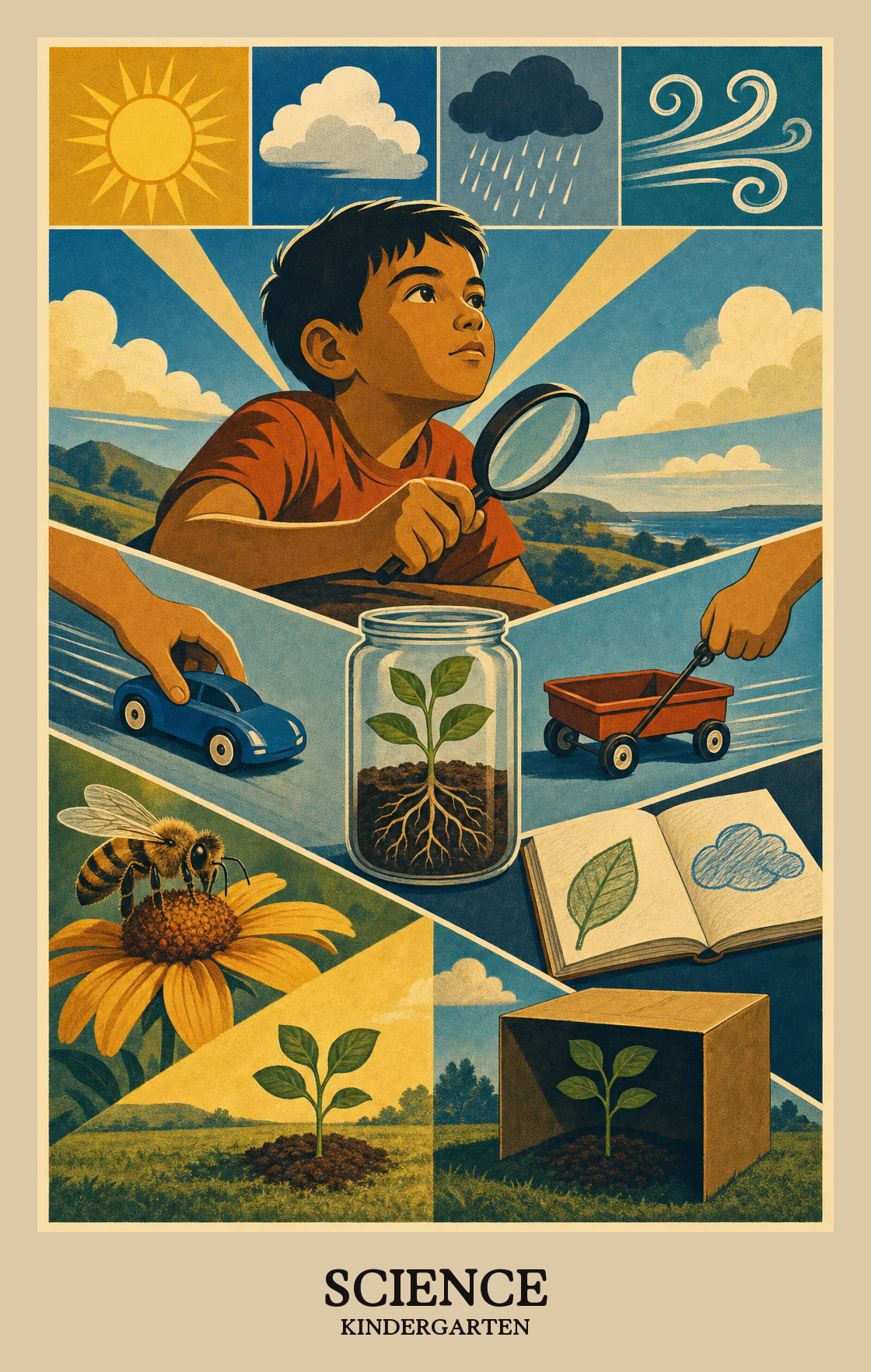
Students start the year as curious observers. They ask questions about what they see outside, sort objects by what they notice, and learn that careful looking is how scientists begin.
Students play with ramps, balls, and blocks to see how a push or a pull changes the way something moves. They test ideas and talk about what happened and why.
Students look closely at plants, animals, and themselves. They figure out what living things need to grow, like food, water, air, and shelter, and compare how different animals get those things.
Students track the weather, watch the sun across the day, and notice how the seasons change. They keep simple charts and start to spot patterns in what they see.
Students take on small building challenges, like making a shelter for a toy animal or a path for a ball. They sketch a plan, try it out, and change the design when something does not work.
Students notice something curious and turn it into a question worth testing. This is the first step in science: figuring out what to investigate and what counts as a real, answerable question.
Students draw or build simple models, like a picture of the sky or a structure made of blocks, to show how something in the world works.
Students plan simple tests and gather information to answer a question, like checking whether a block floats or sinks. The investigation is the way they find out if their idea holds up.
Students sort and compare information they collect, like counting how many cloudy days versus sunny days, to spot a pattern or draw a simple conclusion.
Students use counting, sorting, or simple patterns to help explain what they observe in the world around them.
Students look at what they observed or tested, then explain why they think something happened. The explanation has to connect back to what they actually saw or found.
Students look at two possible answers to a question and decide which one the evidence supports better. They practice saying why one idea makes more sense than another.
Students share what they observe and learn about the world around them. They describe findings using pictures, words, or models so others can understand their thinking.
| Standard | Definition | Code |
|---|---|---|
| Asking Questions and Defining Problems | Students notice something curious and turn it into a question worth testing. This is the first step in science: figuring out what to investigate and what counts as a real, answerable question. | CT-SCI.SEP.K.1 |
| Developing and Using Models | Students draw or build simple models, like a picture of the sky or a structure made of blocks, to show how something in the world works. | CT-SCI.SEP.K.2 |
| Planning and Carrying Out Investigations | Students plan simple tests and gather information to answer a question, like checking whether a block floats or sinks. The investigation is the way they find out if their idea holds up. | CT-SCI.SEP.K.3 |
| Analyzing and Interpreting Data | Students sort and compare information they collect, like counting how many cloudy days versus sunny days, to spot a pattern or draw a simple conclusion. | CT-SCI.SEP.K.4 |
| Mathematics and Computational Thinking | Students use counting, sorting, or simple patterns to help explain what they observe in the world around them. | CT-SCI.SEP.K.5 |
| Constructing Explanations | Students look at what they observed or tested, then explain why they think something happened. The explanation has to connect back to what they actually saw or found. | CT-SCI.SEP.K.6 |
| Engaging in Argument from Evidence | Students look at two possible answers to a question and decide which one the evidence supports better. They practice saying why one idea makes more sense than another. | CT-SCI.SEP.K.7 |
| Communicating Information | Students share what they observe and learn about the world around them. They describe findings using pictures, words, or models so others can understand their thinking. | CT-SCI.SEP.K.8 |
Students sort everyday objects by what they can observe: color, shape, size, and whether something feels rough or smooth. That hands-on sorting is the first step toward understanding why things look and behave the way they do.
Students push, pull, and roll objects to see how things start moving, stop, or stay still. They learn that a harder push moves something farther, and that objects don't move on their own.
Students explore how energy shows up in everyday life, like light from a lamp or sound from a drum, and notice what happens when energy moves from one place to another.
Students explore how waves move energy from place to place. They look at everyday examples like sound, light, and water ripples to see how waves carry information from one spot to another.
| Standard | Definition | Code |
|---|---|---|
| Matter and Interactions | Students sort everyday objects by what they can observe: color, shape, size, and whether something feels rough or smooth. That hands-on sorting is the first step toward understanding why things look and behave the way they do. | CT-SCI.PS.K.1 |
| Motion and Stability | Students push, pull, and roll objects to see how things start moving, stop, or stay still. They learn that a harder push moves something farther, and that objects don't move on their own. | CT-SCI.PS.K.2 |
| Energy | Students explore how energy shows up in everyday life, like light from a lamp or sound from a drum, and notice what happens when energy moves from one place to another. | CT-SCI.PS.K.3 |
| Waves and Information | Students explore how waves move energy from place to place. They look at everyday examples like sound, light, and water ripples to see how waves carry information from one spot to another. | CT-SCI.PS.K.4 |
Students look at living things up close and notice the parts that help them survive, like leaves, roots, or legs. They learn that every living thing has pieces that work together to keep it alive.
Students learn that plants, animals, and other living things depend on each other to survive. They explore how energy from the sun moves through an ecosystem and how living things get what they need from their surroundings.
Students look at plants, animals, and people to see which features pass from parents to offspring and which ones turn out different.
Students look closely at living things to notice what makes them alike and what makes them different. A dog and a fish both need food and water, but they look and move in very different ways.
| Standard | Definition | Code |
|---|---|---|
| Structures and Processes | Students look at living things up close and notice the parts that help them survive, like leaves, roots, or legs. They learn that every living thing has pieces that work together to keep it alive. | CT-SCI.LS.K.1 |
| Ecosystems | Students learn that plants, animals, and other living things depend on each other to survive. They explore how energy from the sun moves through an ecosystem and how living things get what they need from their surroundings. | CT-SCI.LS.K.2 |
| Heredity | Students look at plants, animals, and people to see which features pass from parents to offspring and which ones turn out different. | CT-SCI.LS.K.3 |
| Biological Evolution | Students look closely at living things to notice what makes them alike and what makes them different. A dog and a fish both need food and water, but they look and move in very different ways. | CT-SCI.LS.K.4 |
Students learn that Earth is a planet in space, that the Sun and Moon follow patterns in the sky, and that Earth itself has a long history. They observe how day and night, seasons, and the movement of objects in the sky repeat in predictable ways.
Students explore how land, water, air, and living things connect to each other. They look at what happens when one changes, like rain soaking into soil or wind bending a tree.
Students look at how people change the land, water, and air around them, and how storms, floods, or other natural events can affect where and how people live.
| Standard | Definition | Code |
|---|---|---|
| Earth's Place in the Universe | Students learn that Earth is a planet in space, that the Sun and Moon follow patterns in the sky, and that Earth itself has a long history. They observe how day and night, seasons, and the movement of objects in the sky repeat in predictable ways. | CT-SCI.ESS.K.1 |
| Earth's Systems | Students explore how land, water, air, and living things connect to each other. They look at what happens when one changes, like rain soaking into soil or wind bending a tree. | CT-SCI.ESS.K.2 |
| Earth and Human Activity | Students look at how people change the land, water, and air around them, and how storms, floods, or other natural events can affect where and how people live. | CT-SCI.ESS.K.3 |
Students look at something that does not work well, think of a way to fix it, then try their idea and adjust it until it works better.
Students explore how the tools people build change everyday life, and how everyday needs push inventors to make new tools.
| Standard | Definition | Code |
|---|---|---|
| Engineering Design | Students look at something that does not work well, think of a way to fix it, then try their idea and adjust it until it works better. | CT-SCI.ETS.K.1 |
| Links Among Engineering, Technology, and Society | Students explore how the tools people build change everyday life, and how everyday needs push inventors to make new tools. | CT-SCI.ETS.K.2 |
Federally administered sample-based assessment in reading, mathematics, science, and writing. NAEP results inform state-by-state comparisons rather than individual student or school accountability.
Science at this age is mostly noticing, asking, and testing. Students watch the weather, sort leaves, build ramps for toy cars, and talk about what they see. Most learning happens through play and questions, not worksheets.
Go outside and ask easy questions. What do you hear? Where is the sun? Why did that puddle dry up? Five minutes of wondering together does more than any app. Let students answer in their own words, even if the words are wrong at first.
Not really. Plain words are fine. If a student says the ice melted because it got warm, that is a strong answer. Fancy terms like evaporation or gravity can wait. Clear thinking matters more than the right label.
Students touch on four areas: how things move and feel, living things and what they need, weather and the sky, and simple building and design. Each one comes back several times so students see the same ideas in new settings.
Start with observation routines in the first weeks so students learn to look, draw, and describe. Build weather and living things into daily calendar time. Save longer investigations and design challenges for later in the year, once students can work in pairs without losing focus.
Yes. Stacking blocks, pouring water, and watching bugs are the work right now. Students are building the habit of asking questions and testing ideas. Reading and writing about science come later, once those habits are steady.
Two things tend to lag. First, gathering evidence before giving an answer. Second, comparing two ideas instead of just stating one. Short routines like "what did you see, what do you think" help both. Expect to model these all year.
A ready student can ask a question about something they noticed, try a simple test, and say what happened in their own words. They can sort objects, describe weather, and name what plants and animals need. Curiosity matters more than facts memorized.