Asking questions like a researcher
Students learn how to start an investigation by asking a real question and figuring out where to look for answers. They practice telling the difference between a strong source and a shaky one.
This is the year social studies zooms in on the home state and how it works. Students learn how town and state government make decisions, and how maps show why people settled where they did. They start backing up what they say with evidence from real sources like documents, photos, and articles. By spring, they can pick a question about their community, gather information from a few sources, and explain their answer in writing.
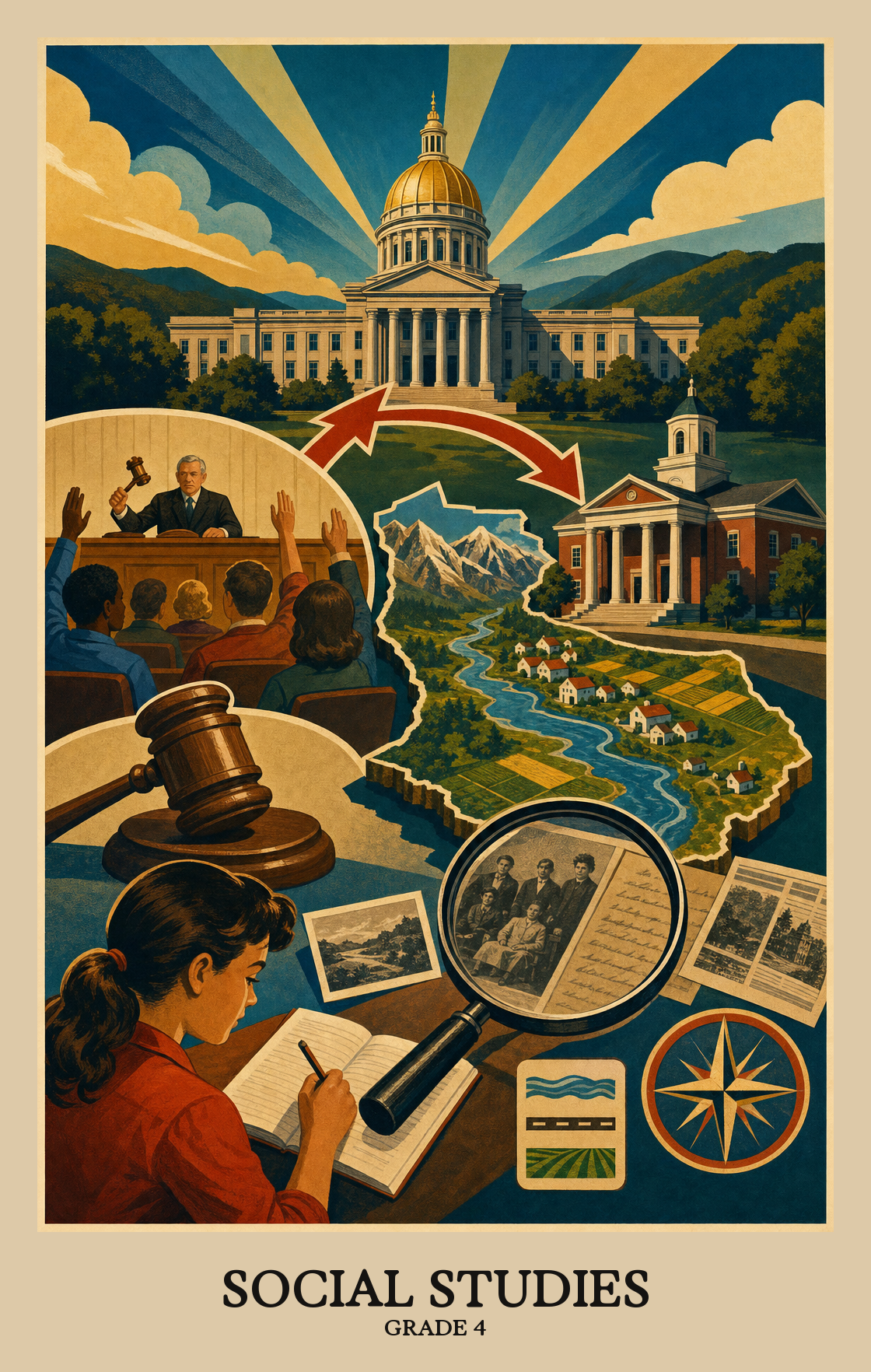
Students learn how to start an investigation by asking a real question and figuring out where to look for answers. They practice telling the difference between a strong source and a shaky one.
Students use maps, photos, and landmarks to study where people live and why. They look at how rivers, coastlines, and cities shape daily life and how people change the land around them.
Students learn what towns, the state, and the country actually do, from the mayor to Congress. They practice the habits of good citizens, like following fair rules and speaking up on issues that matter to them.
Students look at how people decide what to buy, save, and trade, and why prices go up or down. They start thinking about saving and spending in their own lives.
Students study why people settle in some places and move to others, and how cultures travel with them. They trace how food, language, and traditions spread from one region to another.
Students dig into events from the past using letters, photos, and other firsthand records. They learn that the same event can look different depending on who is telling the story, and they build arguments using evidence.
Students come up with a big question worth investigating, then break it into smaller questions that guide a deeper look at a history, geography, or civics topic.
Students pull from what they know about government, money, maps, and history to find and make sense of information that helps answer a question they are investigating.
Students decide whether a source can be trusted, then use details from it to back up a point they're making. They practice telling the difference between firsthand accounts and secondhand ones.
Students pick a real issue at school or in their community, then share what they learned and why it matters through writing, a speech, or another format.
| Standard | Definition | Code |
|---|---|---|
| Develop Questions and Plan Inquiries | Students come up with a big question worth investigating, then break it into smaller questions that guide a deeper look at a history, geography, or civics topic. | CT-SS.INQ.4.1 |
| Apply Disciplinary Concepts and Tools | Students pull from what they know about government, money, maps, and history to find and make sense of information that helps answer a question they are investigating. | CT-SS.INQ.4.2 |
| Evaluate Sources and Use Evidence | Students decide whether a source can be trusted, then use details from it to back up a point they're making. They practice telling the difference between firsthand accounts and secondhand ones. | CT-SS.INQ.4.3 |
| Communicate Conclusions and Take Informed Action | Students pick a real issue at school or in their community, then share what they learned and why it matters through writing, a speech, or another format. | CT-SS.INQ.4.4 |
Students learn what governments actually do and how they're organized, from the town hall down the street to the U.S. Congress to international bodies. They compare how local, state, and national leaders make rules and decisions that affect everyday life.
Students practice habits like fairness, respect, and responsibility in classroom decisions and school or community situations. They see how those same habits shape the way neighborhoods and governments work together.
Students look at a real issue in the news or their community and work through how rules, laws, or civic steps apply to it. They practice the kind of reasoning citizens use to make decisions together.
| Standard | Definition | Code |
|---|---|---|
| Civic and Political Institutions | Students learn what governments actually do and how they're organized, from the town hall down the street to the U.S. Congress to international bodies. They compare how local, state, and national leaders make rules and decisions that affect everyday life. | CT-SS.CIV.4.1 |
| Participation and Deliberation | Students practice habits like fairness, respect, and responsibility in classroom decisions and school or community situations. They see how those same habits shape the way neighborhoods and governments work together. | CT-SS.CIV.4.2 |
| Processes, Rules, and Laws | Students look at a real issue in the news or their community and work through how rules, laws, or civic steps apply to it. They practice the kind of reasoning citizens use to make decisions together. | CT-SS.CIV.4.3 |
Students weigh the pros and cons of a choice before deciding, thinking about what they gain and what they give up. This is how economists think through everyday decisions.
Markets are places where buyers and sellers set prices by competing for goods. Students learn how those prices signal what gets made, bought, and sold in a free-market economy.
Government decisions, bank policies, and trade with other countries all shape how much things cost and whether jobs are available. Students look at how these forces connect and affect everyday life.
Students learn how money decisions work in real life: why saving matters, what it costs to borrow money, and how putting money into something now can grow it over time.
| Standard | Definition | Code |
|---|---|---|
| Economic Decision Making | Students weigh the pros and cons of a choice before deciding, thinking about what they gain and what they give up. This is how economists think through everyday decisions. | CT-SS.ECON.4.1 |
| Exchange and Markets | Markets are places where buyers and sellers set prices by competing for goods. Students learn how those prices signal what gets made, bought, and sold in a free-market economy. | CT-SS.ECON.4.2 |
| The National and Global Economy | Government decisions, bank policies, and trade with other countries all shape how much things cost and whether jobs are available. Students look at how these forces connect and affect everyday life. | CT-SS.ECON.4.3 |
| Personal Financial Literacy | Students learn how money decisions work in real life: why saving matters, what it costs to borrow money, and how putting money into something now can grow it over time. | CT-SS.ECON.4.4 |
Students read maps, photos, and other geographic sources to study how places look, how regions differ, and how people interact with their surroundings.
Students study how a place's land, water, and weather affect the way people live there, and how people in turn change that place by building, farming, or settling.
Students look at why people moved to new places, where they settled, and how their food, language, and traditions spread to neighboring regions.
Students look at how two places in the world affect each other through trade, shared traditions, or government ties. They explain why what happens in one place can change everyday life in another.
| Standard | Definition | Code |
|---|---|---|
| Geographic Representations | Students read maps, photos, and other geographic sources to study how places look, how regions differ, and how people interact with their surroundings. | CT-SS.GEO.4.1 |
| Human-Environment Interaction | Students study how a place's land, water, and weather affect the way people live there, and how people in turn change that place by building, farming, or settling. | CT-SS.GEO.4.2 |
| Movement and Migration | Students look at why people moved to new places, where they settled, and how their food, language, and traditions spread to neighboring regions. | CT-SS.GEO.4.3 |
| Global Interconnections | Students look at how two places in the world affect each other through trade, shared traditions, or government ties. They explain why what happens in one place can change everyday life in another. | CT-SS.GEO.4.4 |
Students look at how life changed over time and how some things stayed the same, comparing places and periods around the world. They ask why a shift happened when it did and what came before it.
Students read about the same historical event from different people's points of view, then explain how each viewpoint changes what we think really happened.
Students look at primary sources like letters, photos, and maps from the past, then use what they find to back up a claim about what happened and why.
Students look at why a historical event happened and what changed because of it, then back up their conclusions with facts from real sources. This is the foundation of thinking like a historian.
| Standard | Definition | Code |
|---|---|---|
| Change, Continuity, and Context | Students look at how life changed over time and how some things stayed the same, comparing places and periods around the world. They ask why a shift happened when it did and what came before it. | CT-SS.HIST.4.1 |
| Perspectives | Students read about the same historical event from different people's points of view, then explain how each viewpoint changes what we think really happened. | CT-SS.HIST.4.2 |
| Historical Sources and Evidence | Students look at primary sources like letters, photos, and maps from the past, then use what they find to back up a claim about what happened and why. | CT-SS.HIST.4.3 |
| Causation and Argumentation | Students look at why a historical event happened and what changed because of it, then back up their conclusions with facts from real sources. This is the foundation of thinking like a historian. | CT-SS.HIST.4.4 |
Federally administered sample-based assessment in reading, mathematics, science, and writing. NAEP results inform state-by-state comparisons rather than individual student or school accountability.
Students study how communities, states, and countries work. They look at maps and regions, how people earn and spend money, how governments make decisions, and how the past shapes the present. A lot of the year is built around asking good questions and finding evidence to answer them.
Talk about the news at dinner and ask what students think and why. Pull out a map when a place comes up in a book or a show. When students make a claim, ask where they heard it and whether the source seems trustworthy. Ten minutes of real conversation goes a long way.
Not really. Fourth grade focuses more on how and why things happened than on memorizing dates. Students should be able to put a few key events in order and explain what caused them, but recalling exact years matters less than explaining the story.
Most teachers anchor the year in geography and history, then weave civics and economics into those units rather than teaching them as separate blocks. An inquiry question for each unit keeps the four strands connected and gives students a reason to use sources.
Source evaluation and supporting a claim with evidence. Students can often summarize a text but struggle to say why a source is trustworthy or to pick the best quote to back up a point. Plan short, repeated practice with two sources side by side across the year.
Use real ones. Look at a road map before a trip, read a weather chart together, or check a bus schedule. Ask questions like what does this symbol mean, what is missing, and what would change if the map were bigger. Students get better at this through use, not worksheets.
An inquiry is an investigation built around a real question, like why did people settle here or is this rule fair. Students gather sources, weigh evidence, and share what they found. It is the main way students practice thinking like a historian, geographer, or citizen.
By spring, students should be able to ask a researchable question, find evidence in two or three sources, and write or speak a short claim backed by that evidence. They should also use a map with confidence and explain how a basic rule, law, or economic choice affects daily life.
Bring them in, but keep them age appropriate. Local stories about a new park, a town vote, or a community problem work better than national politics. The goal is for students to see that the ideas they study in class show up in real life every week.