Asking questions like a scientist
Students start the year learning how scientists work. They ask questions about things they notice, plan small tests to find answers, and record what happens so they can talk about it later.
This is the year science shifts from watching the world to investigating it on purpose. Students ask a real question, plan a test, and use what they collect as evidence for their answer. They look closely at how energy moves, how living things depend on each other, and how Earth's water, rocks, and weather shape the land. By spring, students can run a simple experiment and explain what the results show using their own data.
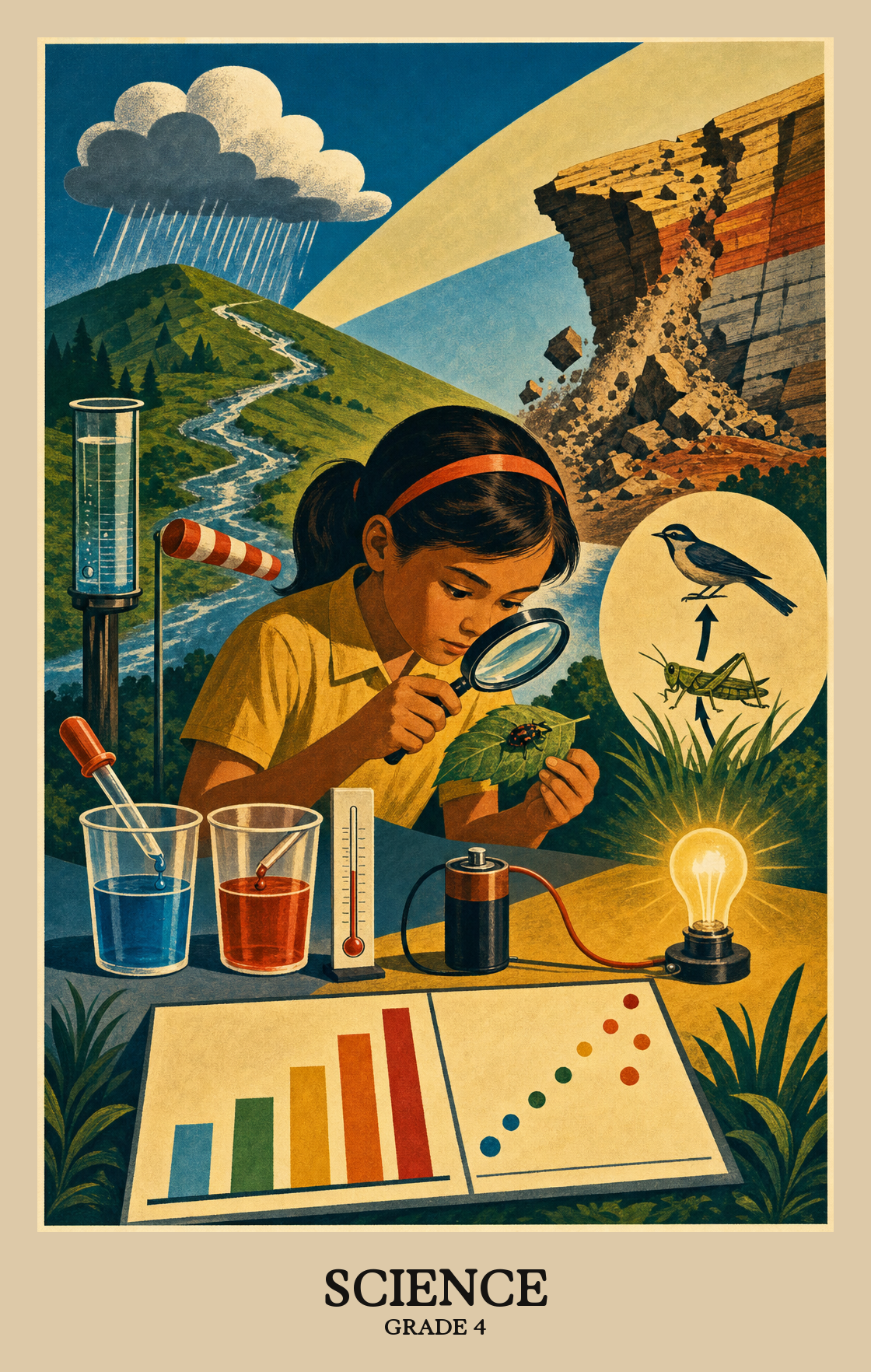
Students start the year learning how scientists work. They ask questions about things they notice, plan small tests to find answers, and record what happens so they can talk about it later.
Students explore how things move, speed up, slow down, and stop. They look at energy in everyday objects like batteries, lamps, and toys, and notice how sound and light travel as waves.
Students study how living things are built and how they survive. They look at the parts of plants and animals, how traits pass from parents to babies, and how living things in one area depend on each other.
Students turn to the planet and beyond. They look at rocks, water, weather, and the patterns of the sun, moon, and stars, and notice how land, air, and oceans shape each other over time.
Students look at how people affect Earth and how Earth affects people. They study natural events like storms and floods, and think about choices that protect water, air, and habitats.
Students wrap up the year as young engineers. They pick a real problem, sketch a few ideas, build something simple, test it, and improve the design based on what worked and what did not.
Students practice turning a curiosity or a real-world problem into a question that can actually be tested or built toward. This is where science and engineering both begin.
Students build or draw models, such as a diagram of the water cycle or a sketch of a bridge design, to show how something works or why it behaves the way it does.
Students plan a test or experiment, carry it out, and collect data to check whether their idea holds up.
Students look at data from experiments or observations and explain what it means. They spot patterns, like temperatures rising each day or plants growing faster in sunlight, and use those patterns to draw conclusions.
Students use numbers, measurements, and simple calculations to back up what they observe in science. Instead of just describing what happened, they show it with data.
Students build written explanations for science questions using evidence from experiments or observations, then connect that evidence to a scientific idea or pattern they have already learned.
Students look at two or more possible explanations or solutions, then use data or observations to argue which one holds up better. The focus is on the evidence, not on who sounds more convincing.
Students read about a science topic, decide which sources are trustworthy, and explain what they learned in writing or a presentation. The focus is on finding good information and sharing it clearly.
| Standard | Definition | Code |
|---|---|---|
| Asking Questions and Defining Problems | Students practice turning a curiosity or a real-world problem into a question that can actually be tested or built toward. This is where science and engineering both begin. | CT-SCI.SEP.4.1 |
| Developing and Using Models | Students build or draw models, such as a diagram of the water cycle or a sketch of a bridge design, to show how something works or why it behaves the way it does. | CT-SCI.SEP.4.2 |
| Planning and Carrying Out Investigations | Students plan a test or experiment, carry it out, and collect data to check whether their idea holds up. | CT-SCI.SEP.4.3 |
| Analyzing and Interpreting Data | Students look at data from experiments or observations and explain what it means. They spot patterns, like temperatures rising each day or plants growing faster in sunlight, and use those patterns to draw conclusions. | CT-SCI.SEP.4.4 |
| Mathematics and Computational Thinking | Students use numbers, measurements, and simple calculations to back up what they observe in science. Instead of just describing what happened, they show it with data. | CT-SCI.SEP.4.5 |
| Constructing Explanations | Students build written explanations for science questions using evidence from experiments or observations, then connect that evidence to a scientific idea or pattern they have already learned. | CT-SCI.SEP.4.6 |
| Engaging in Argument from Evidence | Students look at two or more possible explanations or solutions, then use data or observations to argue which one holds up better. The focus is on the evidence, not on who sounds more convincing. | CT-SCI.SEP.4.7 |
| Communicating Information | Students read about a science topic, decide which sources are trustworthy, and explain what they learned in writing or a presentation. The focus is on finding good information and sharing it clearly. | CT-SCI.SEP.4.8 |
Students explore what everyday materials are made of at a level too small to see. They use that understanding to explain why ice melts, why water evaporates, or why objects sink or float.
Students test how pushes, pulls, and collisions move objects, slow them down, or keep them still. They look for patterns in what makes things speed up, change direction, or stay in place.
Students explore how energy moves and changes form, such as heat turning into light or motion. They learn that energy is never lost, just passed along or converted into something else.
Students explore how waves, like sound and light, carry energy from one place to another. They also look at how waves are used to send information, like a radio signal or a phone call.
| Standard | Definition | Code |
|---|---|---|
| Matter and Interactions | Students explore what everyday materials are made of at a level too small to see. They use that understanding to explain why ice melts, why water evaporates, or why objects sink or float. | CT-SCI.PS.4.1 |
| Motion and Stability | Students test how pushes, pulls, and collisions move objects, slow them down, or keep them still. They look for patterns in what makes things speed up, change direction, or stay in place. | CT-SCI.PS.4.2 |
| Energy | Students explore how energy moves and changes form, such as heat turning into light or motion. They learn that energy is never lost, just passed along or converted into something else. | CT-SCI.PS.4.3 |
| Waves and Information | Students explore how waves, like sound and light, carry energy from one place to another. They also look at how waves are used to send information, like a radio signal or a phone call. | CT-SCI.PS.4.4 |
Students study how living things are built and how they work, from the tiny cells inside a leaf or a finger all the way up to the body systems those cells form together.
Students learn how energy from the sun moves through a food chain and how materials like water and nutrients get reused by plants, animals, and decomposers. They also explore how organisms in the same community compete, cooperate, and depend on each other.
Students look at how traits like eye color or height get passed from parents to offspring, and why siblings can look similar but not identical.
Students look at how living things are alike and how they differ, then explore why those differences develop over generations. The focus is on what drives change in plants and animals over long stretches of time.
| Standard | Definition | Code |
|---|---|---|
| Structures and Processes | Students study how living things are built and how they work, from the tiny cells inside a leaf or a finger all the way up to the body systems those cells form together. | CT-SCI.LS.4.1 |
| Ecosystems | Students learn how energy from the sun moves through a food chain and how materials like water and nutrients get reused by plants, animals, and decomposers. They also explore how organisms in the same community compete, cooperate, and depend on each other. | CT-SCI.LS.4.2 |
| Heredity | Students look at how traits like eye color or height get passed from parents to offspring, and why siblings can look similar but not identical. | CT-SCI.LS.4.3 |
| Biological Evolution | Students look at how living things are alike and how they differ, then explore why those differences develop over generations. The focus is on what drives change in plants and animals over long stretches of time. | CT-SCI.LS.4.4 |
Students study where Earth sits in the solar system and how the sun, moon, and planets move in patterns. They also look at how Earth itself has changed over a very long time.
Students study how Earth's land, water, air, and living things connect and affect each other. They look at what happens when one part changes, like how rain shapes the ground or how plants change the soil.
Students look at how human choices (like building cities or burning fuel) change the land, water, and air around them, and how natural events like floods or earthquakes put people at risk.
| Standard | Definition | Code |
|---|---|---|
| Earth's Place in the Universe | Students study where Earth sits in the solar system and how the sun, moon, and planets move in patterns. They also look at how Earth itself has changed over a very long time. | CT-SCI.ESS.4.1 |
| Earth's Systems | Students study how Earth's land, water, air, and living things connect and affect each other. They look at what happens when one part changes, like how rain shapes the ground or how plants change the soil. | CT-SCI.ESS.4.2 |
| Earth and Human Activity | Students look at how human choices (like building cities or burning fuel) change the land, water, and air around them, and how natural events like floods or earthquakes put people at risk. | CT-SCI.ESS.4.3 |
Students identify a real problem, come up with possible fixes, then test and adjust their ideas until the design works better. It's the same cycle engineers use when building anything from a bridge to a better backpack.
Students explore how inventions shape daily life and how the needs of society push engineers to create new tools. A new technology can change how people live, and those changes often lead to the next problem engineers try to solve.
| Standard | Definition | Code |
|---|---|---|
| Engineering Design | Students identify a real problem, come up with possible fixes, then test and adjust their ideas until the design works better. It's the same cycle engineers use when building anything from a bridge to a better backpack. | CT-SCI.ETS.4.1 |
| Links Among Engineering, Technology, and Society | Students explore how inventions shape daily life and how the needs of society push engineers to create new tools. A new technology can change how people live, and those changes often lead to the next problem engineers try to solve. | CT-SCI.ETS.4.2 |
Federally administered sample-based assessment in reading, mathematics, science, and writing. NAEP results inform state-by-state comparisons rather than individual student or school accountability.
Students study four big areas: how matter and energy work, how living things grow and interact, how Earth changes and fits into space, and how engineers solve problems. They spend a lot of time asking questions, running tests, and explaining what they found.
Notice patterns together. Watch the moon over a week, time how fast ice melts in different spots, or guess which paper airplane will fly farthest and test it. Asking why something happened and how to find out is the habit that matters most.
Investigations should be short, repeatable, and tied to a clear question. Students predict, gather data, and compare results to their guess. The point is not a perfect experiment. It is learning to change one thing at a time and notice what happens.
Vocabulary matters less than understanding. Students should be able to describe what they saw and why they think it happened in their own words first. Formal terms like energy, force, or ecosystem stick better once the idea behind them is solid.
Many teachers anchor each unit in a phenomenon students can observe, then return to the same science practices each time. Physical science often comes first because forces and energy are easy to demonstrate, with life and Earth science building on those ideas later in the year.
Energy transfer and the difference between weather and climate trip up a lot of fourth graders. So does reading a data table and tying it back to the original question. Plan extra time for students to talk through their reasoning, not just record an answer.
Students define a small problem, sketch a design, build something simple, and test it. Then they change one part and test again. A bridge made of index cards or a container that keeps an ice cube cold counts. The point is the cycle of try, measure, improve.
Ask what they already noticed and what they could try to find out more. Resist giving the answer. Five minutes of looking at a puddle, a shadow, or a plant on the windowsill often gets further than looking something up online.
Ready students can ask a testable question, plan a simple investigation, and use their data to back up an explanation. They can also read a short science article and pull out the main idea. Content knowledge matters, but those habits carry the most weight.