Our classroom and school community
Students start the year learning how a classroom works as a small community. They practice asking questions, taking turns, and following rules that keep everyone safe and treated fairly.
This is the year students step outside their own family and start to see how a community works. Students ask questions about the people around them, look at simple maps and photos, and notice the rules that keep a classroom and a town running. They begin to compare life now with life long ago. By spring, students can describe a job in their community, point to their town on a map, and explain one rule and why it matters.
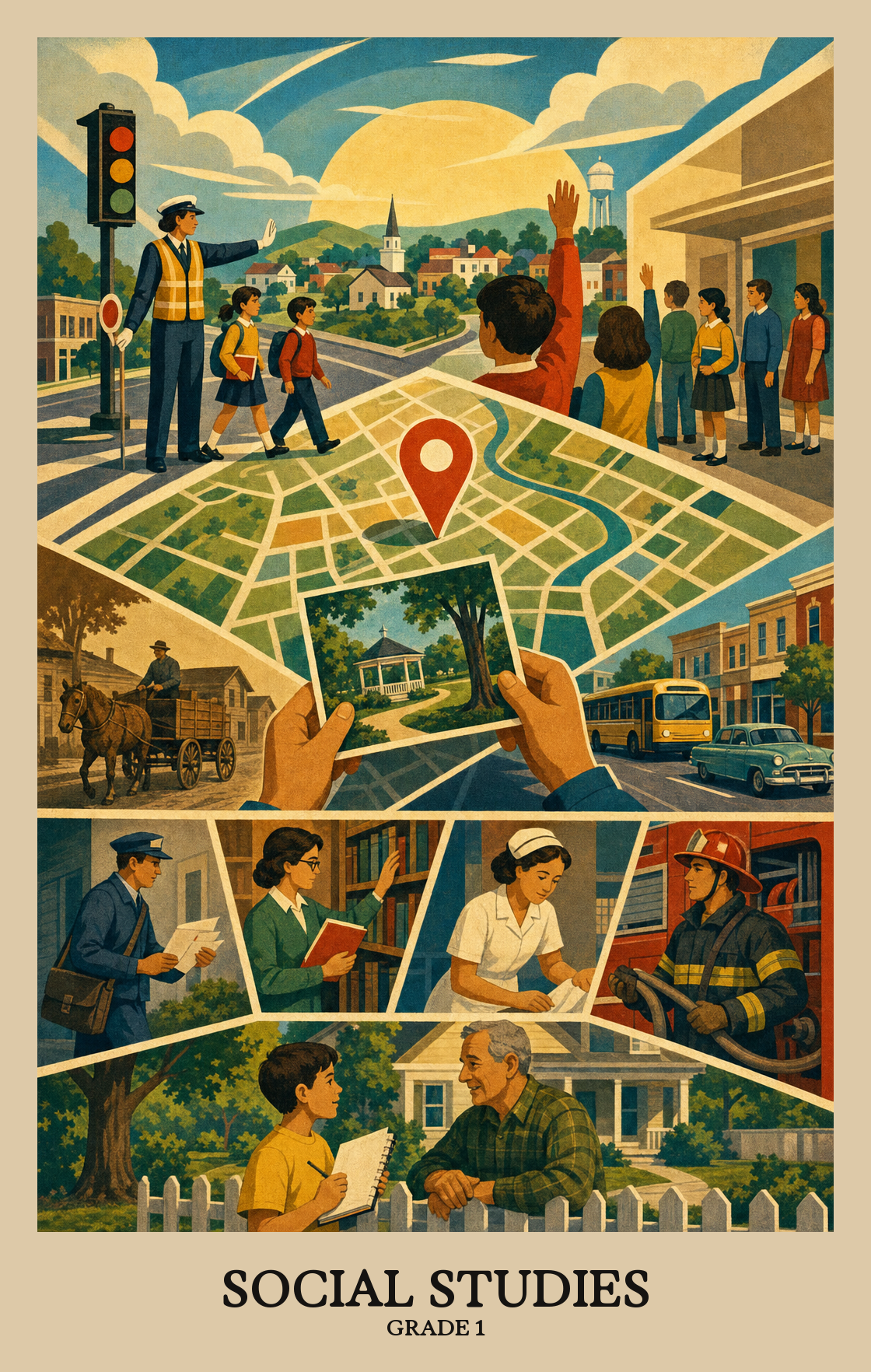
Students start the year learning how a classroom works as a small community. They practice asking questions, taking turns, and following rules that keep everyone safe and treated fairly.
Students look at simple maps and photos of their classroom, school, and neighborhood. They notice what makes a place feel like home and how people change the spaces around them.
Students sort needs from wants and talk about the trade-offs in everyday choices, like spending a dollar or picking one toy over another. They start to see why people save and share.
Students compare life today with life in the past using photos, stories, and family memories. They listen to different points of view about the same event and notice what has changed and what has stayed the same.
Students pull together what they have learned to share an idea with the class or school. They practice writing, drawing, and speaking about a topic that matters to them and suggest a small action others can take.
Students come up with questions they genuinely want to answer about people, places, or events, then figure out how to find answers. The questions should be meaty enough to dig into, not ones that wrap up with a single yes or no.
Students pull in ideas from maps, money, community rules, and the past to answer a question they are investigating. Each subject gives them a different tool for looking at the same problem.
Students look at photos, books, and other sources to decide which ones can be trusted. Then they use what they find to back up what they think is true.
Students share what they learned about a topic by writing, talking, or drawing, then use that knowledge to do something about a real problem at school or in their community.
| Standard | Definition | Code |
|---|---|---|
| Develop Questions and Plan Inquiries | Students come up with questions they genuinely want to answer about people, places, or events, then figure out how to find answers. The questions should be meaty enough to dig into, not ones that wrap up with a single yes or no. | CT-SS.INQ.1.1 |
| Apply Disciplinary Concepts and Tools | Students pull in ideas from maps, money, community rules, and the past to answer a question they are investigating. Each subject gives them a different tool for looking at the same problem. | CT-SS.INQ.1.2 |
| Evaluate Sources and Use Evidence | Students look at photos, books, and other sources to decide which ones can be trusted. Then they use what they find to back up what they think is true. | CT-SS.INQ.1.3 |
| Communicate Conclusions and Take Informed Action | Students share what they learned about a topic by writing, talking, or drawing, then use that knowledge to do something about a real problem at school or in their community. | CT-SS.INQ.1.4 |
Local, state, and national governments all have jobs to do. Students learn what those jobs are, who is in charge at each level, and why these groups exist in the first place.
Students practice being fair, honest, and respectful in class and school decisions. These habits are the building blocks of how communities and governments make choices together.
Students practice using rules and laws to think through real problems, like what makes a school rule fair or how a community decision gets made.
| Standard | Definition | Code |
|---|---|---|
| Civic and Political Institutions | Local, state, and national governments all have jobs to do. Students learn what those jobs are, who is in charge at each level, and why these groups exist in the first place. | CT-SS.CIV.1.1 |
| Participation and Deliberation | Students practice being fair, honest, and respectful in class and school decisions. These habits are the building blocks of how communities and governments make choices together. | CT-SS.CIV.1.2 |
| Processes, Rules, and Laws | Students practice using rules and laws to think through real problems, like what makes a school rule fair or how a community decision gets made. | CT-SS.CIV.1.3 |
Students look at two choices, such as buying a snack or saving money, and think through what each option costs and what they get in return.
Markets are places where people buy and sell things. Students learn how prices change when something is popular or hard to find, and how competition between sellers can affect what things cost.
Government decisions, like setting taxes or printing money, can change how much things cost and how many people have jobs. Students look at how local rules and faraway economies connect to everyday life.
Saving means setting money aside instead of spending it now. Students learn why people save, borrow, and invest money, and how those choices affect what families can buy or do later.
| Standard | Definition | Code |
|---|---|---|
| Economic Decision Making | Students look at two choices, such as buying a snack or saving money, and think through what each option costs and what they get in return. | CT-SS.ECON.1.1 |
| Exchange and Markets | Markets are places where people buy and sell things. Students learn how prices change when something is popular or hard to find, and how competition between sellers can affect what things cost. | CT-SS.ECON.1.2 |
| The National and Global Economy | Government decisions, like setting taxes or printing money, can change how much things cost and how many people have jobs. Students look at how local rules and faraway economies connect to everyday life. | CT-SS.ECON.1.3 |
| Personal Financial Literacy | Saving means setting money aside instead of spending it now. Students learn why people save, borrow, and invest money, and how those choices affect what families can buy or do later. | CT-SS.ECON.1.4 |
Students look at maps, photos, and other visuals to learn about places and how people interact with the land around them.
Students look at what makes a place look and feel the way it does, like its weather, land, and the buildings people have put there. They explain how people change places to meet their needs, and how the land shapes what people do.
Students look at why people move to new places and how they bring their food, language, and traditions with them. Over time, those customs spread and mix into the communities where people settle.
Students look at how people in different countries share ideas, trade goods, and make decisions that affect each other. A toy made in one country and sold in another is one example of how places around the world are connected.
| Standard | Definition | Code |
|---|---|---|
| Geographic Representations | Students look at maps, photos, and other visuals to learn about places and how people interact with the land around them. | CT-SS.GEO.1.1 |
| Human-Environment Interaction | Students look at what makes a place look and feel the way it does, like its weather, land, and the buildings people have put there. They explain how people change places to meet their needs, and how the land shapes what people do. | CT-SS.GEO.1.2 |
| Movement and Migration | Students look at why people move to new places and how they bring their food, language, and traditions with them. Over time, those customs spread and mix into the communities where people settle. | CT-SS.GEO.1.3 |
| Global Interconnections | Students look at how people in different countries share ideas, trade goods, and make decisions that affect each other. A toy made in one country and sold in another is one example of how places around the world are connected. | CT-SS.GEO.1.4 |
Students look at how life has changed over time and how some things have stayed the same. They compare everyday details like clothing, homes, and transportation from the past to what they know today.
Students look at the same historical event from more than one person's point of view to understand why different people saw it differently. Seeing those differences helps explain how the story of the past gets told.
Students look at old photos, stories, and objects to figure out what life was like in the past. Then they use what they find to explain why they think something is true about history.
Students look at why a past event happened and what changed because of it, then explain their thinking using facts from what they read or learned.
| Standard | Definition | Code |
|---|---|---|
| Change, Continuity, and Context | Students look at how life has changed over time and how some things have stayed the same. They compare everyday details like clothing, homes, and transportation from the past to what they know today. | CT-SS.HIST.1.1 |
| Perspectives | Students look at the same historical event from more than one person's point of view to understand why different people saw it differently. Seeing those differences helps explain how the story of the past gets told. | CT-SS.HIST.1.2 |
| Historical Sources and Evidence | Students look at old photos, stories, and objects to figure out what life was like in the past. Then they use what they find to explain why they think something is true about history. | CT-SS.HIST.1.3 |
| Causation and Argumentation | Students look at why a past event happened and what changed because of it, then explain their thinking using facts from what they read or learned. | CT-SS.HIST.1.4 |
Federally administered sample-based assessment in reading, mathematics, science, and writing. NAEP results inform state-by-state comparisons rather than individual student or school accountability.
Students start to notice how families, classrooms, and neighborhoods work. They learn about rules, jobs people do, simple maps, and stories from the past. Most of the work happens through asking questions, looking at pictures, and talking about what they notice.
Talk about the everyday world. Point out community helpers at the grocery store, look at a map before a car trip, or share a story about when you were little. Ask students what they notice and why they think it matters.
A common path starts close to home and moves outward. Begin with self, family, and classroom rules, then move to the neighborhood and community jobs, then to maps and places farther away, and end with stories from the past. Inquiry skills run through every unit.
Not really. The focus is on asking good questions and noticing how people, places, and choices connect. Knowing a few key terms like map, rule, need, and want is more useful than memorizing dates.
It should be small enough to investigate in a week or two and tied to something students can see or experience. Questions like why do we have crossing guards or where does our food come from work well because students can gather real evidence from pictures, books, and walks.
Start with a map of the bedroom or the kitchen. Draw the door, the bed, and one or two other things from above. Then look at a map of the neighborhood and find home, school, and a favorite spot. The skill is matching the picture to the real place.
Needs versus wants, the difference between rules and laws, and reading a simple map key tend to come back several times. Plan to revisit these in short bursts across units rather than teaching them once and moving on.
By spring, students should be able to ask a question about their community, gather information from a picture or short text, and share what they found out loud or in a drawing with a sentence. They should also use words like past, present, map, rule, and choice with meaning.
Social studies gives students real things to read about and talk about. A short book about a firefighter or a picture of an old playground gives them something to describe, compare, and write a sentence about. Pairing the two subjects saves time and makes both stronger.