Counting and adding within 20
Students count, read, and write numbers up to 120 and start adding and subtracting small numbers quickly. Expect lots of finger counting at first, then faster recall of facts like 7 plus 3.
This is the year counting turns into thinking in tens and ones. Students add and subtract within 20, then stretch into numbers up to 100 by grouping them into tens. They start solving word problems by pulling out the math and explaining their thinking out loud. By spring, students can add two numbers like 38 and 24, tell time to the half hour, and compare the lengths of two pencils using a smaller object as a ruler.
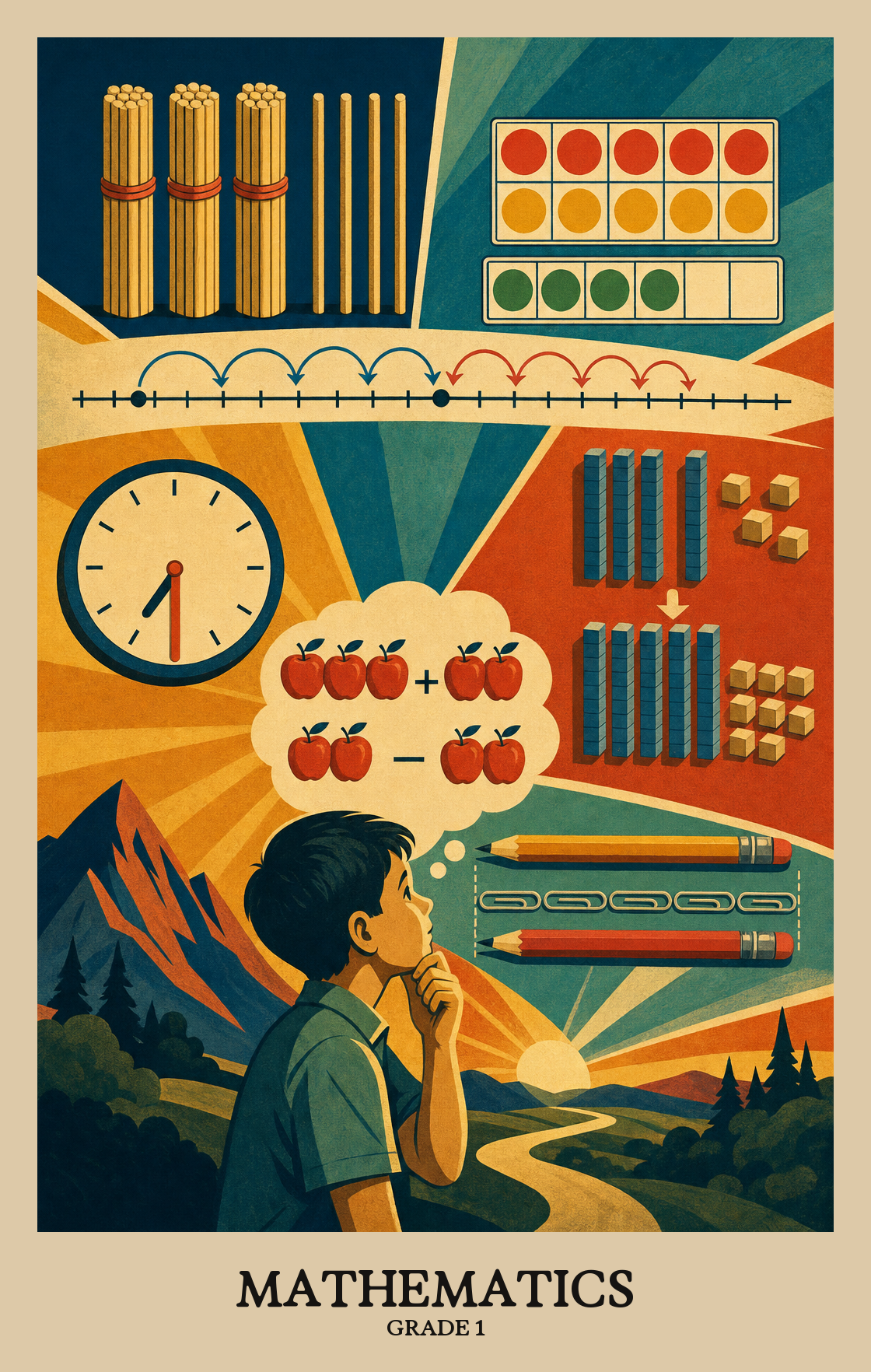
Students count, read, and write numbers up to 120 and start adding and subtracting small numbers quickly. Expect lots of finger counting at first, then faster recall of facts like 7 plus 3.
Students solve short story problems about combining, taking away, and comparing amounts. They start writing number sentences to match the story instead of only saying the answer out loud.
Students learn that a two-digit number is made of tens and ones. They compare numbers, count by tens, and add a one-digit number to a two-digit number using groups of ten.
Students measure objects using paper clips or cubes lined up end to end, and they read clocks to the hour and half hour. They also sort objects into groups and answer questions about simple picture graphs.
Students name and build flat shapes and solid shapes, and they split circles and rectangles into halves and quarters. This is where the words half and fourth start showing up at home.
Students figure out what a math problem is asking before they start solving it, and keep trying even when it gets hard.
Students take a word problem and turn it into numbers, then check that their answer still makes sense in the original story. They move back and forth between the math and the meaning behind it.
Students explain why their math answer is correct using what they know, then listen to a classmate's reasoning and say whether it makes sense.
Students use math to make sense of real situations, like figuring out how many apples to buy or splitting a snack fairly. They show their thinking with pictures, numbers, or simple equations.
Students learn to pick the right tool for the job, whether that means grabbing a ruler, sketching on paper, or using a calculator. The goal is knowing when each tool helps and when it gets in the way.
Students choose words and labels carefully when explaining their math work. They use the right number names, units like inches or cents, and check that their calculations are exact.
Students notice patterns in numbers, shapes, and problems, then use those patterns as a shortcut to figure things out. Recognizing that 7 + 3 is the same kind of problem as 17 + 3 is one example.
Students notice when the same steps keep working the same way, then use that pattern as a shortcut. For example, adding zero to any number always leaves it unchanged.
| Standard | Definition | Code |
|---|---|---|
| Make Sense of Problems | Students figure out what a math problem is asking before they start solving it, and keep trying even when it gets hard. | CT-MATH.MP.1.1 |
| Reason Abstractly | Students take a word problem and turn it into numbers, then check that their answer still makes sense in the original story. They move back and forth between the math and the meaning behind it. | CT-MATH.MP.1.2 |
| Construct Arguments | Students explain why their math answer is correct using what they know, then listen to a classmate's reasoning and say whether it makes sense. | CT-MATH.MP.1.3 |
| Model with Mathematics | Students use math to make sense of real situations, like figuring out how many apples to buy or splitting a snack fairly. They show their thinking with pictures, numbers, or simple equations. | CT-MATH.MP.1.4 |
| Use Tools Strategically | Students learn to pick the right tool for the job, whether that means grabbing a ruler, sketching on paper, or using a calculator. The goal is knowing when each tool helps and when it gets in the way. | CT-MATH.MP.1.5 |
| Attend to Precision | Students choose words and labels carefully when explaining their math work. They use the right number names, units like inches or cents, and check that their calculations are exact. | CT-MATH.MP.1.6 |
| Use Structure | Students notice patterns in numbers, shapes, and problems, then use those patterns as a shortcut to figure things out. Recognizing that 7 + 3 is the same kind of problem as 17 + 3 is one example. | CT-MATH.MP.1.7 |
| Express Regularity | Students notice when the same steps keep working the same way, then use that pattern as a shortcut. For example, adding zero to any number always leaves it unchanged. | CT-MATH.MP.1.8 |
Students count, compare, and work with whole numbers in everyday situations. They start building the number sense that fractions and bigger math will depend on later.
Adding, subtracting, multiplying, and dividing show up in everyday problems. Students learn to recognize which operation a problem needs and solve it using numbers, pictures, or equations.
Students read and fill in simple charts and graphs, like a picture graph showing how many students picked each lunch. They answer basic questions about the data, such as which group has more or less.
Students sort, name, and describe flat and solid shapes like squares, triangles, and cubes. They notice how shapes are alike or different by looking at sides, corners, and size.
Ratio reasoning shows up in first grade as sorting and comparing groups. Students figure out how many more or fewer objects one group has than another, using pictures, counters, or simple math.
| Standard | Definition | Code |
|---|---|---|
| Counting and Number | Students count, compare, and work with whole numbers in everyday situations. They start building the number sense that fractions and bigger math will depend on later. | CT-MATH.K8.1.1 |
| Operations and Algebraic Thinking | Adding, subtracting, multiplying, and dividing show up in everyday problems. Students learn to recognize which operation a problem needs and solve it using numbers, pictures, or equations. | CT-MATH.K8.1.2 |
| Measurement and Data | Students read and fill in simple charts and graphs, like a picture graph showing how many students picked each lunch. They answer basic questions about the data, such as which group has more or less. | CT-MATH.K8.1.3 |
| Geometry | Students sort, name, and describe flat and solid shapes like squares, triangles, and cubes. They notice how shapes are alike or different by looking at sides, corners, and size. | CT-MATH.K8.1.4 |
| Ratios and Proportional Relationships | Ratio reasoning shows up in first grade as sorting and comparing groups. Students figure out how many more or fewer objects one group has than another, using pictures, counters, or simple math. | CT-MATH.K8.1.5 |
Connecticut's spring summative math test for grades 3 through 8, aligned to the Connecticut Core Standards for Mathematics.
Students add and subtract within 20, count to 120, and start to see numbers as tens and ones. They also measure short objects, tell time on the hour and half hour, and sort shapes by how many sides or corners they have.
Count things together. Coins, steps to the car, crackers on a plate. Ask quick questions like how many are left after eating two, or which pile has more and by how much. Five minutes a day adds up.
No. Fingers are a real math tool at this age. Over time, students start to just know small sums like 4 plus 3, and finger counting fades on its own. Pushing students off fingers too early often backfires.
Most teachers start with counting and addition and subtraction within 10, then build to within 20 using strategies like making ten. Place value with tens and ones usually comes mid-year, with measurement, time, and shapes spread across the back half.
Subtraction within 20 and word problems with an unknown in different spots, like 8 plus what equals 13. Place value beyond 20 also takes time. Plan to revisit these in small doses all year instead of teaching them once and moving on.
Short, with numbers students can act out. Three frogs on a log, two more hop on, how many now. Read it twice, draw a picture, then write the number sentence. The goal is making sense of the story, not finding a keyword.
Students should add and subtract within 20 without much hesitation, count past 100, and read numbers like 47 as 4 tens and 7 ones. They should also tell time to the half hour and compare lengths of two objects.
They should be fluent with sums within 10 by the end of the year, meaning quick and accurate without much counting. Facts to 20 keep building into second grade. Short daily practice with cards or quick games works better than long drills.