Thinking like a scientist
Students learn how scientists work. They ask questions about things they notice, plan simple experiments, and keep careful records of what happens so they can talk about the results with evidence.
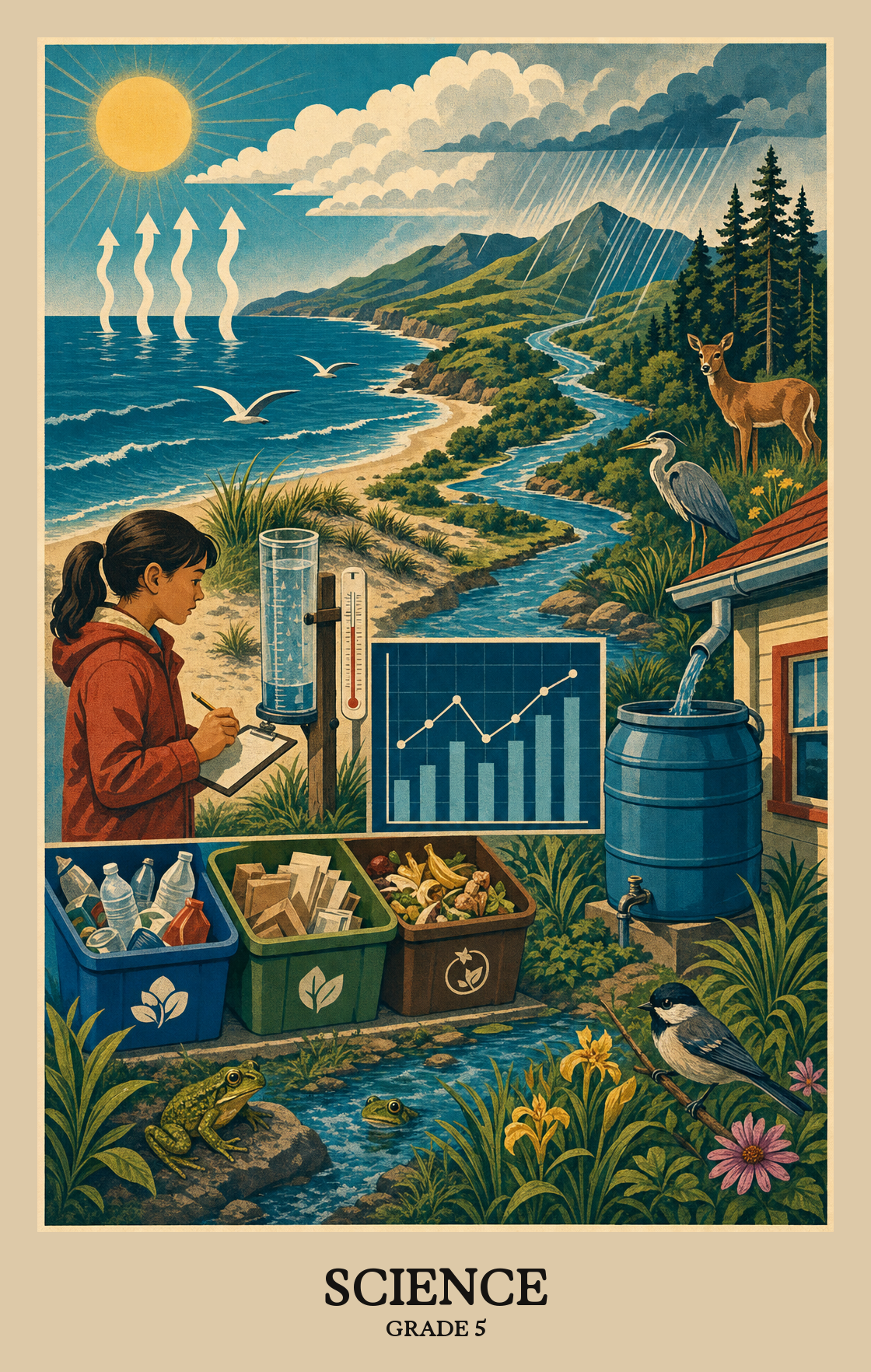
This is the year science starts pulling the pieces together. Students see Earth as one connected system, where the oceans, air, land, and living things shape each other. They run their own investigations, collect data, and back up their ideas with evidence instead of guesses. By spring, students can explain how water cycles through the planet and design a simple solution to a real problem, like reducing waste or protecting a habitat.
Students learn how scientists work. They ask questions about things they notice, plan simple experiments, and keep careful records of what happens so they can talk about the results with evidence.
Students dig into the physical world. They explore what everyday stuff is made of, how pushes and pulls change motion, and how energy moves through light, sound, heat, and electricity.
Students study plants, animals, and the places they live. They look at how bodies work, how food and energy move through a habitat, and why offspring look like their parents but not exactly.
Students zoom out to Earth and space. They track patterns in the sky, look at how land, water, and air shape each other, and consider how people affect the planet and prepare for natural hazards.
Students take on real problems as young engineers. They sketch ideas, build models, test what works, and improve their designs based on what they learn from each round of trying.
Students come up with questions that can be tested with an experiment or a problem that could be fixed by building something. The focus is on whether the question or problem is something science or engineering can actually tackle.
Students build or draw a model (a diagram, a sketch, or a physical replica) to show how something in nature works or how an engineered design is put together. The model helps explain what is hard to see or describe in words alone.
Students design simple tests, collect observations or measurements, and use what they find to check whether an idea holds up.
Students look at charts, measurements, or observations from an experiment and figure out what the numbers actually mean. They spot trends or patterns in the data to draw a conclusion.
Students apply math skills, like measuring, counting, or using data, to back up a scientific idea or explain what they observed.
Students build written explanations for science questions by connecting their answer to actual evidence and known science ideas. They also use that same reasoning to propose a fix or solution to a real problem.
Students look at two or more explanations for the same science question and decide which one has better evidence behind it. They back up their choice with data, observations, or test results, not just opinion.
Students read science articles, diagrams, and data, then decide what information is trustworthy and share their findings in writing or discussion.
| Standard | Definition | Code |
|---|---|---|
| Asking Questions and Defining Problems | Students come up with questions that can be tested with an experiment or a problem that could be fixed by building something. The focus is on whether the question or problem is something science or engineering can actually tackle. | CT-SCI.SEP.5.1 |
| Developing and Using Models | Students build or draw a model (a diagram, a sketch, or a physical replica) to show how something in nature works or how an engineered design is put together. The model helps explain what is hard to see or describe in words alone. | CT-SCI.SEP.5.2 |
| Planning and Carrying Out Investigations | Students design simple tests, collect observations or measurements, and use what they find to check whether an idea holds up. | CT-SCI.SEP.5.3 |
| Analyzing and Interpreting Data | Students look at charts, measurements, or observations from an experiment and figure out what the numbers actually mean. They spot trends or patterns in the data to draw a conclusion. | CT-SCI.SEP.5.4 |
| Mathematics and Computational Thinking | Students apply math skills, like measuring, counting, or using data, to back up a scientific idea or explain what they observed. | CT-SCI.SEP.5.5 |
| Constructing Explanations | Students build written explanations for science questions by connecting their answer to actual evidence and known science ideas. They also use that same reasoning to propose a fix or solution to a real problem. | CT-SCI.SEP.5.6 |
| Engaging in Argument from Evidence | Students look at two or more explanations for the same science question and decide which one has better evidence behind it. They back up their choice with data, observations, or test results, not just opinion. | CT-SCI.SEP.5.7 |
| Communicating Information | Students read science articles, diagrams, and data, then decide what information is trustworthy and share their findings in writing or discussion. | CT-SCI.SEP.5.8 |
Students examine what matter is made of and how tiny particles interact to explain everyday physical changes, like why ice melts or salt dissolves in water.
Students test how pushes, pulls, and collisions make objects speed up, slow down, or change direction. They learn why bigger forces cause bigger changes in motion, and why objects at rest tend to stay put.
Students investigate how energy changes form and moves from one object to another, and how the total amount of energy in a system stays the same even when it shifts around.
Students study how waves (like sound, light, and water ripples) move energy from one place to another. They also look at how waves carry information, the way a radio signal brings music into a car.
| Standard | Definition | Code |
|---|---|---|
| Matter and Interactions | Students examine what matter is made of and how tiny particles interact to explain everyday physical changes, like why ice melts or salt dissolves in water. | CT-SCI.PS.5.1 |
| Motion and Stability | Students test how pushes, pulls, and collisions make objects speed up, slow down, or change direction. They learn why bigger forces cause bigger changes in motion, and why objects at rest tend to stay put. | CT-SCI.PS.5.2 |
| Energy | Students investigate how energy changes form and moves from one object to another, and how the total amount of energy in a system stays the same even when it shifts around. | CT-SCI.PS.5.3 |
| Waves and Information | Students study how waves (like sound, light, and water ripples) move energy from one place to another. They also look at how waves carry information, the way a radio signal brings music into a car. | CT-SCI.PS.5.4 |
Students examine how living things are built, starting with the tiny cells inside them and working up to the organs and systems those cells form.
Students trace how energy from the sun and nutrients from the soil move through living things in an ecosystem. They also study how plants, animals, and other organisms depend on and affect each other.
Students look at traits like eye color, height, or leaf shape to figure out which characteristics get passed down from parents to offspring and which ones vary from one generation to the next.
Students compare living things to find patterns in how species are alike and different, then explore why those differences develop over generations.
| Standard | Definition | Code |
|---|---|---|
| Structures and Processes | Students examine how living things are built, starting with the tiny cells inside them and working up to the organs and systems those cells form. | CT-SCI.LS.5.1 |
| Ecosystems | Students trace how energy from the sun and nutrients from the soil move through living things in an ecosystem. They also study how plants, animals, and other organisms depend on and affect each other. | CT-SCI.LS.5.2 |
| Heredity | Students look at traits like eye color, height, or leaf shape to figure out which characteristics get passed down from parents to offspring and which ones vary from one generation to the next. | CT-SCI.LS.5.3 |
| Biological Evolution | Students compare living things to find patterns in how species are alike and different, then explore why those differences develop over generations. | CT-SCI.LS.5.4 |
Students explore where Earth sits in the solar system, how the planets move in predictable patterns, and how Earth itself has changed over billions of years.
Students examine how Earth's four major systems (the solid ground, water, air, and living things) affect each other. For example, rain shapes the land, wind moves water, and plants change the soil.
Students look at how things like farming, building, and pollution change the land, water, and air around us. They also study how earthquakes, floods, and storms affect the people living in those places.
| Standard | Definition | Code |
|---|---|---|
| Earth's Place in the Universe | Students explore where Earth sits in the solar system, how the planets move in predictable patterns, and how Earth itself has changed over billions of years. | CT-SCI.ESS.5.1 |
| Earth's Systems | Students examine how Earth's four major systems (the solid ground, water, air, and living things) affect each other. For example, rain shapes the land, wind moves water, and plants change the soil. | CT-SCI.ESS.5.2 |
| Earth and Human Activity | Students look at how things like farming, building, and pollution change the land, water, and air around us. They also study how earthquakes, floods, and storms affect the people living in those places. | CT-SCI.ESS.5.3 |
Students identify a real problem, sketch or build possible fixes, then test and adjust their design until it works better.
New tools and systems shape how people live, and the needs of society push engineers to invent new solutions. Students explore how these forces push and pull on each other over time.
| Standard | Definition | Code |
|---|---|---|
| Engineering Design | Students identify a real problem, sketch or build possible fixes, then test and adjust their design until it works better. | CT-SCI.ETS.5.1 |
| Links Among Engineering, Technology, and Society | New tools and systems shape how people live, and the needs of society push engineers to invent new solutions. Students explore how these forces push and pull on each other over time. | CT-SCI.ETS.5.2 |
Computer-based science assessment in grade 5, aligned to the Connecticut Core Science Standards (NGSS).
Students study four big areas: matter and forces, living things and ecosystems, Earth and space, and engineering design. They also learn how scientists work by asking questions, running tests, and explaining results with evidence.
Cook together and talk about what changes when things heat up, freeze, or dissolve. Watch the moon over a few weeks, plant something on a windowsill, or take apart a broken flashlight. Ask students to explain what they notice and why they think it happens.
Students should plan a simple experiment, collect data in a table, and use that data to back up an explanation. They should also be able to describe how parts of a system work together, whether it is a food web, a water cycle, or a model rocket.
Many teachers anchor each quarter to one strand and weave the practices through all of them. A common path is matter and energy first, then life science, then Earth and space, with engineering design tasks layered in whenever students need to apply what they just learned.
Science at this age is mostly noticing and asking questions, not memorizing facts. Pick something they already like, food, sports, animals, weather, and ask what they wonder about it. Curiosity is the skill that matters most right now.
Controlling variables, reading data tables, and writing explanations that actually use evidence are the common sticking points. Short, repeated practice with simple investigations works better than one big unit on the scientific method.
Students measure, graph, and look for patterns in numbers. Expect line plots, bar graphs, averages, and unit conversions tied to real investigations. Strong measurement habits in science also reinforce the math work happening in class.
Engineering tasks work best as the application step after students learn a concept. After studying forces, have students design a vehicle. After ecosystems, have them design a habitat. Build in time for testing and a second round of changes.
They can describe a question they investigated, what they did, and what they found. They can read a chart and say what it shows. And they can talk about cause and effect in the natural world without guessing.