Place value and decimals
Students extend place value to decimals, reading and writing numbers like 3.47 and comparing them on a number line. They round decimals and start to see how each place is ten times the one to its right.
This is the year math stretches past whole numbers into decimals and fractions. Students add and subtract fractions with different bottom numbers, and they start multiplying and dividing them in real situations like recipes and lengths. Decimals show up to the hundredths and thousandths place, with students rounding and calculating money-sized amounts. By spring, students can solve a word problem that mixes fractions and decimals and explain the steps they took.
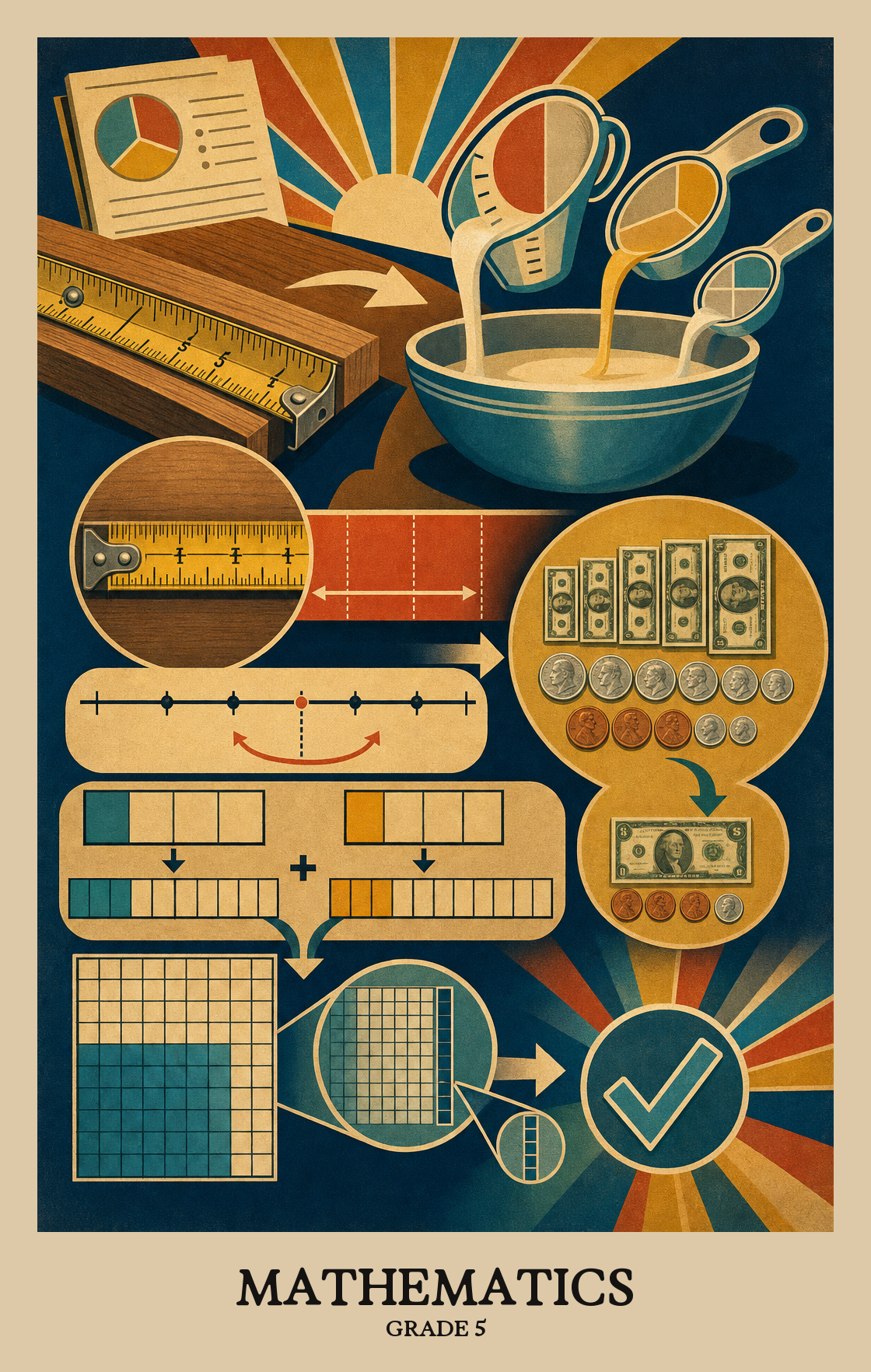
Students extend place value to decimals, reading and writing numbers like 3.47 and comparing them on a number line. They round decimals and start to see how each place is ten times the one to its right.
Students multiply larger numbers and divide with two-digit divisors using the standard method. They also add, subtract, multiply, and divide decimals in everyday contexts like money and measurement.
Students add and subtract fractions with unlike denominators, including mixed numbers. Parents may see word problems about recipes, distances, or splitting time across activities.
Students multiply fractions by whole numbers and by other fractions, and divide whole numbers by unit fractions. They learn why multiplying by a fraction less than one makes a number smaller.
Students convert between units like inches and feet or meters and centimeters, and solve multi-step problems. They also find the volume of boxes and other rectangular solids by counting and multiplying.
Students plot points on a coordinate grid and graph simple patterns from two rules. They sort shapes like triangles and quadrilaterals by their properties and use that to solve problems.
Students read a math problem carefully, figure out what it is actually asking, and keep trying even when the first approach does not work.
Students take a real problem (like splitting a pizza) and turn it into numbers and symbols to solve it, then translate the answer back into plain language that actually answers the question.
Students back up their math answers with reasons, then listen to a classmate's thinking and explain where they agree or disagree.
Students use math to make sense of real situations: drawing a diagram, writing an equation, or reading a graph to figure out an answer that actually matters outside of school.
Students choose the right tool for the job, whether that means a calculator, a pencil, or a rough estimate in their head. They know when each one helps and when it gets in the way.
Students choose the right math words, label answers with the correct units (like inches or grams), and check that their calculations are exact. Sloppy shortcuts get caught and fixed before the work is done.
Students notice patterns and hidden structure in numbers, shapes, and equations, then use those patterns as shortcuts to solve problems faster or spot mistakes before they happen.
Students notice when a process keeps working the same way, then use that pattern as a shortcut or rule. Instead of solving each problem from scratch, they spot what repeats and apply it.
| Standard | Definition | Code |
|---|---|---|
| Make Sense of Problems | Students read a math problem carefully, figure out what it is actually asking, and keep trying even when the first approach does not work. | CT-MATH.MP.5.1 |
| Reason Abstractly | Students take a real problem (like splitting a pizza) and turn it into numbers and symbols to solve it, then translate the answer back into plain language that actually answers the question. | CT-MATH.MP.5.2 |
| Construct Arguments | Students back up their math answers with reasons, then listen to a classmate's thinking and explain where they agree or disagree. | CT-MATH.MP.5.3 |
| Model with Mathematics | Students use math to make sense of real situations: drawing a diagram, writing an equation, or reading a graph to figure out an answer that actually matters outside of school. | CT-MATH.MP.5.4 |
| Use Tools Strategically | Students choose the right tool for the job, whether that means a calculator, a pencil, or a rough estimate in their head. They know when each one helps and when it gets in the way. | CT-MATH.MP.5.5 |
| Attend to Precision | Students choose the right math words, label answers with the correct units (like inches or grams), and check that their calculations are exact. Sloppy shortcuts get caught and fixed before the work is done. | CT-MATH.MP.5.6 |
| Use Structure | Students notice patterns and hidden structure in numbers, shapes, and equations, then use those patterns as shortcuts to solve problems faster or spot mistakes before they happen. | CT-MATH.MP.5.7 |
| Express Regularity | Students notice when a process keeps working the same way, then use that pattern as a shortcut or rule. Instead of solving each problem from scratch, they spot what repeats and apply it. | CT-MATH.MP.5.8 |
Students work with whole numbers, fractions, and negative numbers at the fifth-grade level, using what they know about how numbers are built to solve problems, compare values, and make sense of quantities.
Students write and solve number sentences that mix addition, subtraction, multiplication, and division. They figure out the right order to work through each step and find the unknown value.
Students read and build tables, graphs, and simple data summaries to answer questions about real information. The focus is on making sense of what the numbers say, not just plotting them.
Students sort and measure flat shapes like triangles and rectangles alongside solid shapes like cubes and cylinders. They describe what makes each shape unique, from the number of sides to how its faces connect.
Students use ratio reasoning to compare quantities and solve everyday problems, like figuring out how many cups of juice to mix with water if you double or triple a recipe.
| Standard | Definition | Code |
|---|---|---|
| Counting and Number | Students work with whole numbers, fractions, and negative numbers at the fifth-grade level, using what they know about how numbers are built to solve problems, compare values, and make sense of quantities. | CT-MATH.K8.5.1 |
| Operations and Algebraic Thinking | Students write and solve number sentences that mix addition, subtraction, multiplication, and division. They figure out the right order to work through each step and find the unknown value. | CT-MATH.K8.5.2 |
| Measurement and Data | Students read and build tables, graphs, and simple data summaries to answer questions about real information. The focus is on making sense of what the numbers say, not just plotting them. | CT-MATH.K8.5.3 |
| Geometry | Students sort and measure flat shapes like triangles and rectangles alongside solid shapes like cubes and cylinders. They describe what makes each shape unique, from the number of sides to how its faces connect. | CT-MATH.K8.5.4 |
| Ratios and Proportional Relationships | Students use ratio reasoning to compare quantities and solve everyday problems, like figuring out how many cups of juice to mix with water if you double or triple a recipe. | CT-MATH.K8.5.5 |
Connecticut's spring summative math test for grades 3 through 8, aligned to the Connecticut Core Standards for Mathematics.
Fifth grade focuses on fractions, decimals, and place value with larger numbers. Students add and subtract fractions with unlike denominators, multiply and divide with decimals, and start working with volume and the coordinate grid. Word problems get longer and pull in more than one step.
Cook together and double or halve a recipe. Cut sandwiches or pizza into different numbers of pieces and ask which slices are bigger. When students get stuck adding fractions like 1/2 and 1/3, draw both on a rectangle and count the equal parts.
By June, students should add and subtract fractions fluently, multiply multi-digit whole numbers, and divide with two-digit divisors. They should also read and write decimals to the thousandths and find the volume of a box by counting cubes or using length times width times height.
Most teachers open with place value and decimals, move to whole-number operations, then spend a long stretch on fraction operations through the winter. Spring is usually volume, the coordinate plane, and converting measurements. Save the last weeks for mixed word problems that pull everything together.
Keep practice short and low-stakes. Ten minutes of mental math during a car ride or while setting the table builds confidence faster than a worksheet. Praise the thinking, not the speed, and let students explain how they got an answer even when it is wrong.
Fraction division and decimal place value give students the most trouble. Many can compute 1/2 divided by 4 but cannot explain what it means. Build in extra time for visual models and story problems before moving to the standard procedures.
Ready students can solve a multi-step word problem with fractions or decimals and explain their reasoning. They can estimate before computing and catch their own mistakes. If a student still relies on guess-and-check for basic operations, plan some summer review.
Yes. Fluent multiplication facts make every fifth grade topic easier, from long division to simplifying fractions. If recall is shaky, practice a few facts a day with flashcards or a quick game. Five minutes daily beats an hour on the weekend.