Linear equations and inequalities
Students start the year writing and solving equations with one unknown. They graph lines, work with inequalities, and use them to describe real situations like phone plans or saving money.
This is the year math shifts from solving for a single answer to studying how two quantities change together. Students write and graph equations for straight lines, curves that arc like a thrown ball, and patterns that double or shrink fast. They also solve pairs of equations together and work with data to spot trends. By spring, students can take a real situation, like a phone plan or a savings account, and turn it into an equation and a graph that predict what happens next.
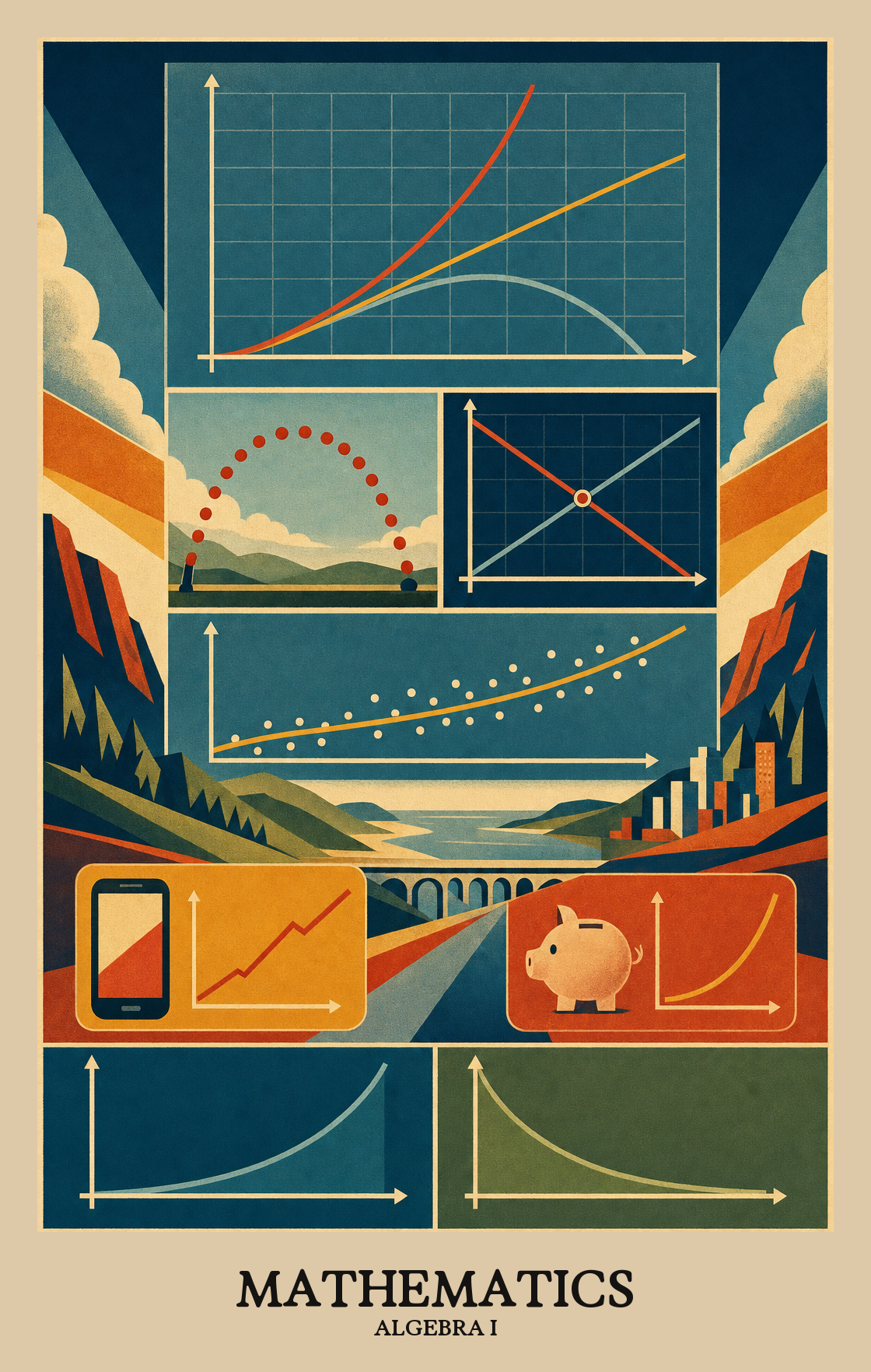
Students start the year writing and solving equations with one unknown. They graph lines, work with inequalities, and use them to describe real situations like phone plans or saving money.
Students work with two equations at once and find the point where the lines meet. They use this to answer questions with more than one unknown, like comparing two pricing options.
Students study curves shaped like a U, called parabolas. They learn to graph them, find where they cross zero, and use them to model things like the path of a ball thrown in the air.
Students explore patterns that double or shrink by half over time. They use these to model savings accounts, populations, and other situations where change speeds up or slows down.
Students add, subtract, and multiply expressions with variables. They also look at sets of data, find patterns between two things like height and shoe size, and draw conclusions from what they see.
Students read a math problem carefully, figure out what it's actually asking, and keep trying even when the first approach doesn't work.
Students take a real problem (a phone plan, a savings goal) and strip it down to symbols and equations to solve it, then translate the answer back into plain language that actually makes sense.
Students back up their math answers with reasons, not just steps. They also look at a classmate's solution and explain whether the logic holds up.
Students use math to make sense of real situations, like figuring out a budget, reading a graph, or estimating how long something takes. The math connects to something that actually happens outside the classroom.
Students choose the right tool for the math in front of them, whether that means a calculator, a quick estimate, or working it out by hand. The goal is knowing when each tool helps and when it gets in the way.
Students choose exact words, correct units, and careful calculations when solving and explaining math problems. Saying "the slope is 2" means something different from "the slope is 2 miles per hour," and precision like that matters here.
Students spot patterns and hidden shortcuts in math problems, then use those patterns to solve faster. Recognizing that a complex expression breaks into familiar pieces is the skill.
Students notice when the same steps keep showing up in a problem and use that pattern as a shortcut or rule. Instead of solving from scratch each time, they ask why the pattern works and write it down as a general method.
Students read a math problem carefully, figure out what it's actually asking, and keep working even when the path forward isn't obvious. Getting unstuck is part of the work.
Students take a real situation, turn it into an equation or expression to solve it, then translate the answer back into plain language that makes sense in the original context.
Students build a mathematical argument to support their answer, then explain where another student's reasoning goes wrong or how it holds up.
Students take a real situation, like figuring out loan payments or predicting ticket sales, and write an equation or draw a graph that helps make sense of it.
Students choose the right tool for the math in front of them: a calculator, a quick estimate, or pencil-and-paper work. The skill is knowing which one fits the problem, not just reaching for the same tool every time.
Students choose words, labels, and units carefully when solving problems. A missing negative sign or the wrong label can change the answer entirely.
Students notice patterns and hidden structure in math problems, like recognizing that a complicated expression is really just a familiar form in disguise. That recognition helps them choose a faster, cleaner path to the answer.
Students notice when the same steps keep appearing in a problem and use that pattern as a shortcut or rule. Instead of redoing the work each time, they describe what's always true.
Students read a math problem carefully, figure out what it's actually asking, and stick with it when the solution isn't obvious. They check whether their answer makes sense before moving on.
Students take a real geometry problem, like finding the area of a floor, strip it down to symbols and equations to solve it, then translate the answer back into something meaningful. Math and meaning stay connected.
Students build a logical case for their answers using facts, diagrams, or examples, then explain where a classmate's reasoning holds up or falls short.
Students take a real situation, like a traffic pattern or a building layout, and use math to make sense of it. The math helps them see what's happening and what might happen next.
Students choose the right tool for the math in front of them. That means knowing when to reach for a calculator, when to sketch it out by hand, and when a quick estimate is close enough.
Students use the right math words, label answers with the correct units, and check their calculations carefully. Sloppy language or a missing unit can make a correct answer wrong in geometry.
Students learn to spot patterns and hidden structure in math problems, like recognizing that a complex shape is really just familiar pieces arranged together. Noticing that structure helps them solve new problems faster.
When a solution method keeps working the same way, students notice the pattern and write a general rule or formula instead of solving every problem from scratch.
| Standard | Definition | Code |
|---|---|---|
| Make Sense of Problems Algebra I | Students read a math problem carefully, figure out what it's actually asking, and keep trying even when the first approach doesn't work. | CT-MATH.MP.hs-algebra-1.1 |
| Reason Abstractly Algebra I | Students take a real problem (a phone plan, a savings goal) and strip it down to symbols and equations to solve it, then translate the answer back into plain language that actually makes sense. | CT-MATH.MP.hs-algebra-1.2 |
| Construct Arguments Algebra I | Students back up their math answers with reasons, not just steps. They also look at a classmate's solution and explain whether the logic holds up. | CT-MATH.MP.hs-algebra-1.3 |
| Model with Mathematics Algebra I | Students use math to make sense of real situations, like figuring out a budget, reading a graph, or estimating how long something takes. The math connects to something that actually happens outside the classroom. | CT-MATH.MP.hs-algebra-1.4 |
| Use Tools Strategically Algebra I | Students choose the right tool for the math in front of them, whether that means a calculator, a quick estimate, or working it out by hand. The goal is knowing when each tool helps and when it gets in the way. | CT-MATH.MP.hs-algebra-1.5 |
| Attend to Precision Algebra I | Students choose exact words, correct units, and careful calculations when solving and explaining math problems. Saying "the slope is 2" means something different from "the slope is 2 miles per hour," and precision like that matters here. | CT-MATH.MP.hs-algebra-1.6 |
| Use Structure Algebra I | Students spot patterns and hidden shortcuts in math problems, then use those patterns to solve faster. Recognizing that a complex expression breaks into familiar pieces is the skill. | CT-MATH.MP.hs-algebra-1.7 |
| Express Regularity Algebra I | Students notice when the same steps keep showing up in a problem and use that pattern as a shortcut or rule. Instead of solving from scratch each time, they ask why the pattern works and write it down as a general method. | CT-MATH.MP.hs-algebra-1.8 |
| Make Sense of Problems Algebra II | Students read a math problem carefully, figure out what it's actually asking, and keep working even when the path forward isn't obvious. Getting unstuck is part of the work. | CT-MATH.MP.hs-algebra-2.1 |
| Reason Abstractly Algebra II | Students take a real situation, turn it into an equation or expression to solve it, then translate the answer back into plain language that makes sense in the original context. | CT-MATH.MP.hs-algebra-2.2 |
| Construct Arguments Algebra II | Students build a mathematical argument to support their answer, then explain where another student's reasoning goes wrong or how it holds up. | CT-MATH.MP.hs-algebra-2.3 |
| Model with Mathematics Algebra II | Students take a real situation, like figuring out loan payments or predicting ticket sales, and write an equation or draw a graph that helps make sense of it. | CT-MATH.MP.hs-algebra-2.4 |
| Use Tools Strategically Algebra II | Students choose the right tool for the math in front of them: a calculator, a quick estimate, or pencil-and-paper work. The skill is knowing which one fits the problem, not just reaching for the same tool every time. | CT-MATH.MP.hs-algebra-2.5 |
| Attend to Precision Algebra II | Students choose words, labels, and units carefully when solving problems. A missing negative sign or the wrong label can change the answer entirely. | CT-MATH.MP.hs-algebra-2.6 |
| Use Structure Algebra II | Students notice patterns and hidden structure in math problems, like recognizing that a complicated expression is really just a familiar form in disguise. That recognition helps them choose a faster, cleaner path to the answer. | CT-MATH.MP.hs-algebra-2.7 |
| Express Regularity Algebra II | Students notice when the same steps keep appearing in a problem and use that pattern as a shortcut or rule. Instead of redoing the work each time, they describe what's always true. | CT-MATH.MP.hs-algebra-2.8 |
| Make Sense of Problems Geometry | Students read a math problem carefully, figure out what it's actually asking, and stick with it when the solution isn't obvious. They check whether their answer makes sense before moving on. | CT-MATH.MP.hs-geometry.1 |
| Reason Abstractly Geometry | Students take a real geometry problem, like finding the area of a floor, strip it down to symbols and equations to solve it, then translate the answer back into something meaningful. Math and meaning stay connected. | CT-MATH.MP.hs-geometry.2 |
| Construct Arguments Geometry | Students build a logical case for their answers using facts, diagrams, or examples, then explain where a classmate's reasoning holds up or falls short. | CT-MATH.MP.hs-geometry.3 |
| Model with Mathematics Geometry | Students take a real situation, like a traffic pattern or a building layout, and use math to make sense of it. The math helps them see what's happening and what might happen next. | CT-MATH.MP.hs-geometry.4 |
| Use Tools Strategically Geometry | Students choose the right tool for the math in front of them. That means knowing when to reach for a calculator, when to sketch it out by hand, and when a quick estimate is close enough. | CT-MATH.MP.hs-geometry.5 |
| Attend to Precision Geometry | Students use the right math words, label answers with the correct units, and check their calculations carefully. Sloppy language or a missing unit can make a correct answer wrong in geometry. | CT-MATH.MP.hs-geometry.6 |
| Use Structure Geometry | Students learn to spot patterns and hidden structure in math problems, like recognizing that a complex shape is really just familiar pieces arranged together. Noticing that structure helps them solve new problems faster. | CT-MATH.MP.hs-geometry.7 |
| Express Regularity Geometry | When a solution method keeps working the same way, students notice the pattern and write a general rule or formula instead of solving every problem from scratch. | CT-MATH.MP.hs-geometry.8 |
Writing and solving equations like y = 2x + 5, then plotting them on a graph. Students also work with inequalities to show a range of values, connecting the math to situations like budgeting or calculating distance.
Students write two or more equations or inequalities together and find the values that satisfy all of them at once. This shows up in real situations like splitting costs or comparing rates.
Students work with U-shaped curves called parabolas to model real situations, like the path of a thrown ball or the area of a rectangle. They write the equation, sketch the graph, and use both to answer questions about the situation.
Exponential functions show how something multiplies (or shrinks) by the same factor again and again. Students read graphs, write equations, and recognize whether a pattern like interest, population, or radioactive decay is growing or fading over time.
Students add, subtract, and multiply expressions with variables and exponents, then read data sets and graphs to draw conclusions about patterns and relationships.
| Standard | Definition | Code |
|---|---|---|
| Linear Functions Algebra I | Writing and solving equations like y = 2x + 5, then plotting them on a graph. Students also work with inequalities to show a range of values, connecting the math to situations like budgeting or calculating distance. | CT-MATH.A1.hs-algebra-1.1 |
| Systems Algebra I | Students write two or more equations or inequalities together and find the values that satisfy all of them at once. This shows up in real situations like splitting costs or comparing rates. | CT-MATH.A1.hs-algebra-1.2 |
| Quadratic Functions Algebra I | Students work with U-shaped curves called parabolas to model real situations, like the path of a thrown ball or the area of a rectangle. They write the equation, sketch the graph, and use both to answer questions about the situation. | CT-MATH.A1.hs-algebra-1.3 |
| Exponential Functions Algebra I | Exponential functions show how something multiplies (or shrinks) by the same factor again and again. Students read graphs, write equations, and recognize whether a pattern like interest, population, or radioactive decay is growing or fading over time. | CT-MATH.A1.hs-algebra-1.4 |
| Polynomials and Statistics Algebra I | Students add, subtract, and multiply expressions with variables and exponents, then read data sets and graphs to draw conclusions about patterns and relationships. | CT-MATH.A1.hs-algebra-1.5 |
Students read graphs of advanced functions, spotting where they rise, fall, level off, or repeat. The function types include polynomials, rationals, exponentials, logarithms, and trig curves.
Students add, subtract, multiply, and divide expressions with variables and fractions that contain variables. They also solve equations built from those expressions.
Students use sine, cosine, and related functions to describe real-world patterns that repeat on a cycle, like sound waves, tides, or seasonal temperature changes. They also use trig identities to simplify and solve those models.
Students use data collected from a sample group to draw conclusions about a larger population. They apply statistical reasoning to decide what the sample likely tells us about the whole group.
| Standard | Definition | Code |
|---|---|---|
| Functions and Graphs Algebra II | Students read graphs of advanced functions, spotting where they rise, fall, level off, or repeat. The function types include polynomials, rationals, exponentials, logarithms, and trig curves. | CT-MATH.A2.hs-algebra-2.1 |
| Polynomial and Rational Algebra II | Students add, subtract, multiply, and divide expressions with variables and fractions that contain variables. They also solve equations built from those expressions. | CT-MATH.A2.hs-algebra-2.2 |
| Trigonometry Algebra II | Students use sine, cosine, and related functions to describe real-world patterns that repeat on a cycle, like sound waves, tides, or seasonal temperature changes. They also use trig identities to simplify and solve those models. | CT-MATH.A2.hs-algebra-2.3 |
| Statistics and Probability Algebra II | Students use data collected from a sample group to draw conclusions about a larger population. They apply statistical reasoning to decide what the sample likely tells us about the whole group. | CT-MATH.A2.hs-algebra-2.4 |
Rigid transformations are moves that keep a shape exactly the same size and angles. Students use slides, flips, and turns to show that two triangles or other figures are identical, then write a formal proof explaining why.
Students use scale, angle measures, and sine, cosine, and tangent ratios to find missing side lengths and angles in right triangles. The problems come from real contexts like ramps, shadows, and building heights.
Students use the rules that govern circles, such as how angles formed by chords or tangents relate to the arcs they intercept, to solve problems involving missing measurements inside or around a circle.
Students use algebra and coordinates on a graph to prove geometric properties. They write equations to show things like whether two lines are parallel, where shapes intersect, or how far apart two points are.
Students find the area, surface area, and volume of shapes, then use those calculations to solve real problems like figuring out how much paint covers a wall or how much water fills a tank.
| Standard | Definition | Code |
|---|---|---|
| Congruence Geometry | Rigid transformations are moves that keep a shape exactly the same size and angles. Students use slides, flips, and turns to show that two triangles or other figures are identical, then write a formal proof explaining why. | CT-MATH.GEO.hs-geometry.1 |
| Similarity, Right Triangles, and Trigonometry Geometry | Students use scale, angle measures, and sine, cosine, and tangent ratios to find missing side lengths and angles in right triangles. The problems come from real contexts like ramps, shadows, and building heights. | CT-MATH.GEO.hs-geometry.2 |
| Circles Geometry | Students use the rules that govern circles, such as how angles formed by chords or tangents relate to the arcs they intercept, to solve problems involving missing measurements inside or around a circle. | CT-MATH.GEO.hs-geometry.3 |
| Coordinate Geometry Geometry | Students use algebra and coordinates on a graph to prove geometric properties. They write equations to show things like whether two lines are parallel, where shapes intersect, or how far apart two points are. | CT-MATH.GEO.hs-geometry.4 |
| Measurement and Modeling Geometry | Students find the area, surface area, and volume of shapes, then use those calculations to solve real problems like figuring out how much paint covers a wall or how much water fills a tank. | CT-MATH.GEO.hs-geometry.5 |
Connecticut administers the SAT School Day to all 11th-grade students free of charge as part of the state's accountability system.
Most of the year centers on linear equations and how to graph them, then moves into systems of two equations, quadratics, and exponential growth and decay. Students also work with polynomials and learn to read patterns in data. The big shift from middle school is moving from arithmetic with numbers to reasoning with variables.
Ask students to explain what each letter in the problem stands for and what the question is really asking. If they get stuck, have them show the last step that made sense and check the arithmetic there. Most algebra mistakes are small slips with signs or order of operations, not deep confusion.
Solving a linear equation, graphing a line from an equation, and finding where two lines cross. Students should also be able to factor a simple quadratic, solve one using the quadratic formula, and tell a linear pattern from an exponential one. These show up in every later math course.
Linear equations and inequalities come first because everything else leans on them. Systems fit naturally next, then quadratics in the middle of the year when factoring and the quadratic formula have time to settle. Exponentials, polynomials, and data work close out the year and connect back to linear and quadratic ideas.
Factoring quadratics, the difference between linear and exponential growth, and solving systems by substitution tend to need a second pass. Sign errors when distributing and moving terms across the equals sign also come back all year. Building in short warm-ups on these keeps them from eroding.
Pick one equation from the day's notes and solve it again from scratch, then check the answer by plugging it back in. For graphing, sketch a line from an equation on scratch paper and label two points. Short, daily practice beats long weekend sessions.
The skills are the same, but students are asked to explain their reasoning and connect equations to real situations more often. Expect questions about populations, prices, distances, and rates of change, not just solving for x. Graphs and tables show up alongside the algebra from the start.
Students should solve and graph linear and quadratic equations without prompting, set up a system from a word problem, and recognize when a situation calls for exponential rather than linear thinking. They should also explain their steps in words. If those hold up on mixed review, the foundation is in place.