Thinking like a scientist
Students start the year asking questions they can test and trying small experiments. They learn to look closely, write down what they notice, and explain why their evidence backs up their answer.
This is the year science becomes a habit of asking questions and looking for answers. Students start to notice patterns in the sky, the weather, and the world around them, and they sort living things by what they need to survive. They also poke at how matter works by pushing, pulling, heating, and cooling everyday objects. By spring, they can ask a simple question, run a small test, and explain what they saw.
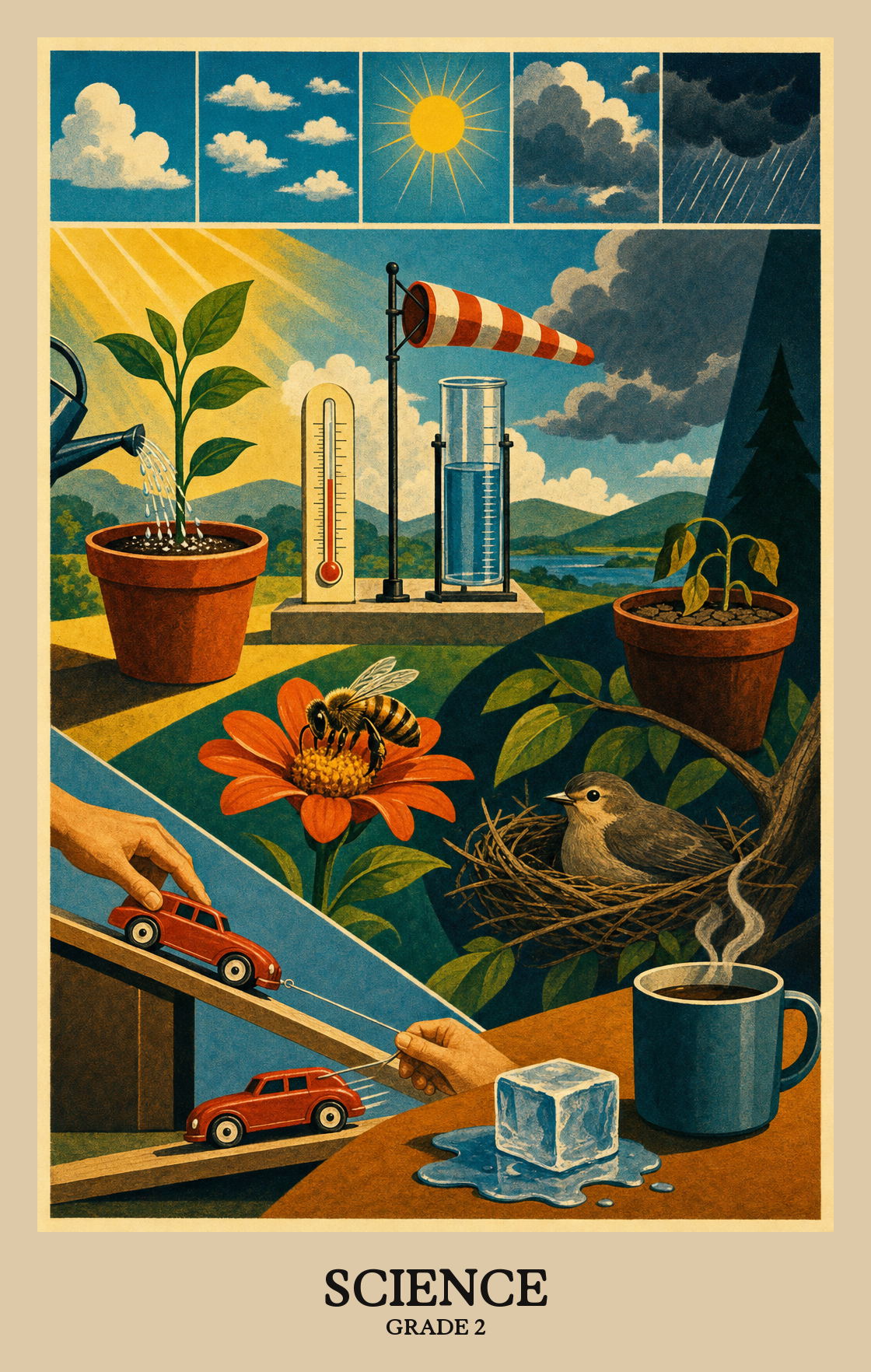
Students start the year asking questions they can test and trying small experiments. They learn to look closely, write down what they notice, and explain why their evidence backs up their answer.
Students explore the stuff around them, from ice melting to balls rolling down ramps. They sort objects by their properties and notice how a push, a pull, or heat can change what something does.
Students look at plants and animals up close and see how each one grows, eats, and raises young. They learn how creatures depend on each other and on the soil, water, and air around them.
Students track the sun, moon, and seasons and notice how the weather shifts through the year. They look at rocks, soil, and water as parts of one planet that keeps changing.
Students ask a question they can actually test, plan a simple investigation to answer it, and use what they find to explain what happened.
Science knowledge is not set in stone. Students learn that scientists test ideas, check each other's work, and update what they know when new evidence shows a better answer.
A hypothesis is a careful guess students test with experiments. A theory explains why something happens after lots of testing. A law describes what always happens, and a model is a drawing or diagram that helps show how something works.
| Standard | Definition | Code |
|---|---|---|
| The Practice of Science | Students ask a question they can actually test, plan a simple investigation to answer it, and use what they find to explain what happened. | FL-SCI.NATURE.2.1 |
| The Characteristics of Scientific Knowledge | Science knowledge is not set in stone. Students learn that scientists test ideas, check each other's work, and update what they know when new evidence shows a better answer. | FL-SCI.NATURE.2.2 |
| The Role of Theories, Laws, and Models | A hypothesis is a careful guess students test with experiments. A theory explains why something happens after lots of testing. A law describes what always happens, and a model is a drawing or diagram that helps show how something works. | FL-SCI.NATURE.2.3 |
Students learn why we have day and night and how the seasons change throughout the year. They look at patterns in sunlight and temperature to understand Earth's place in the solar system.
Students learn what makes up Earth: the rocky ground beneath their feet, the oceans and rivers that cover it, and the air that surrounds it. They explore how these layers work together and change over time.
Students learn that weather follows patterns, like rainy seasons or cold winters, and that where you live affects what that weather looks like. They begin to see the difference between a day's weather and the long-term climate of a place.
| Standard | Definition | Code |
|---|---|---|
| Earth in Space and Time | Students learn why we have day and night and how the seasons change throughout the year. They look at patterns in sunlight and temperature to understand Earth's place in the solar system. | FL-SCI.ESS.2.1 |
| Earth's Structures | Students learn what makes up Earth: the rocky ground beneath their feet, the oceans and rivers that cover it, and the air that surrounds it. They explore how these layers work together and change over time. | FL-SCI.ESS.2.2 |
| Weather and Climate | Students learn that weather follows patterns, like rainy seasons or cold winters, and that where you live affects what that weather looks like. They begin to see the difference between a day's weather and the long-term climate of a place. | FL-SCI.ESS.2.3 |
Living things are built from tiny units called cells, the way a wall is built from bricks. Students learn how those cells group together to form tissues, organs, and whole organisms like plants and animals.
Students learn that living things pass traits to their offspring, like how a puppy looks like its parents. They also study how animals and plants grow from birth to adult and how those patterns repeat generation after generation.
Students learn that living things come in many shapes and sizes, and that over long periods of time, those living things have slowly changed. They study real examples to see how different creatures alive today compare to creatures from the past.
Plants, animals, and other living things depend on each other to survive. Students learn how food, water, and other materials move through an ecosystem and keep every living thing fed and functioning.
| Standard | Definition | Code |
|---|---|---|
| Organization and Development | Living things are built from tiny units called cells, the way a wall is built from bricks. Students learn how those cells group together to form tissues, organs, and whole organisms like plants and animals. | FL-SCI.LS.2.1 |
| Heredity and Reproduction | Students learn that living things pass traits to their offspring, like how a puppy looks like its parents. They also study how animals and plants grow from birth to adult and how those patterns repeat generation after generation. | FL-SCI.LS.2.2 |
| Diversity and Evolution | Students learn that living things come in many shapes and sizes, and that over long periods of time, those living things have slowly changed. They study real examples to see how different creatures alive today compare to creatures from the past. | FL-SCI.LS.2.3 |
| Interdependence | Plants, animals, and other living things depend on each other to survive. Students learn how food, water, and other materials move through an ecosystem and keep every living thing fed and functioning. | FL-SCI.LS.2.4 |
Students sort and describe everyday materials by how they look, feel, and behave. They learn why some things bend, float, or dissolve, and what happens when materials are heated, cooled, or mixed.
Students learn that energy comes in different forms, like light, heat, and sound, and that energy can move from one object to another. A clap makes sound; the sun warms your skin. Energy changes form, but it doesn't disappear.
Students learn what makes objects start moving, stop, or change direction. They explore how pushes and pulls work and how the size of a force affects how far or fast something moves.
| Standard | Definition | Code |
|---|---|---|
| Properties of Matter | Students sort and describe everyday materials by how they look, feel, and behave. They learn why some things bend, float, or dissolve, and what happens when materials are heated, cooled, or mixed. | FL-SCI.PS.2.1 |
| Forms of Energy | Students learn that energy comes in different forms, like light, heat, and sound, and that energy can move from one object to another. A clap makes sound; the sun warms your skin. Energy changes form, but it doesn't disappear. | FL-SCI.PS.2.2 |
| Forces and Motion | Students learn what makes objects start moving, stop, or change direction. They explore how pushes and pulls work and how the size of a force affects how far or fast something moves. | FL-SCI.PS.2.3 |
Federally administered sample-based assessment in reading, mathematics, science, and writing. NAEP results inform state-by-state comparisons rather than individual student or school accountability.
Students explore four big areas: how scientists ask and answer questions, the Earth and sky, living things, and how stuff moves and changes. Most lessons start with something students can see or touch, like the weather outside or a plant on the windowsill, and build up to simple explanations.
Step outside and notice things together. Track the weather on a calendar, watch the moon over a week, plant a bean in a cup, or sort rocks by size and color. Ask students what they noticed and what they think will happen next.
Students should ask a question they can actually test, make a simple prediction, and share what they found out using pictures, words, or a chart. They should also describe basic patterns like day and night, the seasons, and how animals grow and change.
Many teachers anchor each quarter in one strand and weave the nature of science work through all of it. A common path is weather and sky in fall, living things in winter, matter and motion in spring, with investigations running the whole year.
Day and night patterns, the difference between weather and climate, and the idea that matter stays the same amount when it changes shape all tend to need a second pass. Hands-on models and repeated short observations help more than a single big lesson.
It starts with a question students can test in one or two class periods, uses simple tools like rulers, cups, or thermometers, and ends with students sharing what they noticed. The point is the thinking, not a perfect result.
Ask questions that do not have a quick answer, like why ice melts faster on the sidewalk than in the grass, or where the puddle went. Let students guess, test, and change their minds. That back-and-forth is the real work of science.
They can plan a simple test for a question, record what happened, and explain a pattern in their own words. They can also name basic parts of plants and animals, describe states of matter, and talk about how a push or pull changes how something moves.