Building number sense to 1,000
Students learn that the digits in a number stand for hundreds, tens, and ones. They count by 5s, 10s, and 100s, and compare numbers like 348 and 384 to see which is greater.
This is the year math stretches past 100 and starts working in groups of tens and hundreds. Students add and subtract larger numbers, learn to think in tens when solving problems in their heads, and start measuring with rulers in inches and centimeters. They also begin reading simple bar graphs and picture graphs. By spring, students can solve a word problem with numbers up to 100 and explain how they got the answer.
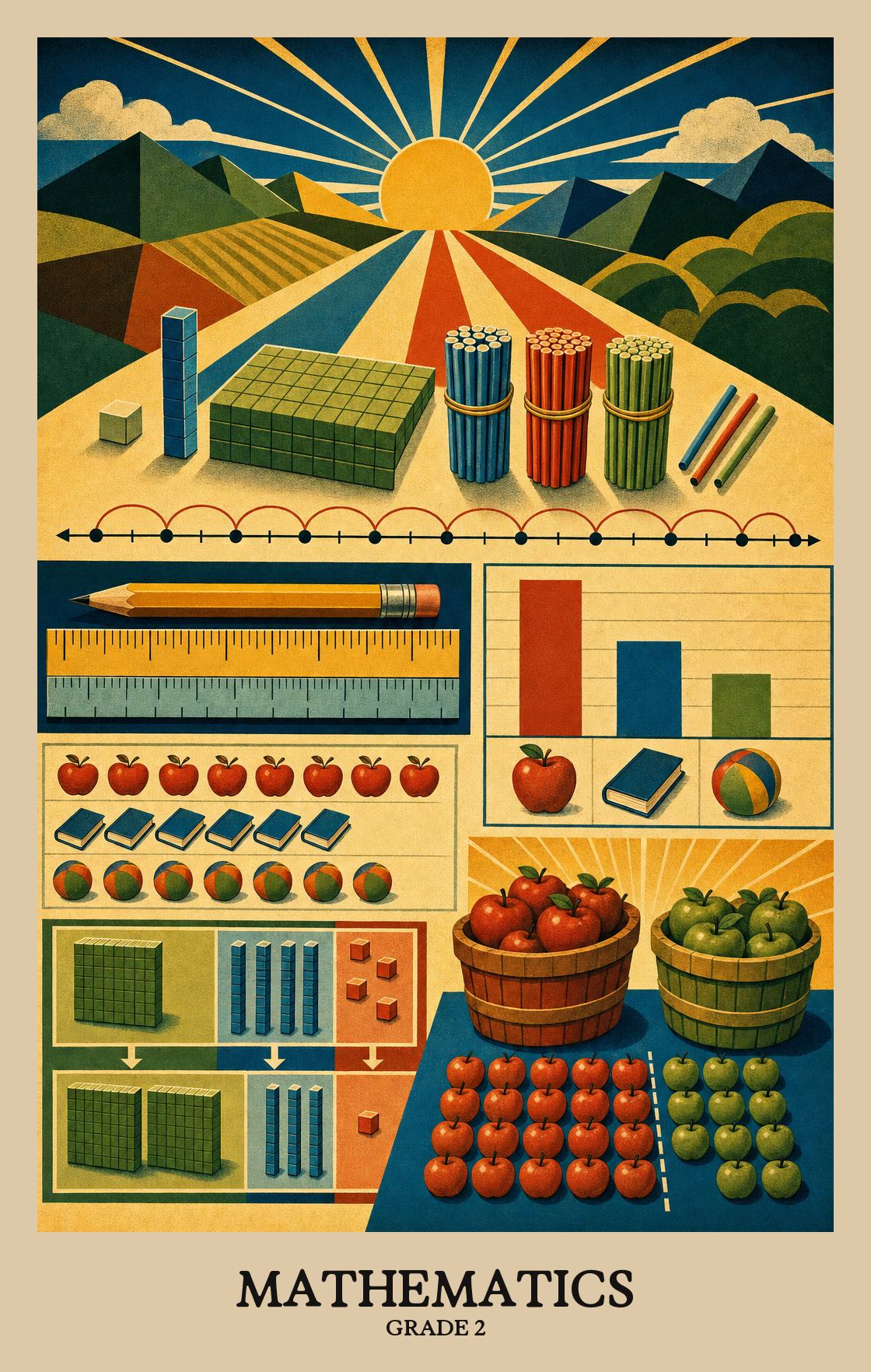
Students learn that the digits in a number stand for hundreds, tens, and ones. They count by 5s, 10s, and 100s, and compare numbers like 348 and 384 to see which is greater.
Students get quick and accurate with addition and subtraction within 20, then move on to adding and subtracting larger numbers up to 100. Word problems become a regular part of the work.
Students measure lengths with rulers in inches and centimeters, tell time to the nearest five minutes, and count mixed coins and dollar bills to solve real shopping problems.
Students name and draw shapes by their sides and corners, and split rectangles and circles into halves, thirds, and fourths. This sets up fractions for next year.
Students collect information from the classroom and show it in picture graphs and bar graphs. They answer questions like how many more or how many fewer by reading the graph.
Students read a math problem carefully, figure out what it is asking, and keep trying even when the first approach does not work.
Students take a word problem and turn it into numbers and symbols to solve it, then explain what the answer actually means in real life. Math and meaning stay connected.
Students explain why their math answer makes sense, then listen to a classmate's explanation and say whether they agree or disagree. Backing up a math choice with words is just as important as getting the right answer.
Students use math to make sense of real situations, like figuring out how many chairs are needed for a party or whether there is enough money to buy two things. Math becomes a tool for solving problems that actually come up.
Students choose the right tool for the math job in front of them. That might mean reaching for a ruler, doing a quick estimate in their head, or working it out on paper.
Students use the right math words, label their answers with the correct units (like inches or dollars), and check that their calculations are exact.
Students spot patterns and rules hiding in numbers and shapes, then use those patterns as shortcuts to solve new problems. A student might notice that adding 10 always changes just the tens column on a hundred chart.
Students notice when the same steps keep showing up in a math problem and use that pattern to find a shortcut or rule. Over time, they check whether that shortcut works every time.
| Standard | Definition | Code |
|---|---|---|
| Make Sense of Problems | Students read a math problem carefully, figure out what it is asking, and keep trying even when the first approach does not work. | DC-MATH.MP.2.1 |
| Reason Abstractly | Students take a word problem and turn it into numbers and symbols to solve it, then explain what the answer actually means in real life. Math and meaning stay connected. | DC-MATH.MP.2.2 |
| Construct Arguments | Students explain why their math answer makes sense, then listen to a classmate's explanation and say whether they agree or disagree. Backing up a math choice with words is just as important as getting the right answer. | DC-MATH.MP.2.3 |
| Model with Mathematics | Students use math to make sense of real situations, like figuring out how many chairs are needed for a party or whether there is enough money to buy two things. Math becomes a tool for solving problems that actually come up. | DC-MATH.MP.2.4 |
| Use Tools Strategically | Students choose the right tool for the math job in front of them. That might mean reaching for a ruler, doing a quick estimate in their head, or working it out on paper. | DC-MATH.MP.2.5 |
| Attend to Precision | Students use the right math words, label their answers with the correct units (like inches or dollars), and check that their calculations are exact. | DC-MATH.MP.2.6 |
| Use Structure | Students spot patterns and rules hiding in numbers and shapes, then use those patterns as shortcuts to solve new problems. A student might notice that adding 10 always changes just the tens column on a hundred chart. | DC-MATH.MP.2.7 |
| Express Regularity | Students notice when the same steps keep showing up in a math problem and use that pattern to find a shortcut or rule. Over time, they check whether that shortcut works every time. | DC-MATH.MP.2.8 |
Second graders work with whole numbers, simple fractions, and how numbers relate to each other. They count, compare, and reason about quantities using what they know about how our number system is built.
Second graders solve word problems using addition, subtraction, multiplication, and division. They figure out which operation fits the situation and write number sentences to show their thinking.
Students read and build simple charts and graphs, then answer questions about what the data shows. They also organize measurements into tables to spot patterns or compare amounts.
Students sort and describe flat shapes (like squares and triangles) and solid shapes (like cubes and cones) by their sides, corners, and faces. They also measure or compare shapes using basic attributes like length and area.
Students use ratio reasoning to solve everyday math problems at the Grade 2 level. They compare quantities and figure out how things relate, like how many apples per bag or how many steps per minute.
| Standard | Definition | Code |
|---|---|---|
| Counting and Number | Second graders work with whole numbers, simple fractions, and how numbers relate to each other. They count, compare, and reason about quantities using what they know about how our number system is built. | DC-MATH.K8.2.1 |
| Operations and Algebraic Thinking | Second graders solve word problems using addition, subtraction, multiplication, and division. They figure out which operation fits the situation and write number sentences to show their thinking. | DC-MATH.K8.2.2 |
| Measurement and Data | Students read and build simple charts and graphs, then answer questions about what the data shows. They also organize measurements into tables to spot patterns or compare amounts. | DC-MATH.K8.2.3 |
| Geometry | Students sort and describe flat shapes (like squares and triangles) and solid shapes (like cubes and cones) by their sides, corners, and faces. They also measure or compare shapes using basic attributes like length and area. | DC-MATH.K8.2.4 |
| Ratios and Proportional Relationships | Students use ratio reasoning to solve everyday math problems at the Grade 2 level. They compare quantities and figure out how things relate, like how many apples per bag or how many steps per minute. | DC-MATH.K8.2.5 |
DC's spring summative math test for grades 3 through 8, aligned to DC's Common Core-based math standards.
Alternate assessment for students with the most significant cognitive disabilities, given in grades 3-8 and high school in ELA, math, and science.
By spring, students add and subtract within 100 quickly, count and trade coins, measure with a ruler, tell time to the nearest five minutes, and read simple bar graphs. They also start to see groups of equal numbers, which sets up multiplication later.
Practice quick addition and subtraction facts on the way to school. Count out coins to make a dollar. Ask what time it will be in 20 minutes. Small daily practice beats long weekend sessions.
No. Finger counting is a normal step. The goal this year is for facts within 20 to become quick and automatic, so keep practicing in short bursts. Speed grows from understanding, not from taking the fingers away too soon.
Students learn that 234 means 2 hundreds, 3 tens, and 4 ones. They count by 5s, 10s, and 100s, and they compare numbers up to 1,000. Base-ten blocks or stacks of coins at home make this much easier to picture.
Start with tens and ones inside 100, then push to hundreds and three-digit numbers by midyear. Anchor addition and subtraction strategies in place value before moving to the standard algorithm, so trading tens and hundreds makes sense.
Subtraction with regrouping, telling time past the half hour, and word problems with two steps tend to need a second pass. Plan a short review block in late winter to revisit these before testing season.
Problems now have two steps and ask for a written explanation or a drawing. Students might add, then subtract, then check if the answer makes sense. At home, ask students to explain how they got an answer, not just what it is.
They can add and subtract within 100 without much hesitation, solve a two-step word problem, measure an object in inches and centimeters, and explain their thinking in a sentence. If those four are solid, the next grade will feel like a step up, not a wall.