Linear equations and inequalities
Students write and solve equations with one unknown, then graph lines and shaded regions on a coordinate plane. They use these tools to answer real questions about money, distance, and time.
This is the year math shifts from arithmetic to thinking in functions. Students write equations with letters like x and y, then graph them as straight lines, curves, and steep growth patterns to describe real situations like a phone bill or a savings account. They also learn to handle two equations at once and to spot trends in real data. By spring, students can take a word problem, write an equation for it, and graph the answer.
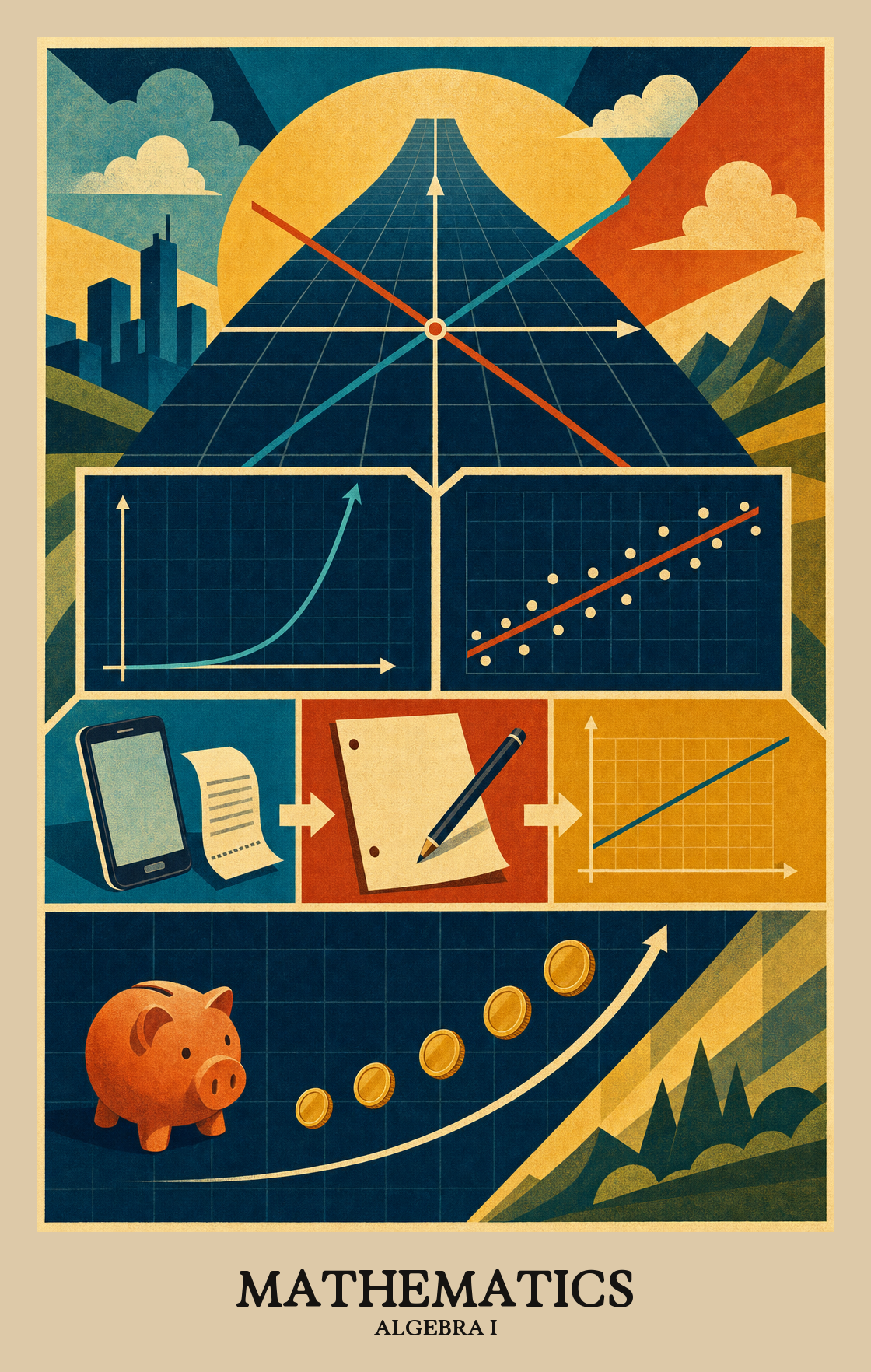
Students write and solve equations with one unknown, then graph lines and shaded regions on a coordinate plane. They use these tools to answer real questions about money, distance, and time.
Students work with two equations at once to find where two lines cross. They use systems to compare options, like which phone plan costs less after a certain number of months.
Students study curves shaped like a U, the kind that show the path of a thrown ball. They learn to graph them, find where they hit zero, and write equations that match a picture or a story.
Students see what happens when something doubles each step or shrinks by half. They use these patterns to model savings that earn interest, populations that grow, and medicine that fades from the body.
Students add, subtract, and multiply longer algebraic expressions. They also look at real data sets, fit a line or curve to the points, and decide what the numbers suggest.
Students read a math problem carefully, figure out what it's actually asking, and keep trying even when the first approach doesn't work.
Students take a real situation (like a bike ride or a sale price) and turn it into an equation, then solve it and translate the answer back into plain language that matches the original problem.
Students back up their math answers with reasons, then explain where someone else's reasoning goes wrong or why it holds up.
Students take a real situation, like splitting a bill or estimating a trip's cost, and write an equation or draw a graph to make sense of it. The math explains something that actually happens outside the classroom.
Students choose the right tool for the problem, whether that means a calculator, a quick estimate, or working it out by hand. The goal is knowing which approach fits, not just reaching for the same one every time.
Students choose words and labels carefully when solving problems. They use the right units, write clear math statements, and double-check calculations so their answers mean exactly what they intend.
Students learn to spot patterns and hidden structure in math problems, like recognizing that an expression factors a certain way or that a graph has symmetry. That recognition becomes a shortcut for solving harder problems faster.
Students notice when the same steps keep showing up in a problem and use that pattern to find a shortcut or write a general rule. It's the habit of asking, "Why does this keep working?"
Students read a math problem carefully, figure out what it's actually asking, and keep working through it even when the first approach doesn't pan out.
Students take a real problem, strip it down to numbers and symbols to solve it, then translate the answer back into plain English to check that it actually makes sense in context.
Students build a logical case for their answer using facts, diagrams, or examples, then explain where another student's reasoning holds up or falls apart.
Students use math to make sense of real situations, like figuring out how much paint covers a wall or how a ramp meets a building code. The math connects to something outside the textbook.
Students choose the right tool for the job, whether that means a calculator, a sketch on paper, or a quick estimate. The goal is knowing when each one helps and when it gets in the way.
Students use exact math words and the right units when solving problems. A length stays in inches or centimeters, an angle stays in degrees, and a calculation gets carried through without rounding too early.
Students learn to spot patterns and hidden structure in math problems, like recognizing that a complicated shape is really just a few simpler ones combined. Seeing that structure helps them solve problems faster and with more confidence.
When a method works the same way every time, students notice the pattern and write it as a rule or formula. That shortcut saves them from redoing the same steps on every new problem.
| Standard | Definition | Code |
|---|---|---|
| Make Sense of Problems Algebra I | Students read a math problem carefully, figure out what it's actually asking, and keep trying even when the first approach doesn't work. | DC-MATH.MP.hs-algebra-1.1 |
| Reason Abstractly Algebra I | Students take a real situation (like a bike ride or a sale price) and turn it into an equation, then solve it and translate the answer back into plain language that matches the original problem. | DC-MATH.MP.hs-algebra-1.2 |
| Construct Arguments Algebra I | Students back up their math answers with reasons, then explain where someone else's reasoning goes wrong or why it holds up. | DC-MATH.MP.hs-algebra-1.3 |
| Model with Mathematics Algebra I | Students take a real situation, like splitting a bill or estimating a trip's cost, and write an equation or draw a graph to make sense of it. The math explains something that actually happens outside the classroom. | DC-MATH.MP.hs-algebra-1.4 |
| Use Tools Strategically Algebra I | Students choose the right tool for the problem, whether that means a calculator, a quick estimate, or working it out by hand. The goal is knowing which approach fits, not just reaching for the same one every time. | DC-MATH.MP.hs-algebra-1.5 |
| Attend to Precision Algebra I | Students choose words and labels carefully when solving problems. They use the right units, write clear math statements, and double-check calculations so their answers mean exactly what they intend. | DC-MATH.MP.hs-algebra-1.6 |
| Use Structure Algebra I | Students learn to spot patterns and hidden structure in math problems, like recognizing that an expression factors a certain way or that a graph has symmetry. That recognition becomes a shortcut for solving harder problems faster. | DC-MATH.MP.hs-algebra-1.7 |
| Express Regularity Algebra I | Students notice when the same steps keep showing up in a problem and use that pattern to find a shortcut or write a general rule. It's the habit of asking, "Why does this keep working?" | DC-MATH.MP.hs-algebra-1.8 |
| Make Sense of Problems Geometry | Students read a math problem carefully, figure out what it's actually asking, and keep working through it even when the first approach doesn't pan out. | DC-MATH.MP.hs-geometry.1 |
| Reason Abstractly Geometry | Students take a real problem, strip it down to numbers and symbols to solve it, then translate the answer back into plain English to check that it actually makes sense in context. | DC-MATH.MP.hs-geometry.2 |
| Construct Arguments Geometry | Students build a logical case for their answer using facts, diagrams, or examples, then explain where another student's reasoning holds up or falls apart. | DC-MATH.MP.hs-geometry.3 |
| Model with Mathematics Geometry | Students use math to make sense of real situations, like figuring out how much paint covers a wall or how a ramp meets a building code. The math connects to something outside the textbook. | DC-MATH.MP.hs-geometry.4 |
| Use Tools Strategically Geometry | Students choose the right tool for the job, whether that means a calculator, a sketch on paper, or a quick estimate. The goal is knowing when each one helps and when it gets in the way. | DC-MATH.MP.hs-geometry.5 |
| Attend to Precision Geometry | Students use exact math words and the right units when solving problems. A length stays in inches or centimeters, an angle stays in degrees, and a calculation gets carried through without rounding too early. | DC-MATH.MP.hs-geometry.6 |
| Use Structure Geometry | Students learn to spot patterns and hidden structure in math problems, like recognizing that a complicated shape is really just a few simpler ones combined. Seeing that structure helps them solve problems faster and with more confidence. | DC-MATH.MP.hs-geometry.7 |
| Express Regularity Geometry | When a method works the same way every time, students notice the pattern and write it as a rule or formula. That shortcut saves them from redoing the same steps on every new problem. | DC-MATH.MP.hs-geometry.8 |
Students write equations for straight-line relationships, solve them, and plot them on a graph. They also apply this to real situations, like figuring out costs over time or when two quantities are equal.
Students write pairs of equations or inequalities together and find the values that satisfy both at once. This shows up in real problems like comparing phone plans or splitting costs.
Quadratic functions make a U-shaped curve on a graph. Students learn to write and graph these functions to describe real situations, like the path of a thrown ball or the area of a rectangle with a changing side.
Students read graphs and write equations that show how something grows fast (like money earning interest) or shrinks over time (like a car losing value). The focus is on spotting the pattern and connecting it to a formula.
Students add, subtract, and multiply polynomials (expressions with variables and exponents), then read data from charts and graphs to spot patterns and draw conclusions about one or two sets of numbers.
| Standard | Definition | Code |
|---|---|---|
| Linear Functions Algebra I | Students write equations for straight-line relationships, solve them, and plot them on a graph. They also apply this to real situations, like figuring out costs over time or when two quantities are equal. | DC-MATH.A1.hs-algebra-1.1 |
| Systems Algebra I | Students write pairs of equations or inequalities together and find the values that satisfy both at once. This shows up in real problems like comparing phone plans or splitting costs. | DC-MATH.A1.hs-algebra-1.2 |
| Quadratic Functions Algebra I | Quadratic functions make a U-shaped curve on a graph. Students learn to write and graph these functions to describe real situations, like the path of a thrown ball or the area of a rectangle with a changing side. | DC-MATH.A1.hs-algebra-1.3 |
| Exponential Functions Algebra I | Students read graphs and write equations that show how something grows fast (like money earning interest) or shrinks over time (like a car losing value). The focus is on spotting the pattern and connecting it to a formula. | DC-MATH.A1.hs-algebra-1.4 |
| Polynomials and Statistics Algebra I | Students add, subtract, and multiply polynomials (expressions with variables and exponents), then read data from charts and graphs to spot patterns and draw conclusions about one or two sets of numbers. | DC-MATH.A1.hs-algebra-1.5 |
Rigid transformations are moves that preserve shape and size: slides, flips, and turns. Students use those moves to show that two figures are congruent and to write formal proofs about triangles and other shapes.
Using similar shapes and trig ratios like sine, cosine, and tangent, students find missing side lengths and angles in right triangles. This shows up in real problems involving ramps, shadows, and distances that can't be measured directly.
Students use the relationships between angles, arcs, and line segments inside and around a circle to solve problems, such as finding a missing angle or the length of a chord.
Students use equations and coordinate grids to describe shapes and lines precisely. They prove geometric properties, like whether two lines are parallel or a triangle is a right triangle, using numbers instead of diagrams alone.
Students find the area of flat shapes, the surface area and volume of solids, and apply those calculations to real problems like estimating materials or filling a container.
| Standard | Definition | Code |
|---|---|---|
| Congruence Geometry | Rigid transformations are moves that preserve shape and size: slides, flips, and turns. Students use those moves to show that two figures are congruent and to write formal proofs about triangles and other shapes. | DC-MATH.GEO.hs-geometry.1 |
| Similarity, Right Triangles, and Trigonometry Geometry | Using similar shapes and trig ratios like sine, cosine, and tangent, students find missing side lengths and angles in right triangles. This shows up in real problems involving ramps, shadows, and distances that can't be measured directly. | DC-MATH.GEO.hs-geometry.2 |
| Circles Geometry | Students use the relationships between angles, arcs, and line segments inside and around a circle to solve problems, such as finding a missing angle or the length of a chord. | DC-MATH.GEO.hs-geometry.3 |
| Coordinate Geometry Geometry | Students use equations and coordinate grids to describe shapes and lines precisely. They prove geometric properties, like whether two lines are parallel or a triangle is a right triangle, using numbers instead of diagrams alone. | DC-MATH.GEO.hs-geometry.4 |
| Measurement and Modeling Geometry | Students find the area of flat shapes, the surface area and volume of solids, and apply those calculations to real problems like estimating materials or filling a container. | DC-MATH.GEO.hs-geometry.5 |
End-of-course CAPE assessments in Algebra I and English II for high school accountability.
Students work with four main families of equations: linear, systems of two equations at once, quadratic, and exponential. They learn to write each one from a real situation, solve it, and graph it. The year ends with polynomial operations and a short unit on analyzing data.
Ask them to read the problem out loud and say what the variable stands for in plain words. Most algebra mistakes come from losing track of what x actually is. If they can tell you what x means and what the question is asking, the math usually unlocks.
A few, yes. The slope formula, the quadratic formula, and the basic form of an exponential equation come up constantly. Flashcards for ten minutes a few nights a week are enough. Most other formulas are built up from these.
Most teachers start with linear equations and inequalities, move to systems, then spend a long stretch on quadratics before exponentials. Polynomials and data analysis fit well at the end because they pull from earlier units. Build in time to revisit linear work during the quadratic unit.
Solving quadratics by factoring and the difference between linear and exponential growth. Students also struggle to interpret what a solution means in context, not just find it. Plan extra days for word problems in each unit, not just procedure practice.
Students can take a real situation, decide whether it is linear, quadratic, or exponential, write an equation for it, and solve and graph it. They can also explain what their answer means in the original context. Procedure alone is not enough.
They should be able to solve a linear equation, factor a simple quadratic, and read a graph without prompting. Ask them to explain a recent homework problem to you. If they can walk through why each step works, they are in good shape.
Often, but with a purpose. Graphing technology helps students see how changing a number changes the graph, which is hard to feel on paper. Pencil-and-paper work still matters for building fluency with factoring, distributing, and solving by hand.