Thinking and working like scientists
Students learn how scientists ask questions, run fair tests, and back up claims with evidence. They practice measuring carefully, recording results, and explaining what their data actually shows.
These are the years science stops being a tour of cool facts and starts being a way of thinking. Students learn to ask a real question, run a test, and back up their answer with what they actually saw. They dig into atoms and energy, cells and ecosystems, and how Earth fits into the solar system. By spring, students can read a graph from an experiment and explain what it shows in plain language.
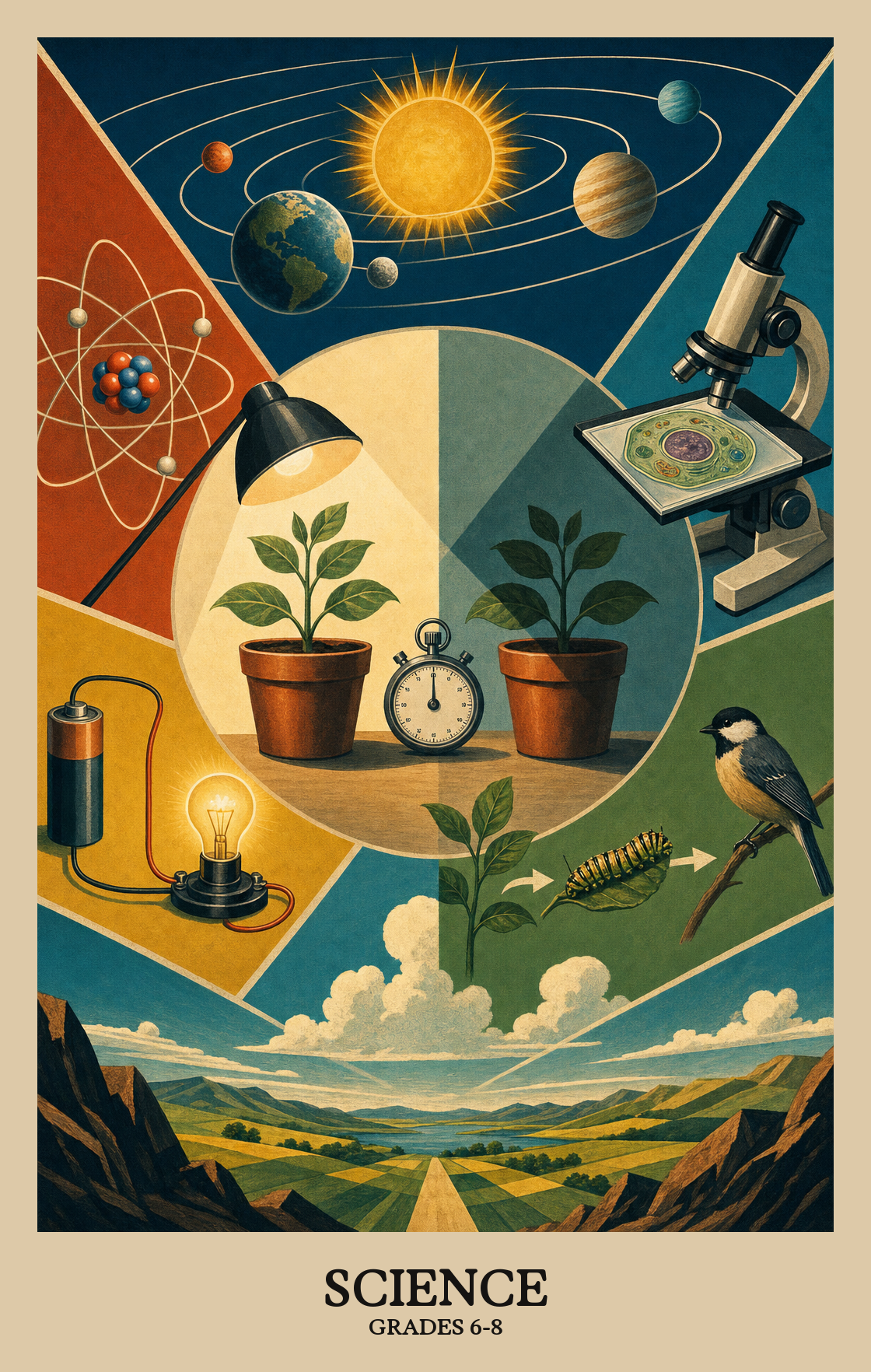
Students learn how scientists ask questions, run fair tests, and back up claims with evidence. They practice measuring carefully, recording results, and explaining what their data actually shows.
Students look at what everyday stuff is made of and why things move the way they do. They study pushes and pulls, heat, sound, and light, and track how energy moves from one place to another.
Students zoom in on cells and body systems, then zoom out to whole habitats. They follow how food, water, and energy move through plants, animals, and the places they live.
Students study the planet and what surrounds it, from rocks and oceans to weather and the solar system. They also look at how people change the Earth and how natural events like storms and earthquakes affect daily life.
Students take on engineering challenges. They define a problem, sketch ideas, build something, test it, and improve the design based on what worked and what flopped.
Students identify a question or problem that can actually be tested with evidence or fixed with a design. This practice separates "I wonder why" from "here's how we find out."
Students build diagrams, simulations, or physical models to show how something in nature works or how an engineered design is put together. The model helps explain a pattern or system that's hard to see directly.
Students design a test, collect data, and use what they find to check whether an idea holds up. This is the core of doing science, not just reading about it.
Reading a chart or experiment results, students look for patterns across the data to figure out what it actually means, not just what it shows.
Students use numbers, measurements, and calculations to back up a scientific argument. Instead of just describing what they observed, they show it with data.
Students build written explanations for science questions using evidence from data, observations, or experiments. The explanation connects what they found to a scientific idea that helps make sense of it.
Students look at two or more scientific explanations or solutions, weigh the evidence behind each, and argue for the one the data best supports.
Students read science articles or data, judge whether the source and evidence hold up, and present what they found clearly in writing, a diagram, or a discussion.
| Standard | Definition | Code |
|---|---|---|
| Asking Questions and Defining Problems Grades 6-8 | Students identify a question or problem that can actually be tested with evidence or fixed with a design. This practice separates "I wonder why" from "here's how we find out." | DC-SCI.SEP.6-8.1 |
| Developing and Using Models Grades 6-8 | Students build diagrams, simulations, or physical models to show how something in nature works or how an engineered design is put together. The model helps explain a pattern or system that's hard to see directly. | DC-SCI.SEP.6-8.2 |
| Planning and Carrying Out Investigations Grades 6-8 | Students design a test, collect data, and use what they find to check whether an idea holds up. This is the core of doing science, not just reading about it. | DC-SCI.SEP.6-8.3 |
| Analyzing and Interpreting Data Grades 6-8 | Reading a chart or experiment results, students look for patterns across the data to figure out what it actually means, not just what it shows. | DC-SCI.SEP.6-8.4 |
| Mathematics and Computational Thinking Grades 6-8 | Students use numbers, measurements, and calculations to back up a scientific argument. Instead of just describing what they observed, they show it with data. | DC-SCI.SEP.6-8.5 |
| Constructing Explanations Grades 6-8 | Students build written explanations for science questions using evidence from data, observations, or experiments. The explanation connects what they found to a scientific idea that helps make sense of it. | DC-SCI.SEP.6-8.6 |
| Engaging in Argument from Evidence Grades 6-8 | Students look at two or more scientific explanations or solutions, weigh the evidence behind each, and argue for the one the data best supports. | DC-SCI.SEP.6-8.7 |
| Communicating Information Grades 6-8 | Students read science articles or data, judge whether the source and evidence hold up, and present what they found clearly in writing, a diagram, or a discussion. | DC-SCI.SEP.6-8.8 |
Students examine how atoms and molecules behave to explain everyday physical changes, like why substances melt, dissolve, or react. The focus is on what's happening at a scale too small to see.
Students learn why objects speed up, slow down, or stay still by studying Newton's laws. They apply those laws to real problems, like what happens when two objects collide or what keeps a bridge from falling.
Students trace how energy moves from one place to another and changes form, like heat turning into motion, while the total amount stays the same.
Waves carry energy and information from one place to another. Students investigate how waves work and how people use them in things like sound, light, and wireless signals.
| Standard | Definition | Code |
|---|---|---|
| Matter and Interactions Grades 6-8 | Students examine how atoms and molecules behave to explain everyday physical changes, like why substances melt, dissolve, or react. The focus is on what's happening at a scale too small to see. | DC-SCI.PS.6-8.1 |
| Motion and Stability Grades 6-8 | Students learn why objects speed up, slow down, or stay still by studying Newton's laws. They apply those laws to real problems, like what happens when two objects collide or what keeps a bridge from falling. | DC-SCI.PS.6-8.2 |
| Energy Grades 6-8 | Students trace how energy moves from one place to another and changes form, like heat turning into motion, while the total amount stays the same. | DC-SCI.PS.6-8.3 |
| Waves and Information Grades 6-8 | Waves carry energy and information from one place to another. Students investigate how waves work and how people use them in things like sound, light, and wireless signals. | DC-SCI.PS.6-8.4 |
Cells make up tissues, tissues make up organs, and organs work together as systems. Students study how each level of organization keeps a living thing alive and functioning.
Students trace how food, water, and nutrients move through an ecosystem and how living things depend on each other to survive. This covers food webs, energy flow, and the roles predators, prey, and decomposers play in keeping a community balanced.
Students study how traits like eye color or height pass from parents to offspring, and why siblings can look different even when they share the same parents.
Students study why living things share basic traits while still being wildly different from one another. They look at how populations change over generations and what drives those changes.
| Standard | Definition | Code |
|---|---|---|
| Structures and Processes Grades 6-8 | Cells make up tissues, tissues make up organs, and organs work together as systems. Students study how each level of organization keeps a living thing alive and functioning. | DC-SCI.LS.6-8.1 |
| Ecosystems Grades 6-8 | Students trace how food, water, and nutrients move through an ecosystem and how living things depend on each other to survive. This covers food webs, energy flow, and the roles predators, prey, and decomposers play in keeping a community balanced. | DC-SCI.LS.6-8.2 |
| Heredity Grades 6-8 | Students study how traits like eye color or height pass from parents to offspring, and why siblings can look different even when they share the same parents. | DC-SCI.LS.6-8.3 |
| Biological Evolution Grades 6-8 | Students study why living things share basic traits while still being wildly different from one another. They look at how populations change over generations and what drives those changes. | DC-SCI.LS.6-8.4 |
Students study where Earth sits in the solar system and how the planets move in predictable patterns. They also look at how Earth itself formed and changed over billions of years.
Students examine how Earth's major systems (rock and soil, water, air, and living things) connect and affect each other, such as how rainfall shapes landforms or how plants change the soil beneath them.
Students examine how things like farming, building, and burning fuel change the land, water, and air, and how earthquakes, floods, and wildfires affect where and how people live.
| Standard | Definition | Code |
|---|---|---|
| Earth's Place in the Universe Grades 6-8 | Students study where Earth sits in the solar system and how the planets move in predictable patterns. They also look at how Earth itself formed and changed over billions of years. | DC-SCI.ESS.6-8.1 |
| Earth's Systems Grades 6-8 | Students examine how Earth's major systems (rock and soil, water, air, and living things) connect and affect each other, such as how rainfall shapes landforms or how plants change the soil beneath them. | DC-SCI.ESS.6-8.2 |
| Earth and Human Activity Grades 6-8 | Students examine how things like farming, building, and burning fuel change the land, water, and air, and how earthquakes, floods, and wildfires affect where and how people live. | DC-SCI.ESS.6-8.3 |
Students identify a real problem, sketch or build possible solutions, then test and adjust their design until it works better.
Students look at how inventions and systems shape daily life, and how the needs of society push engineers to build new things. A new technology changes how people live; people's problems change what engineers work on next.
| Standard | Definition | Code |
|---|---|---|
| Engineering Design Grades 6-8 | Students identify a real problem, sketch or build possible solutions, then test and adjust their design until it works better. | DC-SCI.ETS.6-8.1 |
| Links Among Engineering, Technology, and Society Grades 6-8 | Students look at how inventions and systems shape daily life, and how the needs of society push engineers to build new things. A new technology changes how people live; people's problems change what engineers work on next. | DC-SCI.ETS.6-8.2 |
Computer-based science assessment in grade 8, aligned to the NGSS-based DC Science Standards.
Alternate assessment for students with the most significant cognitive disabilities, given in grades 3-8 and high school in ELA, math, and science.
Federally administered sample-based assessment in reading, mathematics, science, and writing. NAEP results inform state-by-state comparisons rather than individual student or school accountability.
Students study four big areas across the three years: physical science (matter, forces, energy, waves), life science (cells, ecosystems, genetics, evolution), and earth and space science (the solar system, Earth's systems, human impact). They also learn how engineers design and test solutions to real problems.
Ask students to explain what they did in class and why it happened. Watch a short science video together, cook something and talk about the changes in the food, or look up answers to everyday questions like why the sky changes color. Curiosity at home matters more than fancy equipment.
Students ask a clear question, plan a fair test, collect data, and explain what the data shows using science ideas they have learned. They also compare their thinking with classmates and revise when the evidence points somewhere new.
Most middle school science struggles come from new vocabulary and from feeling rushed, not from a lack of ability. Slow down on one idea at a time, draw pictures of what is happening, and let students teach the idea back in their own words. Confidence usually follows.
Many schools spend roughly a third of the year on each strand, with engineering practices woven through all of them. Leading with a hands-on physical science unit often builds investigation habits that pay off later in life and earth science. Keep the science and engineering practices visible in every unit.
Quite important. Students graph data, calculate averages and rates, work with ratios and proportions, and use simple formulas for things like speed and density. If math is shaky, science explanations tend to get vague, so a quick math refresher before a data-heavy unit pays off.
Energy transfer, the difference between weight and mass, photosynthesis and respiration as paired processes, and genetics with Punnett squares tend to need a second pass. Plate tectonics and the scale of the solar system also trip students up because the sizes and timeframes are hard to picture.
By the end of eighth grade, students should be able to read a science article, pull out the main claim and evidence, and explain a familiar phenomenon using cause and effect. They should also be comfortable planning a simple experiment and graphing the results without much help.
Engineering is treated as a partner to science, not a separate subject. Students define a problem, sketch possible solutions, build and test a prototype, then improve it based on what failed. A few well-chosen design challenges across the year usually do more than one long capstone.