How government works
Students look at how the United States government is set up, from local town councils to Congress and the president. They study why power is split into branches and shared between federal, state, and local levels.
This is the year students start thinking like citizens, not just learning about government. They look at how power is split between Congress, the president, and the courts, and between federal, state, and local leaders. Students also weigh real trade-offs in money choices, study how people change the land they live on, and use primary sources to see why history looks different from different sides. By spring, they can read a map, explain a basic right or responsibility of a citizen, and back up a claim about the past with evidence.
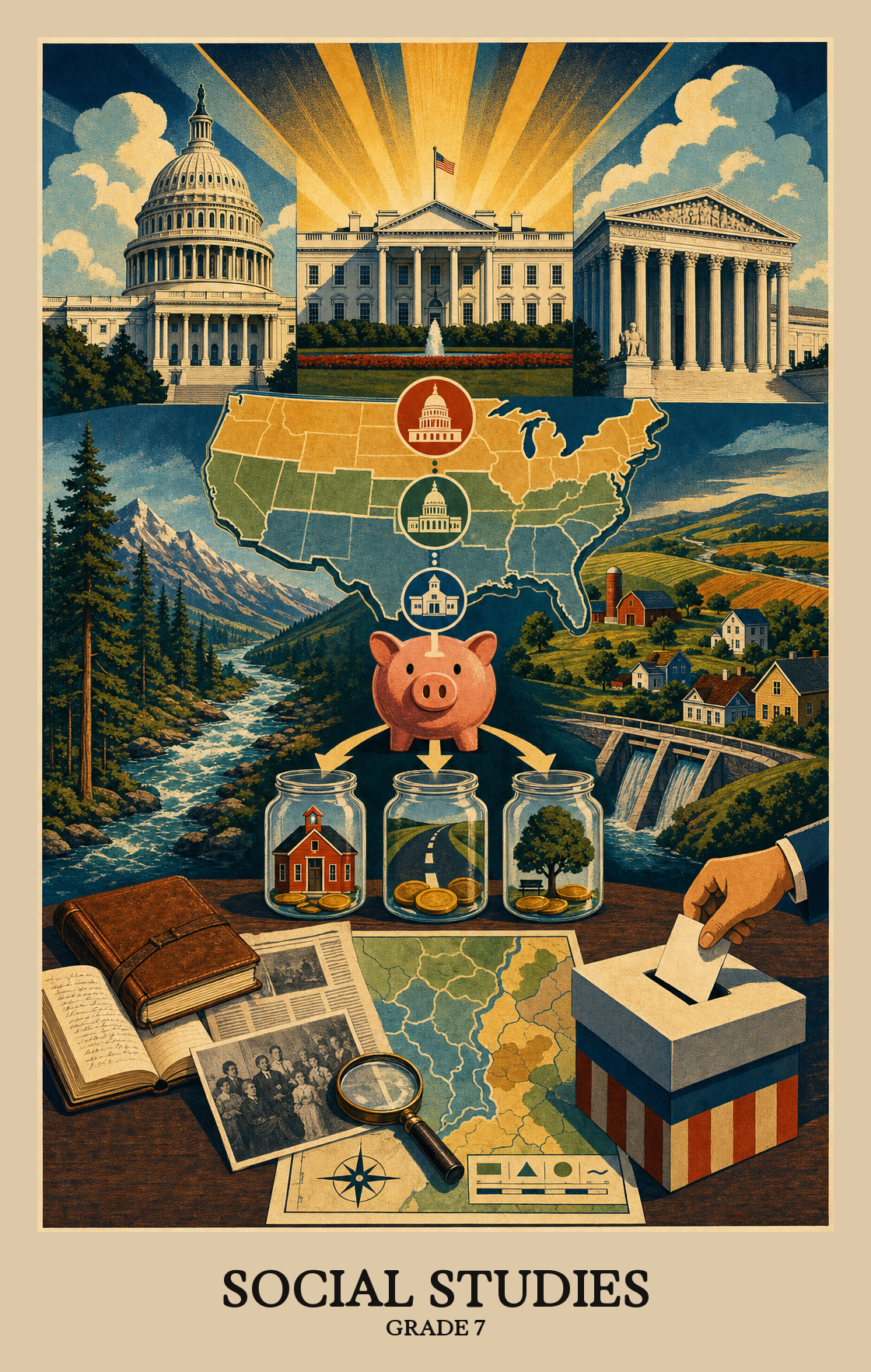
Students look at how the United States government is set up, from local town councils to Congress and the president. They study why power is split into branches and shared between federal, state, and local levels.
Students read parts of the Declaration of Independence and Constitution to see where ideas like liberty and equality come from. They also talk about the rights and responsibilities that come with being a citizen.
Students use maps and other tools to study how the world is organized into regions and how those regions connect through trade, travel, and culture. They look at how people change the land and how the land shapes how people live.
Students learn why people cannot have everything they want and how that shapes the choices families and businesses make. They study how prices work, compare different economic systems, and start building personal money skills.
Students work like historians by reading letters, speeches, photos, and articles from the past. They learn to spot cause and effect, notice different points of view, and explain why an event happened the way it did.
Students study major events in Delaware history alongside national and world history. They trace how those events connect and shaped the country and communities students live in today.
Students learn how the U.S. government is organized, why it exists, and how power is split between Congress, the President, and the courts, as well as between national, state, and local governments.
Students read documents like the Constitution and Declaration of Independence to understand the core ideas behind American government, such as liberty, equality, and the consent of the governed.
Citizens in a democracy have rights the government must respect and responsibilities they're expected to meet. Students learn what those rights and responsibilities look like in real civic life, from voting to obeying laws to participating in the community.
Students practice the skills needed to take part in their community. That means writing to officials, speaking at meetings, or working with others to address a local problem.
| Standard | Definition | Code |
|---|---|---|
| Government | Students learn how the U.S. government is organized, why it exists, and how power is split between Congress, the President, and the courts, as well as between national, state, and local governments. | DE-SS.CIV.7.1 |
| Politics | Students read documents like the Constitution and Declaration of Independence to understand the core ideas behind American government, such as liberty, equality, and the consent of the governed. | DE-SS.CIV.7.2 |
| Citizenship | Citizens in a democracy have rights the government must respect and responsibilities they're expected to meet. Students learn what those rights and responsibilities look like in real civic life, from voting to obeying laws to participating in the community. | DE-SS.CIV.7.3 |
| Participation | Students practice the skills needed to take part in their community. That means writing to officials, speaking at meetings, or working with others to address a local problem. | DE-SS.CIV.7.4 |
When something is scarce, people can't have everything they want, so every choice means giving something else up. Students look at the real costs and benefits behind personal money decisions, from buying a snack to saving for something bigger.
In a market economy, prices and incentives guide what businesses make and what people buy. Students look at how government policy can shift those decisions and what happens when it does.
Students look at how different countries decide who owns businesses, sets prices, and controls resources. They also explain what causes those rules to shift over time.
Students learn how to manage money, like budgeting and saving, and explore how families, local businesses, and countries depend on each other to make the economy work.
| Standard | Definition | Code |
|---|---|---|
| Microeconomics | When something is scarce, people can't have everything they want, so every choice means giving something else up. Students look at the real costs and benefits behind personal money decisions, from buying a snack to saving for something bigger. | DE-SS.ECON.7.1 |
| Macroeconomics | In a market economy, prices and incentives guide what businesses make and what people buy. Students look at how government policy can shift those decisions and what happens when it does. | DE-SS.ECON.7.2 |
| Economic Systems | Students look at how different countries decide who owns businesses, sets prices, and controls resources. They also explain what causes those rules to shift over time. | DE-SS.ECON.7.3 |
| Personal Finance and Interdependence | Students learn how to manage money, like budgeting and saving, and explore how families, local businesses, and countries depend on each other to make the economy work. | DE-SS.ECON.7.4 |
Students build a mental picture of how the world is organized, then use maps, charts, and other visuals to explore what specific places and regions look like and how they connect.
Students look at how people change the land, water, and air around them and how those changes affect neighborhoods, wildlife, and natural systems in return.
Students examine how cultures differ around the world and what makes specific places distinct. They look at things like language, customs, and daily life to understand why communities look and feel different from one another.
Regions are areas grouped by shared features, like climate, culture, or economy. Students learn how regions connect to each other at scales ranging from a neighborhood to the whole world.
| Standard | Definition | Code |
|---|---|---|
| Maps and Mental Maps | Students build a mental picture of how the world is organized, then use maps, charts, and other visuals to explore what specific places and regions look like and how they connect. | DE-SS.GEO.7.1 |
| Environment | Students look at how people change the land, water, and air around them and how those changes affect neighborhoods, wildlife, and natural systems in return. | DE-SS.GEO.7.2 |
| Places and Cultures | Students examine how cultures differ around the world and what makes specific places distinct. They look at things like language, customs, and daily life to understand why communities look and feel different from one another. | DE-SS.GEO.7.3 |
| Regions | Regions are areas grouped by shared features, like climate, culture, or economy. Students learn how regions connect to each other at scales ranging from a neighborhood to the whole world. | DE-SS.GEO.7.4 |
Students look at events across time to figure out what caused them, what changed, and what stayed the same. It is the habit of asking "why did this happen, and what came next?"
Students read firsthand accounts, photographs, maps, and other historical records to figure out what happened in the past and why. They compare sources to spot where the accounts agree or differ.
Students read historical accounts of the same event and explain how the author's point of view changes what gets included, left out, or emphasized.
Students study the major events that shaped Delaware, the United States, and the wider world. They build a timeline of history in their heads, connecting what happened locally to what happened globally.
| Standard | Definition | Code |
|---|---|---|
| Chronology | Students look at events across time to figure out what caused them, what changed, and what stayed the same. It is the habit of asking "why did this happen, and what came next?" | DE-SS.HIST.7.1 |
| Analysis | Students read firsthand accounts, photographs, maps, and other historical records to figure out what happened in the past and why. They compare sources to spot where the accounts agree or differ. | DE-SS.HIST.7.2 |
| Interpretation | Students read historical accounts of the same event and explain how the author's point of view changes what gets included, left out, or emphasized. | DE-SS.HIST.7.3 |
| Content | Students study the major events that shaped Delaware, the United States, and the wider world. They build a timeline of history in their heads, connecting what happened locally to what happened globally. | DE-SS.HIST.7.4 |
Federally administered sample-based assessment in reading, mathematics, science, and writing. NAEP results inform state-by-state comparisons rather than individual student or school accountability.
Students study four big areas: how government works, how the economy works, how geography shapes where people live, and how history unfolds over time. They also learn to read maps, weigh primary sources, and think about how decisions get made in a community or a country.
Talk about the news at dinner and ask why someone made the choice they did. Pull up a map when a place comes up in conversation. Five minutes of real questions does more than a worksheet.
Read it out loud together one paragraph at a time. After each paragraph, ask who wrote it, when, and what they wanted the reader to believe. Old language gets easier once students slow down and put it in their own words.
Most teachers anchor the year in history and pull civics, economics, and geography in as each unit calls for them. A unit on early America naturally pulls in founding documents, trade routes, and regional geography. Treating the strands as separate units in a row tends to feel choppy.
Sourcing and perspective. Students can summarize a document but struggle to ask who wrote it and why. Plan to revisit sourcing in every unit instead of teaching it once in September.
Students learn the difference between needs and wants, how scarcity forces trade-offs, and how interest, taxes, and saving work. At home, let students help compare prices at the store or talk through a real family budget choice.
By spring, students should be able to read a short primary source, say who wrote it and what their point of view was, and back up a claim with evidence from the text. They should also be able to locate major regions on a map and explain how geography shaped the people there.
Plan a focused unit on Delaware in the context of United States history, not a separate course. Use local sites, the state constitution, and Delaware's role in founding-era events as case studies for bigger ideas like federalism and citizenship.
Keep a world map or globe somewhere visible. When a country comes up in the news, a movie, or a recipe, find it together and name a neighbor country, a major river, or the closest ocean. Two minutes a few times a week builds real geographic sense.