Counting and adding within twenty
Students count, read, and write numbers up to 120 and start adding and subtracting small amounts. Parents may hear them sound out problems like seven plus five out loud.
This is the year math stretches past counting into thinking in tens and ones. Students add and subtract within 20 and start building speed with the easier facts. They line up objects to measure length, tell time on a clock, and sort shapes by what makes them alike. By spring, students can solve a word problem about adding or taking away and explain how they got the answer.
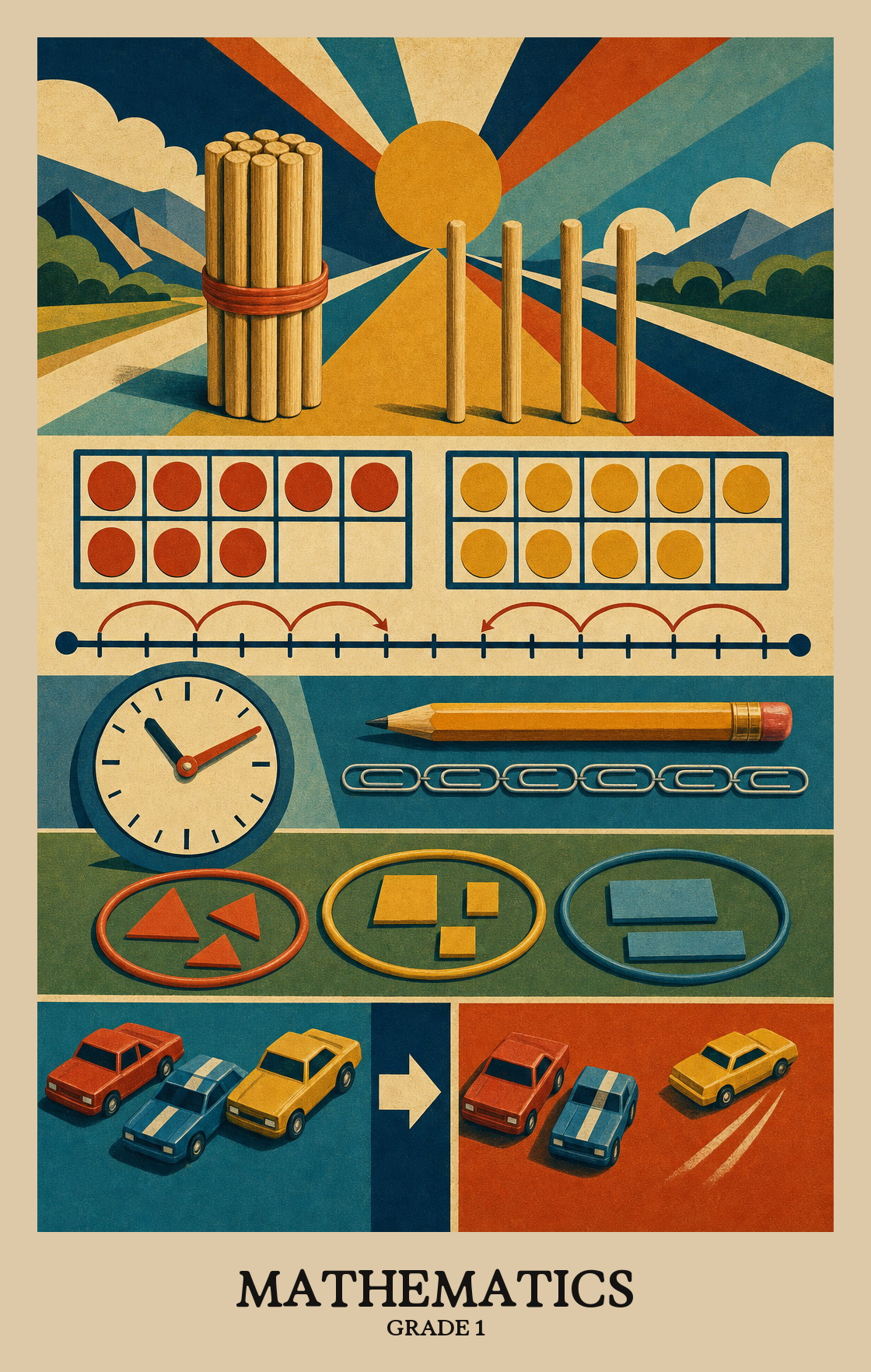
Students count, read, and write numbers up to 120 and start adding and subtracting small amounts. Parents may hear them sound out problems like seven plus five out loud.
Students learn shortcuts for harder problems, like making a ten or using a known fact to find a new one. Word problems get longer and ask students to explain their thinking.
Students see that the digits in a number stand for tens and ones. They compare numbers, add two-digit numbers, and count by tens from any starting point.
Students line up objects to compare lengths and measure with paper clips or cubes. They read clocks to the hour and half hour and sort information into simple charts.
Students name flat and solid shapes by their sides and corners, then split shapes into halves and quarters. They start to see that fair shares mean equal pieces.
Students read a math problem carefully, figure out what it is asking, and keep trying even when the first approach does not work.
Students take a word problem and turn it into numbers and symbols to solve it, then translate the answer back into real-world terms. They move between the math on paper and the situation it describes.
Students explain why their math answer makes sense and listen to how classmates solved the same problem. They practice backing up their thinking and spotting where someone else's reasoning goes wrong.
Students use math to make sense of real situations, like figuring out how many chairs are needed for a group or how much money to bring to the store.
Students pick the right tool for the job, whether that means using their fingers to count, drawing a picture, or reaching for a calculator. They learn when each tool helps and when it gets in the way.
Students use the right math words and label their answers correctly, like writing "3 inches" instead of just "3." They check that their calculations are accurate before finishing.
Students notice patterns and structure in math, like how numbers follow a predictable order or how shapes fit together. Spotting those patterns helps students solve problems faster and with more confidence.
Students notice when the same steps keep showing up in a problem and use that pattern as a shortcut. Instead of starting from scratch each time, they recognize the rule behind the repetition.
| Standard | Definition | Code |
|---|---|---|
| Make Sense of Problems | Students read a math problem carefully, figure out what it is asking, and keep trying even when the first approach does not work. | DE-MATH.MP.1.1 |
| Reason Abstractly | Students take a word problem and turn it into numbers and symbols to solve it, then translate the answer back into real-world terms. They move between the math on paper and the situation it describes. | DE-MATH.MP.1.2 |
| Construct Arguments | Students explain why their math answer makes sense and listen to how classmates solved the same problem. They practice backing up their thinking and spotting where someone else's reasoning goes wrong. | DE-MATH.MP.1.3 |
| Model with Mathematics | Students use math to make sense of real situations, like figuring out how many chairs are needed for a group or how much money to bring to the store. | DE-MATH.MP.1.4 |
| Use Tools Strategically | Students pick the right tool for the job, whether that means using their fingers to count, drawing a picture, or reaching for a calculator. They learn when each tool helps and when it gets in the way. | DE-MATH.MP.1.5 |
| Attend to Precision | Students use the right math words and label their answers correctly, like writing "3 inches" instead of just "3." They check that their calculations are accurate before finishing. | DE-MATH.MP.1.6 |
| Use Structure | Students notice patterns and structure in math, like how numbers follow a predictable order or how shapes fit together. Spotting those patterns helps students solve problems faster and with more confidence. | DE-MATH.MP.1.7 |
| Express Regularity | Students notice when the same steps keep showing up in a problem and use that pattern as a shortcut. Instead of starting from scratch each time, they recognize the rule behind the repetition. | DE-MATH.MP.1.8 |
Students count, compare, and work with whole numbers up to 120 and start exploring simple fractions like halves and fourths. The focus is on understanding what numbers mean, not just reciting them.
Adding and subtracting whole numbers to solve simple word problems. Students learn to write a number sentence that matches the story, then find the answer.
Students read simple charts and graphs, then answer questions about what the data shows. They also build their own tables or picture graphs to organize information they've collected.
Students sort flat shapes (triangles, rectangles, circles) and solid shapes (cubes, cones, spheres) by their sides, corners, and faces. They describe what makes each shape different from the others.
Students use ratio reasoning to solve everyday math problems at the first-grade level. That might mean figuring out how many apples each person gets if there are 10 apples and 2 kids.
| Standard | Definition | Code |
|---|---|---|
| Counting and Number | Students count, compare, and work with whole numbers up to 120 and start exploring simple fractions like halves and fourths. The focus is on understanding what numbers mean, not just reciting them. | DE-MATH.K8.1.1 |
| Operations and Algebraic Thinking | Adding and subtracting whole numbers to solve simple word problems. Students learn to write a number sentence that matches the story, then find the answer. | DE-MATH.K8.1.2 |
| Measurement and Data | Students read simple charts and graphs, then answer questions about what the data shows. They also build their own tables or picture graphs to organize information they've collected. | DE-MATH.K8.1.3 |
| Geometry | Students sort flat shapes (triangles, rectangles, circles) and solid shapes (cubes, cones, spheres) by their sides, corners, and faces. They describe what makes each shape different from the others. | DE-MATH.K8.1.4 |
| Ratios and Proportional Relationships | Students use ratio reasoning to solve everyday math problems at the first-grade level. That might mean figuring out how many apples each person gets if there are 10 apples and 2 kids. | DE-MATH.K8.1.5 |
Delaware's spring summative math test for grades 3 through 8, aligned to the Delaware Math Standards.
Students add and subtract within 20, count to 120, and start working with numbers up to 100 by tens and ones. They also compare lengths, tell time on a clock to the hour and half hour, and sort basic shapes.
Count steps to the car, count coins from a jar, or ask quick questions like nine plus four. Cooking and setting the table also give natural practice with numbers, shapes, and amounts.
Students should know addition and subtraction facts within 10 from memory by the end of the year. Short daily practice with flashcards or quick verbal questions during car rides works well. Speed is not the point; confidence is.
Most teachers start with addition and subtraction within 10, build up to 20 by mid-year, then move into place value with numbers to 100. Measurement, time, and shapes fit well between number units and give a break from heavy computation.
Students see a number like 47 as 4 tens and 7 ones, not just two separate digits. They can build 47 with bundles of straws or base-ten blocks and compare it to numbers like 43 or 52 using greater than and less than.
Subtraction within 20 and the meaning of the equal sign are the two big ones. Many students think the equal sign means the answer comes next, so problems like 8 equals blank plus 3 trip them up. Plan to revisit both across the year.
Have them act it out with small objects or draw a quick picture. Reading the problem twice helps too. The goal is making sense of the situation before reaching for an answer.
They can solve addition and subtraction word problems within 20, work fluently with facts to 10, and read and write numbers to 120. They can also measure a pencil with paper clips and tell time to the half hour on an analog clock.