Mapping places and regions
Students start the year as geographers. They read maps, locate states and countries, and notice how the land, climate, and resources of a place shape the way people live there.
This is the year social studies zooms out to the big American story and how the country runs. Students learn how the federal, state, and local governments share power, and what ideas from documents like the Constitution still shape daily life. They read maps, study how people change the land around them, and think about why people make the money choices they do. By spring, students can explain how a law gets made and back up an answer about history with a quote from a real source.
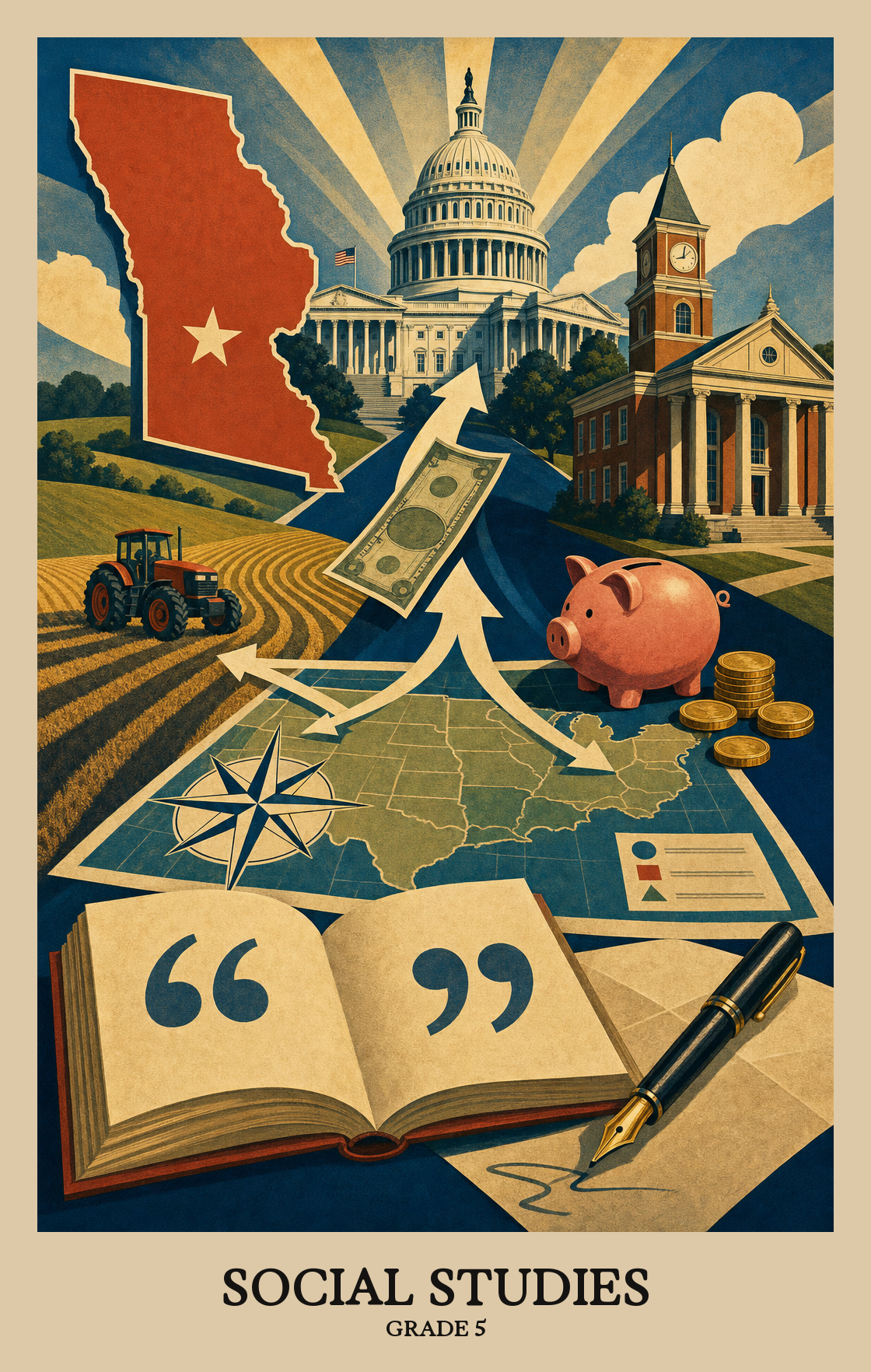
Students start the year as geographers. They read maps, locate states and countries, and notice how the land, climate, and resources of a place shape the way people live there.
Students learn how the country is run. They study the three branches, the difference between local, state, and federal government, and the big ideas in documents like the Constitution.
Students look at what it means to be a citizen. They talk about rights, responsibilities, and the everyday ways people take part in their community, from voting to speaking up at a meeting.
Students think like economists. They weigh the trade-offs in everyday choices, see how prices and jobs connect buyers and sellers, and practice basic ideas about saving, spending, and earning.
Students work like historians. They read letters, photos, and other primary sources, put events in order, and explain how one event led to another in Delaware, the United States, and the wider world.
Students pull the year together. They look at how people have shaped the land and how the land has shaped people, and compare different points of view on the same event or place.
Students learn how the U.S. government is organized: who makes the laws, who carries them out, and who decides if they're fair. They also look at how power is split between national, state, and local governments.
Students study the core beliefs behind American democracy, like liberty and equality, and trace those ideas to documents such as the Constitution and Declaration of Independence. They look at what the founders wrote and what it still means today.
Citizens in a democracy have rights the government must protect and responsibilities they are expected to keep, like voting, obeying laws, and staying informed. Students learn what those look like in practice.
Students practice the real skills of citizenship: researching issues, forming an opinion, and taking action in their school or community.
| Standard | Definition | Code |
|---|---|---|
| Government | Students learn how the U.S. government is organized: who makes the laws, who carries them out, and who decides if they're fair. They also look at how power is split between national, state, and local governments. | DE-SS.CIV.5.1 |
| Politics | Students study the core beliefs behind American democracy, like liberty and equality, and trace those ideas to documents such as the Constitution and Declaration of Independence. They look at what the founders wrote and what it still means today. | DE-SS.CIV.5.2 |
| Citizenship | Citizens in a democracy have rights the government must protect and responsibilities they are expected to keep, like voting, obeying laws, and staying informed. Students learn what those look like in practice. | DE-SS.CIV.5.3 |
| Participation | Students practice the real skills of citizenship: researching issues, forming an opinion, and taking action in their school or community. | DE-SS.CIV.5.4 |
Scarcity means there is never enough of everything, so people make trade-offs. Students look at everyday choices, like spending or saving money, and weigh what is gained against what is given up.
Students learn how people, businesses, and government all pull on the same economy at once. They look at why prices rise and fall, what pushes people to buy or sell, and how government rules change what happens in the market.
Students look at how different countries decide who makes goods, who owns businesses, and who sets prices. They also explain why those rules shift as societies change.
Students learn how to manage money, read a budget, and make spending decisions. They also explore how families, local businesses, and countries depend on each other to get the goods and services they need.
| Standard | Definition | Code |
|---|---|---|
| Microeconomics | Scarcity means there is never enough of everything, so people make trade-offs. Students look at everyday choices, like spending or saving money, and weigh what is gained against what is given up. | DE-SS.ECON.5.1 |
| Macroeconomics | Students learn how people, businesses, and government all pull on the same economy at once. They look at why prices rise and fall, what pushes people to buy or sell, and how government rules change what happens in the market. | DE-SS.ECON.5.2 |
| Economic Systems | Students look at how different countries decide who makes goods, who owns businesses, and who sets prices. They also explain why those rules shift as societies change. | DE-SS.ECON.5.3 |
| Personal Finance and Interdependence | Students learn how to manage money, read a budget, and make spending decisions. They also explore how families, local businesses, and countries depend on each other to get the goods and services they need. | DE-SS.ECON.5.4 |
Students build a mental picture of the world by reading maps, globes, and other geographic tools to figure out what different places and regions are like and how they connect.
Students look at how people change the land around them (by building roads, clearing forests, or farming) and how those changes affect the animals, plants, and communities that depend on that land.
Students compare how people in different parts of the world live, work, and celebrate, then explain what makes each place distinct from everywhere else.
Regions are areas that share something in common, like climate, language, or land type. Students learn how regions connect to each other and why those connections matter at local, national, and global scales.
| Standard | Definition | Code |
|---|---|---|
| Maps and Mental Maps | Students build a mental picture of the world by reading maps, globes, and other geographic tools to figure out what different places and regions are like and how they connect. | DE-SS.GEO.5.1 |
| Environment | Students look at how people change the land around them (by building roads, clearing forests, or farming) and how those changes affect the animals, plants, and communities that depend on that land. | DE-SS.GEO.5.2 |
| Places and Cultures | Students compare how people in different parts of the world live, work, and celebrate, then explain what makes each place distinct from everywhere else. | DE-SS.GEO.5.3 |
| Regions | Regions are areas that share something in common, like climate, language, or land type. Students learn how regions connect to each other and why those connections matter at local, national, and global scales. | DE-SS.GEO.5.4 |
Students put historical events in order and look at how one event led to another. They look for what stayed the same over time and what changed.
Students read firsthand accounts, photographs, old maps, and textbooks about a historical event, then compare what those sources say to figure out what actually happened.
Students look at maps, letters, diaries, and other sources from the past and explain how the same event can look different depending on who lived it. A soldier, a settler, and a child might each tell a very different version of the same story.
Students learn the major events that shaped Delaware, the United States, and the wider world. They build a timeline of history from local stories to global turning points.
| Standard | Definition | Code |
|---|---|---|
| Chronology | Students put historical events in order and look at how one event led to another. They look for what stayed the same over time and what changed. | DE-SS.HIST.5.1 |
| Analysis | Students read firsthand accounts, photographs, old maps, and textbooks about a historical event, then compare what those sources say to figure out what actually happened. | DE-SS.HIST.5.2 |
| Interpretation | Students look at maps, letters, diaries, and other sources from the past and explain how the same event can look different depending on who lived it. A soldier, a settler, and a child might each tell a very different version of the same story. | DE-SS.HIST.5.3 |
| Content | Students learn the major events that shaped Delaware, the United States, and the wider world. They build a timeline of history from local stories to global turning points. | DE-SS.HIST.5.4 |
Federally administered sample-based assessment in reading, mathematics, science, and writing. NAEP results inform state-by-state comparisons rather than individual student or school accountability.
Students study four big areas: how government works, how money and choices shape daily life, how maps and places connect people, and how the past shapes the present. Expect lessons on the branches of government, founding documents, and major events in Delaware and U.S. history.
Talk about the news at dinner and ask what students think and why. Pull up a map when a place comes up in a book or show. Visit a local landmark, museum, or town meeting when you can. Five minutes of real conversation does more than a worksheet.
Students should be able to name the three branches and explain what each one does. They should also know the difference between local, state, and federal government, and point to ideas in documents like the Constitution and the Bill of Rights.
Many teachers anchor the year in history and weave the other three strands into it. A unit on the founding pulls in civics. A unit on westward movement pulls in geography. A unit on trade or colonies pulls in economics. That keeps the four strands connected instead of siloed.
The structure of government trips students up, especially the difference between the three branches and the three levels. Economic vocabulary like scarcity, incentive, and supply also needs repeated exposure. Plan to revisit both across several units rather than teaching them once.
When students bring home a letter, photo, or document from class, ask three questions. Who made this? When? Why? Old family photos, recipes, or letters work just as well as anything from a textbook. The goal is getting students to read carefully and ask questions.
Some key dates and names matter, like 1776 and the names of the branches of government. Most of the work is about understanding cause and effect and how events connect. Knowing why the Revolution happened matters more than reciting every battle.
Students can read a short primary source and explain what it says and who wrote it. They can use a map to answer a question about a place. They can explain how a personal or government choice has costs and benefits, and connect an event in the past to something today.
Students should be able to read a short article or document and summarize it in their own words. They should hold a conversation about a current event and back up an opinion with a reason. Comfort with maps, timelines, and basic government vocabulary also signals readiness.