Functions and their graphs
Students start the year looking closely at different kinds of math relationships and what their graphs look like. They learn to spot patterns, find key points, and describe how one quantity changes as another one shifts.
This is the year math stretches beyond straight lines into the curves and waves that describe the real world. Students study new families of functions, including polynomials, exponentials, logarithms, and the sine waves that repeat like tides or seasons. They also learn to draw careful conclusions about a whole group from a small sample. By spring, students can sketch a curve from its equation and explain what it predicts.
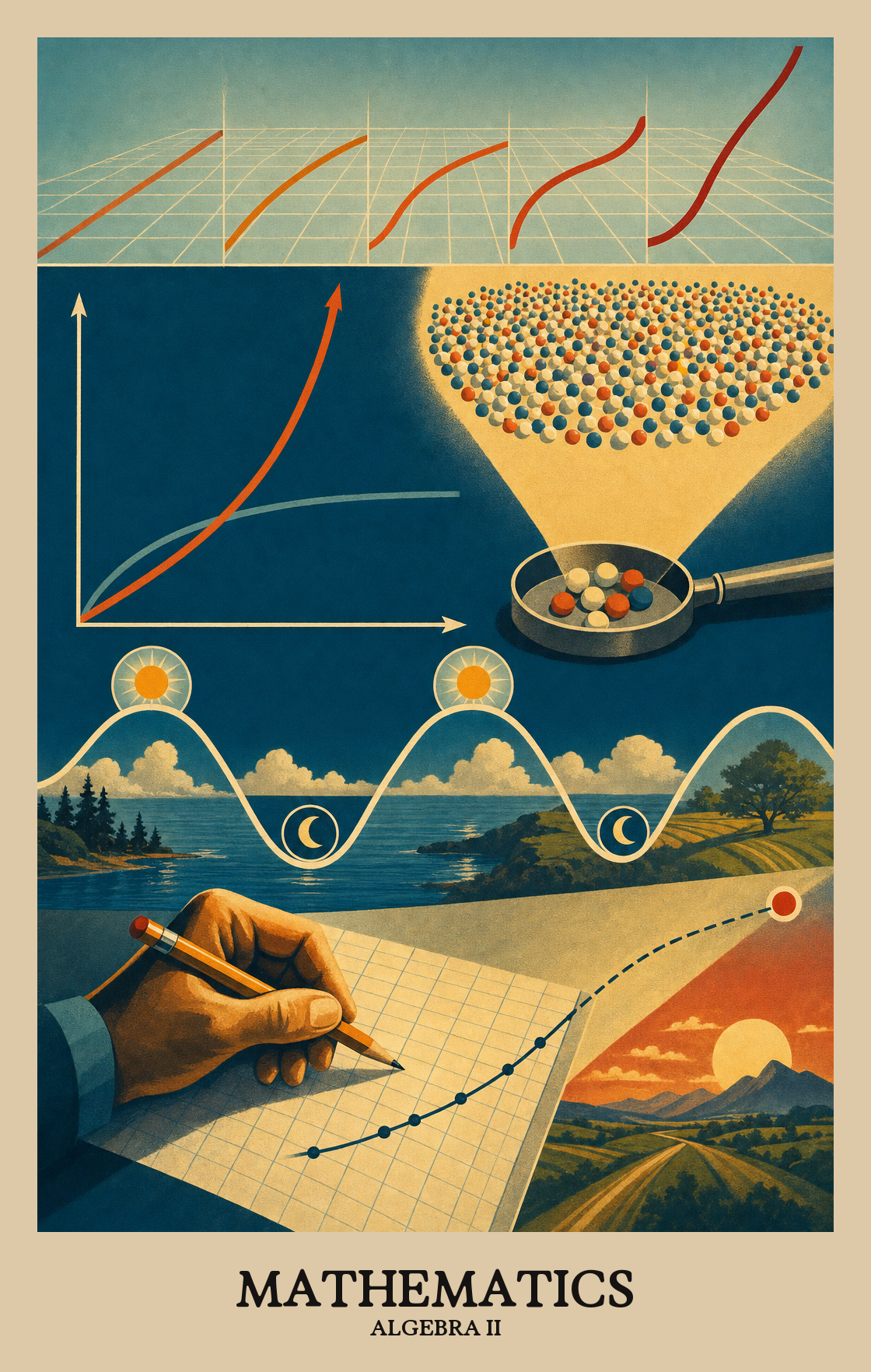
Students start the year looking closely at different kinds of math relationships and what their graphs look like. They learn to spot patterns, find key points, and describe how one quantity changes as another one shifts.
Students work with longer algebraic expressions and learn how to add, subtract, multiply, and divide them. They also solve equations that include fractions with variables, which shows up later in science and finance.
Students study growth and decay, the kind of math behind interest on a savings account or a population over time. They learn what a logarithm is and how to use one to undo an exponent.
Students extend trigonometry beyond triangles and use it to describe things that repeat, like tides, sound waves, or hours of daylight. They graph these wave patterns and use identities to simplify expressions.
Students close the year by using samples to make claims about larger groups, the kind of thinking behind polls and medical studies. They learn what makes a sample trustworthy and how confident a conclusion really is.
Students read a math problem carefully, figure out what it's actually asking, and keep working even when the path forward isn't obvious. Getting unstuck is part of the work.
Students take a real situation, turn it into an equation or expression to solve it, then translate the answer back into plain language that makes sense in the original context.
Students build a mathematical argument to support their answer, then explain where another student's reasoning goes wrong or how it holds up.
Students take a real situation, like figuring out loan payments or predicting ticket sales, and write an equation or draw a graph that helps make sense of it.
Students choose the right tool for the math in front of them: a calculator, a quick estimate, or pencil-and-paper work. The skill is knowing which one fits the problem, not just reaching for the same tool every time.
Students choose words, labels, and units carefully when solving problems. A missing negative sign or the wrong label can change the answer entirely.
Students notice patterns and hidden structure in math problems, like recognizing that a complicated expression is really just a familiar form in disguise. That recognition helps them choose a faster, cleaner path to the answer.
Students notice when the same steps keep appearing in a problem and use that pattern as a shortcut or rule. Instead of redoing the work each time, they describe what's always true.
| Standard | Definition | Code |
|---|---|---|
| Make Sense of Problems Algebra II | Students read a math problem carefully, figure out what it's actually asking, and keep working even when the path forward isn't obvious. Getting unstuck is part of the work. | CT-MATH.MP.hs-algebra-2.1 |
| Reason Abstractly Algebra II | Students take a real situation, turn it into an equation or expression to solve it, then translate the answer back into plain language that makes sense in the original context. | CT-MATH.MP.hs-algebra-2.2 |
| Construct Arguments Algebra II | Students build a mathematical argument to support their answer, then explain where another student's reasoning goes wrong or how it holds up. | CT-MATH.MP.hs-algebra-2.3 |
| Model with Mathematics Algebra II | Students take a real situation, like figuring out loan payments or predicting ticket sales, and write an equation or draw a graph that helps make sense of it. | CT-MATH.MP.hs-algebra-2.4 |
| Use Tools Strategically Algebra II | Students choose the right tool for the math in front of them: a calculator, a quick estimate, or pencil-and-paper work. The skill is knowing which one fits the problem, not just reaching for the same tool every time. | CT-MATH.MP.hs-algebra-2.5 |
| Attend to Precision Algebra II | Students choose words, labels, and units carefully when solving problems. A missing negative sign or the wrong label can change the answer entirely. | CT-MATH.MP.hs-algebra-2.6 |
| Use Structure Algebra II | Students notice patterns and hidden structure in math problems, like recognizing that a complicated expression is really just a familiar form in disguise. That recognition helps them choose a faster, cleaner path to the answer. | CT-MATH.MP.hs-algebra-2.7 |
| Express Regularity Algebra II | Students notice when the same steps keep appearing in a problem and use that pattern as a shortcut or rule. Instead of redoing the work each time, they describe what's always true. | CT-MATH.MP.hs-algebra-2.8 |
Students read graphs of advanced functions, spotting where they rise, fall, level off, or repeat. The function types include polynomials, rationals, exponentials, logarithms, and trig curves.
Students add, subtract, multiply, and divide expressions with variables and fractions that contain variables. They also solve equations built from those expressions.
Students use sine, cosine, and related functions to describe real-world patterns that repeat on a cycle, like sound waves, tides, or seasonal temperature changes. They also use trig identities to simplify and solve those models.
Students use data collected from a sample group to draw conclusions about a larger population. They apply statistical reasoning to decide what the sample likely tells us about the whole group.
| Standard | Definition | Code |
|---|---|---|
| Functions and Graphs Algebra II | Students read graphs of advanced functions, spotting where they rise, fall, level off, or repeat. The function types include polynomials, rationals, exponentials, logarithms, and trig curves. | CT-MATH.A2.hs-algebra-2.1 |
| Polynomial and Rational Algebra II | Students add, subtract, multiply, and divide expressions with variables and fractions that contain variables. They also solve equations built from those expressions. | CT-MATH.A2.hs-algebra-2.2 |
| Trigonometry Algebra II | Students use sine, cosine, and related functions to describe real-world patterns that repeat on a cycle, like sound waves, tides, or seasonal temperature changes. They also use trig identities to simplify and solve those models. | CT-MATH.A2.hs-algebra-2.3 |
| Statistics and Probability Algebra II | Students use data collected from a sample group to draw conclusions about a larger population. They apply statistical reasoning to decide what the sample likely tells us about the whole group. | CT-MATH.A2.hs-algebra-2.4 |
Federally administered sample-based assessment in reading, mathematics, science, and writing. NAEP results inform state-by-state comparisons rather than individual student or school accountability.
Students study a wider set of functions than before, including curves with multiple bends, fractions with variables, growth and decay patterns, and the wave shapes used for sound and seasons. They also learn how to draw conclusions about a large group from a small sample.
Ask students to explain what the problem is asking before they pick up a pencil. If they get stuck, have them sketch a quick graph or try a smaller version of the problem first. Most of the work is about noticing patterns, so questions like what changes and what stays the same go a long way.
The functions get more complicated and the problems combine ideas from earlier years. Students also have to switch between an equation, a graph, and a table for the same situation. Expect more time per problem and more written reasoning.
A common path starts with polynomials and rational expressions, moves into exponential and logarithmic functions, then trigonometry and periodic models, and ends with statistical inference from samples. Function analysis runs through every unit, so graphs and structure should come up daily.
Logarithms, rational expressions, and the unit circle tend to be the stickiest. Students often need a refresh on factoring and on solving equations that produce extra answers that do not actually work. Plan for short review loops rather than one long fix later.
A graphing tool helps students see the shape of a function and check answers, but it will not explain why a graph behaves the way it does. Students should still be able to sketch a basic curve by hand and read key features like intercepts and turning points without help.
The statistics work is about using a sample to say something reasonable about a larger group, with attention to how the sample was collected. It connects to the rest of the year through careful reasoning and precise language, not through new algebra. Many teachers save it for the final stretch.
By spring, students should be able to look at an unfamiliar function and describe its shape, find where it crosses the axes, and explain what the numbers mean in a real situation. They should also be able to solve an equation and check whether the answer actually fits the problem.
Reviewing one or two problems from class out loud is more useful than a worksheet. Ask students to talk through why each step works, not just what the answer is. Catching a small misunderstanding tonight saves an hour of confusion next week.