Asking questions like a scientist
Students start the year noticing things around them and asking questions they can actually test. They learn that good questions lead to a plan, and that a plan means watching closely and writing down what happens.
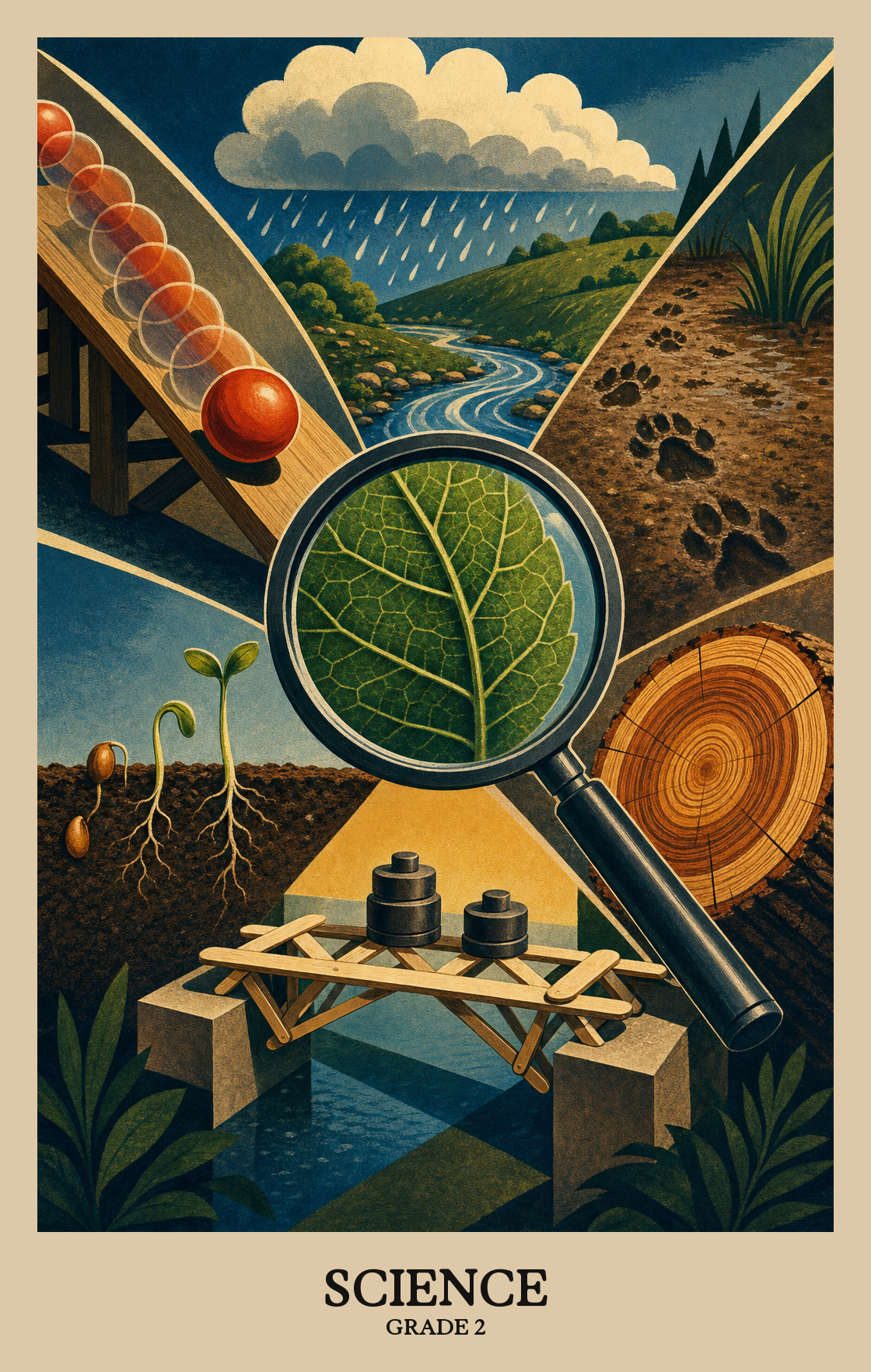
This is the year science becomes a habit of asking questions and looking for answers in the world outside. Students notice patterns in materials, plants, animals, weather, and the land around them, then try to explain what they see. They sketch, build, and test small designs, fixing what does not work. By spring, a student can watch something happen, like a seed sprouting or a ball rolling, and describe what caused it using their own evidence.
Students start the year noticing things around them and asking questions they can actually test. They learn that good questions lead to a plan, and that a plan means watching closely and writing down what happens.
Students explore what things are made of and how they behave when pushed, pulled, heated, or cooled. They try out building materials, watch objects roll and stop, and start explaining why with words like force and energy.
Students look at what living things need to grow and how they fit into the places they live. They compare how a bird and a fish are built for their homes, and trace where food and water come from in a small habitat.
Students track the sun, the moon, and the weather over days and weeks. They notice patterns, talk about land and water on Earth, and think about how rain, wind, and storms affect the places people live.
Students take on small engineering challenges, like building something that floats or keeps an ice cube cold. They sketch a plan, build a first try, test it, and change one thing to make it work better.
Students come up with questions about the world around them that can be tested with an experiment, and figure out what problem needs solving before trying to build or fix something.
Students draw or build simple models to show how something works, like a diagram of a water cycle or a sketch of a bridge design. The model helps explain an idea that's hard to see just by looking.
Students come up with a question, plan a simple test, and collect information to find out if their idea holds up.
Students look at data from an experiment and explain what it shows. They spot patterns, like which condition made a plant grow taller or which material kept ice frozen longer.
Students use counting, measuring, or simple math to help explain what they observe in science. For example, they might count how many times something happens or measure how far an object moves.
Students take what they observed or tested and use it to explain why something happened. The explanation has to connect back to real evidence, not just a guess.
Students look at two different explanations or solutions, then use what they observed or tested to argue which one works better.
Students read simple science books or charts, decide if the information makes sense, and share what they learned by writing or talking about it.
| Standard | Definition | Code |
|---|---|---|
| Asking Questions and Defining Problems | Students come up with questions about the world around them that can be tested with an experiment, and figure out what problem needs solving before trying to build or fix something. | CT-SCI.SEP.2.1 |
| Developing and Using Models | Students draw or build simple models to show how something works, like a diagram of a water cycle or a sketch of a bridge design. The model helps explain an idea that's hard to see just by looking. | CT-SCI.SEP.2.2 |
| Planning and Carrying Out Investigations | Students come up with a question, plan a simple test, and collect information to find out if their idea holds up. | CT-SCI.SEP.2.3 |
| Analyzing and Interpreting Data | Students look at data from an experiment and explain what it shows. They spot patterns, like which condition made a plant grow taller or which material kept ice frozen longer. | CT-SCI.SEP.2.4 |
| Mathematics and Computational Thinking | Students use counting, measuring, or simple math to help explain what they observe in science. For example, they might count how many times something happens or measure how far an object moves. | CT-SCI.SEP.2.5 |
| Constructing Explanations | Students take what they observed or tested and use it to explain why something happened. The explanation has to connect back to real evidence, not just a guess. | CT-SCI.SEP.2.6 |
| Engaging in Argument from Evidence | Students look at two different explanations or solutions, then use what they observed or tested to argue which one works better. | CT-SCI.SEP.2.7 |
| Communicating Information | Students read simple science books or charts, decide if the information makes sense, and share what they learned by writing or talking about it. | CT-SCI.SEP.2.8 |
Students explore what everyday objects are made of and why materials look, feel, or behave the way they do. They learn that tiny building blocks too small to see determine whether something is hard or soft, heavy or light.
Students push, pull, and observe how objects start moving, stop, or stay still. They learn why heavier objects are harder to move and what happens when two objects hit each other.
Students explore how energy shows up in everyday forms like light, heat, and sound, and how it can move from one object to another. A hot pan warming your hand or a lamp lighting a room are the kinds of examples students work with.
Students explore how waves move energy from place to place, like sound traveling through air or light bouncing off a mirror. They also look at how waves carry information, the way a phone call or radio signal does.
| Standard | Definition | Code |
|---|---|---|
| Matter and Interactions | Students explore what everyday objects are made of and why materials look, feel, or behave the way they do. They learn that tiny building blocks too small to see determine whether something is hard or soft, heavy or light. | CT-SCI.PS.2.1 |
| Motion and Stability | Students push, pull, and observe how objects start moving, stop, or stay still. They learn why heavier objects are harder to move and what happens when two objects hit each other. | CT-SCI.PS.2.2 |
| Energy | Students explore how energy shows up in everyday forms like light, heat, and sound, and how it can move from one object to another. A hot pan warming your hand or a lamp lighting a room are the kinds of examples students work with. | CT-SCI.PS.2.3 |
| Waves and Information | Students explore how waves move energy from place to place, like sound traveling through air or light bouncing off a mirror. They also look at how waves carry information, the way a phone call or radio signal does. | CT-SCI.PS.2.4 |
Students look closely at living things to understand how their parts work. A leaf, a bone, or a root each has a job, and those parts work together so the whole organism can grow and survive.
Students explore how plants, animals, and other living things in a place depend on each other for food and survival. They look at how energy moves from the sun to plants to animals, and how matter gets reused across the community.
Students look at how parents pass traits like eye color or height to their offspring, and notice that siblings can look similar but not identical.
Students look at how living things are alike and how they differ, then explore why those differences matter for survival. It's the building block for understanding why life on Earth looks the way it does.
| Standard | Definition | Code |
|---|---|---|
| Structures and Processes | Students look closely at living things to understand how their parts work. A leaf, a bone, or a root each has a job, and those parts work together so the whole organism can grow and survive. | CT-SCI.LS.2.1 |
| Ecosystems | Students explore how plants, animals, and other living things in a place depend on each other for food and survival. They look at how energy moves from the sun to plants to animals, and how matter gets reused across the community. | CT-SCI.LS.2.2 |
| Heredity | Students look at how parents pass traits like eye color or height to their offspring, and notice that siblings can look similar but not identical. | CT-SCI.LS.2.3 |
| Biological Evolution | Students look at how living things are alike and how they differ, then explore why those differences matter for survival. It's the building block for understanding why life on Earth looks the way it does. | CT-SCI.LS.2.4 |
Students learn where Earth sits in the solar system and how the sun, moon, and planets follow predictable patterns as they move. They also look at how Earth itself has changed over a very long time.
Students look at how land, water, air, and living things work together on Earth. They investigate what happens when one of those parts changes and how the others respond.
Students look at how things people do (like building roads or cutting down trees) change the land, water, or air. They also explore how natural events like floods, earthquakes, or storms affect where and how people live.
| Standard | Definition | Code |
|---|---|---|
| Earth's Place in the Universe | Students learn where Earth sits in the solar system and how the sun, moon, and planets follow predictable patterns as they move. They also look at how Earth itself has changed over a very long time. | CT-SCI.ESS.2.1 |
| Earth's Systems | Students look at how land, water, air, and living things work together on Earth. They investigate what happens when one of those parts changes and how the others respond. | CT-SCI.ESS.2.2 |
| Earth and Human Activity | Students look at how things people do (like building roads or cutting down trees) change the land, water, or air. They also explore how natural events like floods, earthquakes, or storms affect where and how people live. | CT-SCI.ESS.2.3 |
Students look at a real problem, sketch out a few ways to fix it, build or test their best idea, and then adjust it based on what they learn.
Students explore how inventions shape daily life and how everyday problems push engineers to build new tools. A new technology can change how people live, and the needs of a community can change what gets invented.
| Standard | Definition | Code |
|---|---|---|
| Engineering Design | Students look at a real problem, sketch out a few ways to fix it, build or test their best idea, and then adjust it based on what they learn. | CT-SCI.ETS.2.1 |
| Links Among Engineering, Technology, and Society | Students explore how inventions shape daily life and how everyday problems push engineers to build new tools. A new technology can change how people live, and the needs of a community can change what gets invented. | CT-SCI.ETS.2.2 |
Federally administered sample-based assessment in reading, mathematics, science, and writing. NAEP results inform state-by-state comparisons rather than individual student or school accountability.
Students spend the year asking questions about the world and testing ideas in simple ways. They look at materials and how they change, plants and animals and what they need, weather and land, and how everyday objects are designed. Most of it happens through hands-on activities, not reading from a textbook.
Follow their curiosity. When students ask why leaves change color or why ice melts, slow down and wonder out loud with them. A walk around the block, a cup of water in the freezer, or planting a bean in a jar all count as real science at this age.
Not really. Second grade is more about noticing patterns and explaining what students see than memorizing definitions. If a child can describe how a plant grew over two weeks or why a ramp made a ball roll faster, that matters more than naming parts.
Most teachers anchor each unit in one phenomenon and let the science practices repeat across units. A common flow is materials and matter in the fall, life cycles and habitats in the winter, and Earth's surface and weather in the spring, with a short engineering design challenge woven in.
Students should be able to ask a testable question, plan a simple investigation, collect data in a chart or drawing, and explain what they found using evidence. The explanation does not need to be polished. It needs to connect what they did to what they saw.
Two areas tend to need extra time. The first is the difference between observation and explanation, since students often jump to why before describing what. The second is reading and making simple data tables and bar graphs, which takes more practice than most pacing guides suggest.
Pick one thing outside and look at it closely for a few minutes. A puddle drying up, a bug on a leaf, or the moon at bedtime all work. Ask what students notice, what they wonder, and what they think is happening. That is the whole practice in miniature.
A ready student can describe a simple cause and effect, sort objects by properties such as hard, soft, or magnetic, and talk about what plants and animals need to live. They should also be comfortable trying an idea, watching what happens, and changing their mind when the evidence points somewhere else.