Building technique and body awareness
Students start the year strengthening control, alignment, and stamina. They learn the vocabulary of movement and practice phrases that build the skills they will use in their own choreography later.
This is the year dance shifts from learning steps to shaping a piece with a point of view. Students draw on their own experiences and the world around them to build short works with clear intent. They sharpen their technique, then revise their choreography based on feedback. By spring, they can perform a polished dance they helped create and explain the choices behind it.
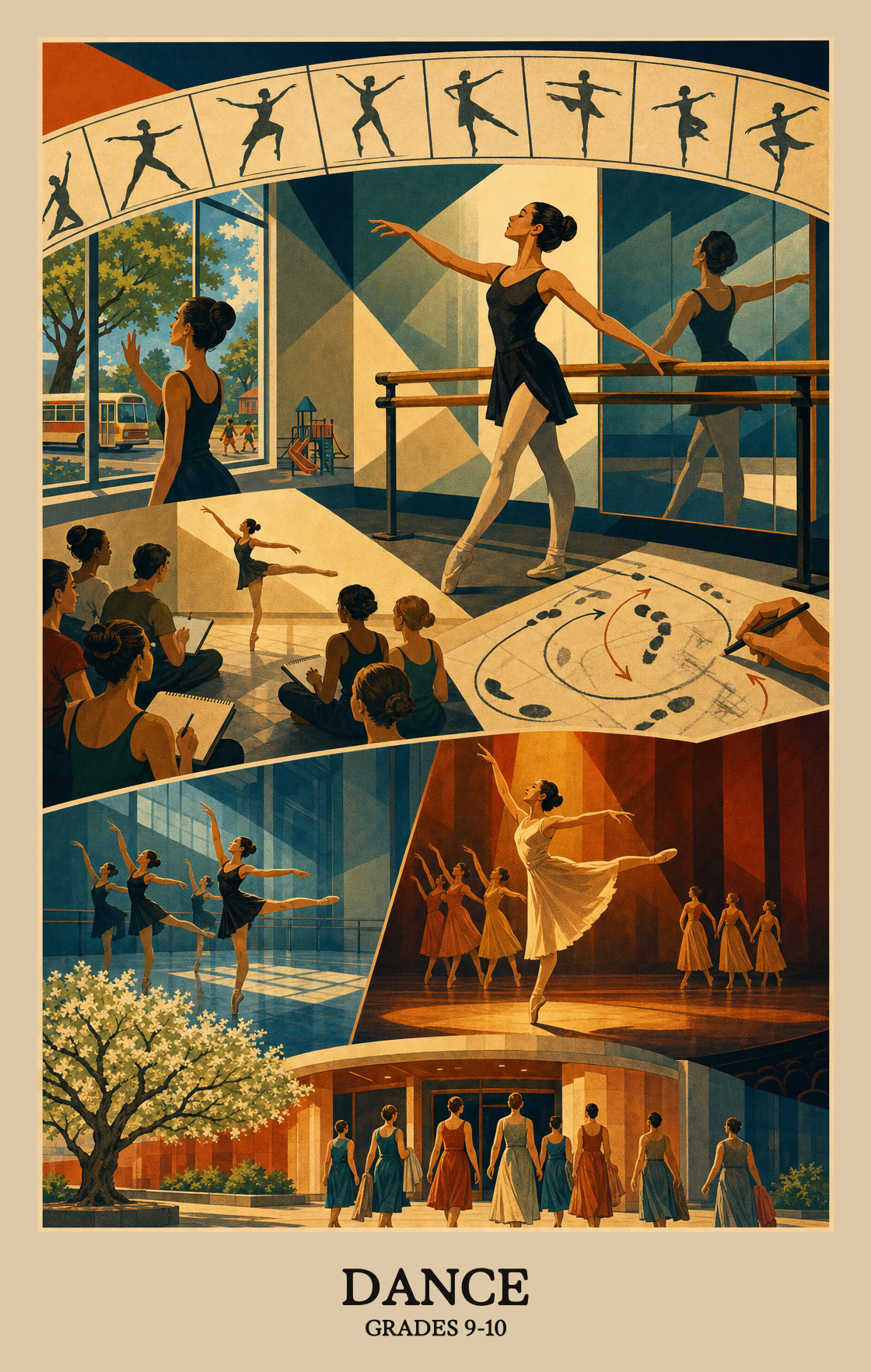
Students start the year strengthening control, alignment, and stamina. They learn the vocabulary of movement and practice phrases that build the skills they will use in their own choreography later.
Students explore where dance ideas come from. They draw on personal experiences, music, images, and prompts to create short movement studies they can shape into longer pieces.
Students organize their movement studies into full pieces. They make choices about space, timing, and energy, then revise based on feedback from peers and teachers.
Students study how dance reflects history, identity, and community. They look at choreographers and styles from different cultures and time periods, and connect those ideas to their own work.
Students prepare finished pieces for an audience. They rehearse with intent, perform with clear meaning, and use criteria to evaluate their own work and the work of others.
Students connect what they know from daily life, other subjects, and past dance experience to shape the choices they make in their own choreography.
Students connect a dance or choreographer to the time period and culture that shaped it, explaining what that context reveals about the work's meaning.
| Standard | Definition | Code |
|---|---|---|
| Connecting life experience to dance Grades 9-10 | Students connect what they know from daily life, other subjects, and past dance experience to shape the choices they make in their own choreography. | CA-DA:Cn10.9-10.HsProficient |
| Dance and its place in history Grades 9-10 | Students connect a dance or choreographer to the time period and culture that shaped it, explaining what that context reveals about the work's meaning. | CA-DA:Cn11.9-10.HsProficient |
Students brainstorm and develop original ideas for dances, exploring movement choices before settling on a direction for their work.
Students take a dance idea and shape it into something finished, making deliberate choices about movement, structure, and how the piece fits together from start to finish.
Students revisit a dance they've been building, make specific changes to sharpen the movement or intention, and bring it to a finished state ready to perform or share.
| Standard | Definition | Code |
|---|---|---|
| Coming up with original dance ideas Grades 9-10 | Students brainstorm and develop original ideas for dances, exploring movement choices before settling on a direction for their work. | CA-DA:Cr1.9-10.HsProficient |
| Building and shaping a dance piece Grades 9-10 | Students take a dance idea and shape it into something finished, making deliberate choices about movement, structure, and how the piece fits together from start to finish. | CA-DA:Cr2.9-10.HsProficient |
| Finishing and refining a dance piece Grades 9-10 | Students revisit a dance they've been building, make specific changes to sharpen the movement or intention, and bring it to a finished state ready to perform or share. | CA-DA:Cr3.9-10.HsProficient |
Students review and choose dances to perform, thinking through what each piece communicates and whether it's ready for an audience.
Students practice and improve their dance technique to get a performance ready to share with an audience. That means returning to the movement again and again, fixing what isn't working until the piece holds together.
Students perform a dance they've shaped and refined, making clear choices about movement so the piece communicates a specific idea or feeling to the audience.
| Standard | Definition | Code |
|---|---|---|
| Choosing dances worth performing Grades 9-10 | Students review and choose dances to perform, thinking through what each piece communicates and whether it's ready for an audience. | CA-DA:Pr4.9-10.HsProficient |
| Refining dance technique for performance Grades 9-10 | Students practice and improve their dance technique to get a performance ready to share with an audience. That means returning to the movement again and again, fixing what isn't working until the piece holds together. | CA-DA:Pr5.9-10.HsProficient |
| Perform a dance that means something Grades 9-10 | Students perform a dance they've shaped and refined, making clear choices about movement so the piece communicates a specific idea or feeling to the audience. | CA-DA:Pr6.9-10.HsProficient |
Students watch a dance performance and break down what they see: how the choreographer made choices about movement, structure, and style, and what those choices communicate to an audience.
Students analyze a dance performance and explain what they think the choreographer meant to express, using specific movements or patterns as evidence for their interpretation.
Students choose specific standards, like technique, intention, or structure, and use them to judge whether a dance is working and why. The focus is on building a reasoned case, not just a reaction.
| Standard | Definition | Code |
|---|---|---|
| Reading and analyzing dance performances Grades 9-10 | Students watch a dance performance and break down what they see: how the choreographer made choices about movement, structure, and style, and what those choices communicate to an audience. | CA-DA:Re7.9-10.HsProficient |
| Reading meaning in dance works Grades 9-10 | Students analyze a dance performance and explain what they think the choreographer meant to express, using specific movements or patterns as evidence for their interpretation. | CA-DA:Re8.9-10.HsProficient |
| Judging dance with your own criteria Grades 9-10 | Students choose specific standards, like technique, intention, or structure, and use them to judge whether a dance is working and why. The focus is on building a reasoned case, not just a reaction. | CA-DA:Re9.9-10.HsProficient |
Students can create a short original dance, perform it with control and clear intent, and talk about what it means. They can also watch another dance and explain what worked, using specific reasons instead of just liking or disliking it.
Yes. Beginners are common at this level. Students start by building basic body awareness and technique, then move into making and sharing short pieces. Encourage practice at home in any open space, even five minutes of stretching or repeating a phrase from class.
Make room for movement and let students show what they are working on. Ask what the dance is about and what choice they made as the choreographer. Showing interest in the meaning behind the movement matters more than knowing any technique.
Most teachers spend the first weeks on technique and vocabulary, then layer in short choreography tasks, then move to longer pieces with revision and performance. Responding to dance runs all year through video study and peer feedback, not as a separate unit.
Refining work is the hardest part. Students often treat the first draft of a phrase as finished. Plan time for structured revision cycles where students rework a section based on specific feedback, then perform it again.
Yes. Connecting dance to its cultural and historical roots is a core part of the year, not an add-on. Short readings, video clips, and brief discussions before a movement unit usually give students enough context to make informed choices in their own work.
Grading looks at growth, effort, and the choices a student makes, not at who is the most flexible or trained. Students are assessed on how well they apply technique they have been taught, how they develop their own ideas, and how they reflect on their work.
Students should be able to take a prompt, build a short original piece with a clear idea behind it, refine it after feedback, and perform it for an audience. They should also be able to evaluate another dance using shared criteria rather than personal taste.